DbcultAccessing Vault...
Cult Review
Senior Film Conservator
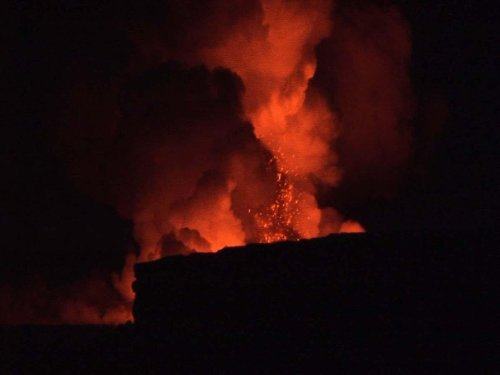
It’s not often a film manages to capture the very heartbeat of a planet, but Kilauea Volcano does precisely that. This cinematic journey isn't a narrative in the conventional sense; there are no protagonists, no intricate plot twists, no dialogue to decipher. Instead, its star is the Earth itself, performing an ancient, ongoing drama on the Big Island of Hawaii. From the moment the camera settles on the slow, inexorable creep of molten rock, you are transported into a realm where geological time compresses into cinematic minutes, where the sheer, unadulterated power of creation is laid bare before your eyes. It’s a profound testament to the planet’s ceaseless, magnificent, and terrifying metamorphosis, an epic without spoken words, inviting pure, unmediated observation.
The initial impression is one of overwhelming scale. We're accustomed to human dramas, to conflicts measured in lifetimes or generations. Here, the struggle is between elements, between fire and water, between ancient crust and nascent land. The lava, a river of dark orange and fiery red, moves with a ponderous, unstoppable grace. It engulfs everything in its path – trees, rocks, whatever stands as a temporary testament to a previous epoch. There’s a stark, brutal beauty in this destruction, a reminder that nature operates on a different moral compass, one dictated by physics and chemistry rather than ethics. It’s a force that makes even the most intense human struggles, like those depicted in The Last of the Ingrams, feel almost quaint in their scope, though no less significant to the individuals involved. The volcano’s actions are devoid of malice, yet profoundly impactful, an indifferent sculptor of the Earth's surface, constantly redefining what 'permanent' means with each new flow.
The visual tapestry woven by Kilauea is nothing short of hypnotic. The lava itself is a character, constantly shifting its texture and hue. Sometimes it’s a smooth, glass-like flow, reflecting the sky in its obsidian sheen; other times, it’s a jagged, clinkering mass, a slow-motion avalanche of incandescent rock that seems to breathe with internal heat. The colors are particularly striking: the deep, smoldering reds that pulse from beneath a cooling crust, the bright, almost fluorescent oranges where new fissures appear, and the stark, volcanic black of solidified flows that resemble crumpled velvet. These aren't merely colors; they are temperatures, states of matter, indicators of immense pressure and heat, all captured with remarkable clarity. The film captures these subtle transitions with an observational patience that allows the viewer to truly absorb the spectacle, tracing every ripple and incandescent vein as the earth reshapes itself.
The Climax: Where Fire Meets Water
But the true crescendo, the moment that etches itself into the mind's eye, is the confrontation between the molten earth and the vast, indifferent Pacific. This isn't a gentle merging; it's a cataclysmic clash of titans, an elemental opera played out on a grand stage. The superheated lava, pouring into the comparatively frigid ocean, instantly vaporizes the water, sending colossal plumes of steam skyward. These plumes, often towering hundreds of feet, are tinted with the fiery glow of the lava below, creating an ethereal, almost otherworldly spectacle that shifts from brilliant white to smoky grey, illuminated from within. It’s a constant, thunderous hiss and boom – sounds you can almost feel even in a silent film, a primal symphony of creation and destruction. The air fills with hydrochloric acid and volcanic glass particles, a hazardous beauty that underscores the raw, untamed nature of this encounter. It's a stark reminder of the elemental forces that shape our world, making the structured conflicts of films like Doing Their Bit seem like mere whispers against the roaring, geological upheaval of planetary formation. The sheer energy released is staggering, a testament to the power locked within our planet, continuously unleashed.
The film excels in its portrayal of the new land being born. As the lava cools upon contact with the water, it solidifies, extending the island's coastline, inch by arduous inch, sometimes forming dramatic new cliffs that constantly calve and reform. This process, slow and relentless, is a tangible demonstration of Earth’s continuous growth. You witness the very act of geological accretion, the planet literally expanding before your eyes, creating fresh, untainted rock where previously there was only ocean. It’s a profound thought: this land, once liquid fire, will one day be fertile soil, supporting new ecosystems and perhaps even human habitation. The cycle of destruction and creation is laid bare, an eternal dance that puts human endeavors and their fleeting nature into stark perspective. One might ponder the transient nature of human constructs when confronted with such raw, enduring power, a theme sometimes explored in the futility of ambition in films like Society for Sale, but here, it’s manifest in the very ground beneath our feet, an undeniable physical reality that dwarfs any human enterprise.
What truly elevates Kilauea Volcano beyond a mere travelogue or scientific recording is its inherent artistry. The cinematography, though perhaps rudimentary by today's standards, possesses a raw, unflinching honesty. There’s no artificial drama, no manipulative scoring; the drama is intrinsic to the subject matter. The framing often emphasizes the sheer scale, contrasting the vastness of the ocean with the concentrated intensity of the lava flow, or showcasing the delicate dance of steam against a pristine sky. Close-ups reveal the intricate textures of the cooling rock, the way it cracks and buckles, the mesmerizing patterns formed by solidifying rivulets that look like abstract art. It’s a masterclass in letting the subject speak for itself, an approach that many modern documentaries, often burdened by excessive narration or stylistic flourishes, could learn from. It reminds me of the unvarnished truth captured in some early cinematic explorations of distant lands, though Kilauea focuses on an internal, geological landscape rather than a cultural one, probing the very essence of planetary dynamics with a quiet reverence.
The implicit danger is another palpable aspect. While the film doesn't explicitly depict human peril, the sheer force and destructive potential are omnipresent, a constant, underlying hum of threat. You can almost feel the intense heat radiating from the screen, smell the sulfurous fumes, hear the guttural groans of the earth as it shifts and flows, a symphony of geological power. This sense of being an observer at the edge of a monumental, dangerous event adds a layer of respectful trepidation to the viewing experience. It’s a reminder that for all our technological prowess, we remain utterly dwarfed by the planet's fundamental processes, its unpredictable and overwhelming might. This feeling of being overwhelmed by forces beyond human control echoes the existential angst sometimes found in dramas like The Unbeliever, albeit here, the force is geological, a tangible, inescapable reality rather than a crisis of faith or societal collapse. It’s an awe-inspiring, yet sobering, encounter with raw nature.
A Meditative Experience
For some, the lack of a traditional narrative might be a deterrent. But for those willing to surrender to its rhythm, Kilauea Volcano offers a deeply meditative and profoundly humbling experience. It invites contemplation on themes of impermanence, renewal, and the sheer, brutal beauty of natural forces. It’s a film that doesn't demand engagement through plot, but rather through observation, through quiet awe, allowing the mind to wander and absorb the grand spectacle. It teaches patience, asking the viewer to simply watch, to absorb, to understand that some of the most dramatic stories unfold at a pace far slower than human perception typically allows. The relentless, slow march of the lava could be seen as a metaphor for inevitable change, a concept that sometimes underpins the quiet, persistent struggles in films like With Hoops of Steel, though the scale here is cosmic, a universal truth rather than an individual triumph. It’s a rare cinematic journey that prioritizes existential wonder over manufactured excitement.
The lasting impression is one of profound respect for the Earth. Kilauea isn't just a volcano; it’s a living entity, breathing fire, expanding its domain, constantly reshaping itself. The film is a window into this geological heartbeat, a rare opportunity to witness planetary evolution in real-time. It compels you to consider your place in the grand scheme of things, to appreciate the delicate balance of forces that allow life to flourish, even as new land is forged in fire and steam. It’s a documentary that transcends its subject matter, becoming a philosophical treatise on existence itself, much like how some early abstract films sought to evoke profound feelings without explicit narratives, but with far greater immediacy and impact. The sheer visual poetry of the flows, the steam, the ocean, coalesces into a singular, unforgettable vision of our planet's dynamic core.
Comparing it to other cinematic works feels almost reductive, as its purpose and impact are so distinct. While a film like The Call of the North might evoke the majesty of wild landscapes, Kilauea Volcano presents a landscape actively, violently, and majestically creating itself. It’s less about observing nature and more about witnessing its very genesis, its continuous act of becoming. The raw, untamed power here isn't a backdrop for human drama; it is the drama, unfolding with an ancient, inherent rhythm. There’s an undeniable purity to it, an absence of human-imposed meaning that allows the viewer to project their own wonder onto the spectacle, to find personal resonance in its elemental grandeur. It stands alone as a pure document of natural wonder, a singular cinematic statement.
In an age saturated with special effects and digitally rendered spectacles, Kilauea Volcano stands as a powerful testament to the fact that reality, in its most extreme forms, remains the most compelling visual experience. No CGI monster or explosion can quite replicate the visceral impact of real lava flowing, real steam erupting, real land being born. It’s a reminder that the greatest show on Earth is often performed by Earth itself, and sometimes, the best role a filmmaker can play is simply to point the camera and let the magic unfold. It invites a re-evaluation of what constitutes 'spectacle' in cinema, suggesting that authenticity often trumps elaborate fabrication and that the power of observation can be more profound than any constructed narrative. This unadorned presentation finds a parallel in the directness of early cinema, where the novelty of simply seeing the world in motion was often enough, devoid of the complex narrative structures seen in later films like The Black Envelope, yet carrying a weight of significance that few can match with their intricate plots.
Final Thoughts on an Unforgettable Experience
Ultimately, Kilauea Volcano is more than just a film; it’s an experience. It’s a journey to the very edge of creation, a glimpse into the furnace of our world, a visceral encounter with geological time. It will leave you with a newfound appreciation for the dynamic, ever-changing nature of our planet and the immense, terrifying beauty of its raw power. It’s a timeless piece, precisely because its subject matter is timeless, reflecting processes that have shaped Earth for billions of years and will continue to do so long after human civilizations have faded into dust. It's a profound cinematic document that deserves to be seen, not just for its visual splendor, but for the fundamental truths it reveals about our terrestrial home and our fleeting existence within its grand cycles. The sheer, relentless force of nature depicted here makes human struggles, even those of historical import like in My Official Wife, seem like fleeting moments against an eternal backdrop of geological change, offering a humbling, yet exhilarating, perspective on our place in the cosmos.
The relentless push of the lava, carving new pathways, filling depressions, and ultimately meeting the ocean, serves as a potent metaphor for life itself: constant change, inevitable progression, and the cyclical nature of destruction leading to renewal. The sheer audacity of the planet to continually reinvent itself is breathtaking. No human architect, no grand builder, could ever conceive of a project on this scale, with this kind of inherent, visceral drama that unfolds without a script or a director's cut. It’s a testament to the fact that the most incredible stories are not always written by human hands, but by the very forces of the cosmos, a narrative of elemental power that predates and will outlast all human narratives. It’s a humbling realization, one that stays with you long after the final frame, prompting introspection on our place in this cosmic ballet, a tiny part of something infinitely vast and powerful.
Consider the profound implications for human existence, for our brief tenancy on this dynamic sphere. While we meticulously build our cities and chart our intricate histories, beneath our feet, the planet continues its ancient, indifferent work, oblivious to our timelines and ambitions. This film captures a vivid sliver of that immense, ongoing saga. It’s a stark, beautiful reminder that we are part of something unimaginably larger, a continuous process of becoming, a fleeting moment in a geological eon. For anyone seeking to reconnect with the primal forces of nature, or simply to witness a spectacle of unparalleled grandeur that defies human imagination, Kilauea Volcano is an essential viewing. It's a powerful counterpoint to the more contained, human-centric narratives of most cinema, like the personal struggles in The Little Boy Scout, reminding us of the universe's grander, more enduring narratives. It leaves you feeling small, yet strangely exhilarated, by the sheer, magnificent power of our home planet, a feeling that resonates deeply and lasts long after the credits roll.

IMDb 6
1917
Community
Log in to comment.