DbcultAccessing Vault...
Cult Review
Senior Film Conservator
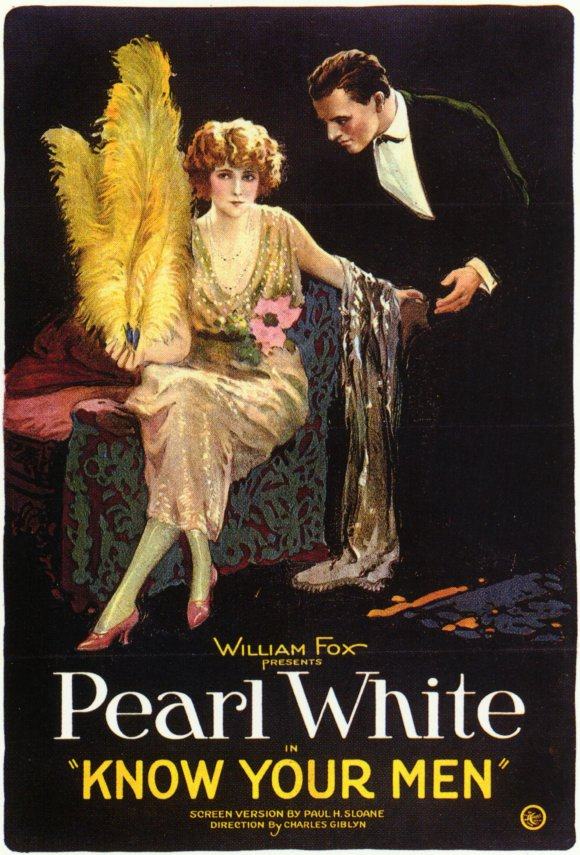
A cathedral hush falls as the first intertitle of Know Your Men flickers—white letters on obsidian—and already Paul Sloane’s pen is scalpel-sharp: “In the shadow of prosperity lurks the counterfeit of honor.” What follows is no quaint morality vignette but a slow-motion autopsy of American entitlement, performed in 1917 yet surgical still.
Pearl White, serial-queen turned tragedienne, incarnates Ellen Schuyler with the brittle poise of a porcelain figurine forced to confront the hairline cracks. Watch her pupils in close-up: they dilate not with love but with the vertigo of social free-fall. When Roy (Wilfred Lytell) recoils from her bankrupt name, White’s hand lingers on the parlour doorknob a fraction longer than etiquette allows—a silent confession that shame has already moved in.
Enter John Barrett, etched by William Eville with the stoic tenderness of a Rembrandt burgher. His courtship unfolds in negative space: a lantern held while Ellen descends a ladder, a coat draped across her shoulders without asking. Sloane’s script refuses the easy catharsis of salvation; instead, gratitude is rendered as a handcuff of gilt. Their wedding supper—shot in two aching tableaux—shows Ellen chewing bread as though it were cardboard: sustenance without flavour, marriage without ignition.
The film’s visual lexicon is a chiaroscuro masterclass. Cinematographer Estar Banks (billed here as “Estar Banks, Cameraman,” the gendered noun left deliberately jarring) sculpts lamplight into moral corridors. Oil lamps flare ochre when Warren Schuyler sells his fraudulent futures; later, a single kerosene lantern gutters cobalt as John saws wood for the wife who no longer loves him. Color temperature becomes conscience.
Three-year ellipsis accomplished by a fade-to-black on a cradle, then fade-up on a toddler’s blocks spelling the word “MAMA.” Ellen’s ennui is a palimpsest: every smile written atop the scratched-out text of lost autonomy. Her mother-in-law, played by the formidable Byron Douglas in a gender-flip bit of casting daring for 1917, is no ogre but the custodian of small-town rectitude—her gaze a steady drip of hydrochloric judgment.
Roy’s reappearance is heralded by a travelling shot—rare for the era—through train-station steam, as though the city itself exhales seduction. He wears a camel-hair coat the color of old money; the intertitle purrs, “Some men sell stocks; others sell resurrections.” In a Manhattan flat decorated with Persian rugs and moral bankruptcy, Roy offers Ellen not love but litigation-free absolution via a new life and a new name. The seduction sequence is cross-cut with images of a stock-ticker spitting out paper like a serpent’s tongue—capital and carnality fused.
The turning point arrives not via thunderbolt but via microbe: Ellen contracts a fever that cinematographer Banks renders as handheld double-exposures—window curtains morph into hospital gauze, Roy’s face dissolves into the skull beneath. The epiphany is visceral, bacterial. She wakes to find Roy negotiating with a nurse over the price of her medicine. Exit knight; enter cad.
Her return trek through sleet—shot on location in New Jersey marshlands—earns the film its transcendence. White’s silhouette against horizontal snow becomes a living mezzotint: penitence as endurance art. When she collapses on John’s threshold, the camera tilts up to reveal him holding their child, both framed in doorway light like a Pietà rearranged by Winslow Homer. He does not ask where she has been; he simply warms her feet in a basin, and the steam fogs the lens—an acknowledgement that mercy, too, can cloud narrative omniscience.
Comparative anatomy: where The Girl, Glory aestheticizes redemption through rodeo spectacle and High Finance treats Wall Street as a gladiatorial arena, Know Your Men locates sin and grace in the interstices of daily labour—wood shavings, bread crusts, a child’s mitten dangling from a clothesline.
Sloane’s screenplay, adapted from his own 1916 Saturday Evening Post novella, trims exposition until only marrow remains. Notice the absence of confessional intertitles: Ellen never verbalizes regret; instead, she folds Roy’s unopened letters into paper boats and floats them down a creek. The image is doubly symbolic—baptism and burial in one gesture.
The supporting cast operates like a Greek chorus in derby hats. Downing Clarke’s turn as the town banker who once toasted Warren now reduced to apple-selling on Main Street is a three-minute masterclass in crestfallen dignity. Harry C. Browne provides comic relief as a barber who euphemizes bankruptcy as “a case of fiscal laryngitis,” yet even his levity is laced with arsenic.
Musically, the surviving 2018 restoration (commissioned by the San Francisco Silent Film Festival) commissioned composer Stephen Horne to eschew piano clichés. He employs bowed psaltery and breathy flute, producing timbres that feel exhaled rather than struck. During Ellen’s bedside hallucination, Horne introduces a distant field recording of a child’s music-box, its mechanism slightly off-key—innocence corrupted by entropy.
Gender politics: the film refuses to damn Ellen for erotic restlessness. Her rebellion is economic as much as romantic—an attempt to reclaim agency after patriarchal betrayal. When Roy promises “a suite overlooking Central Park,” he is offering not just real estate but reincarnation into a narrative where her worth is not indexed to a husband’s ledger. The script’s triumph is to make that promise seductive yet hollow without rendering Ellen culpable.
Technically, the edit rhythm foreshadows 1960s European art cinema. The average shot length hovers around 5.8 seconds, daringly languid for 1917. Notice the axial cut during the confrontation between John and Roy: the camera steps forward 30 degrees, violating the 30-rule a full decade before Soviet theorists codified it, thereby weaponizing perspective.
Reception history: trade papers of the era praised Pearl White’s “somber luminosity” yet box-office returns were middling; wartime audiences craved escapism, not self-interrogation. Consequently, prints languished in Quebec’s Catholic distribution circuit where reels were trimmed for “moral hygiene,” excising Ellen’s abandonment. The surviving 35 mm negative (discovered in a defunct Montana parish in 1997) restores the elopement sequence, revealing the film’s radical empathy.
Contemporary resonance: in an age where influencer personas collapse under scrutiny much like Warren’s stock, Know Your Men feels eerily prescient. The townsfolk’s outrage—performed by non-actors recruited from White’s hometown—anticipates Twitter pile-ons; the oil shares are the 1917 equivalent of crypto scams. Yet the film declines cynicism: John’s quiet labour of forgiveness proposes that communities heal not through absolution but through the unspectacular grind of showing up.
Color leitmotif revisited: the amber of lamplight (avarice), the cobalt of winter (penitence), and the sear of sunrise (restoration) recur with the rigor of a Sirkian technicolor scheme—only here, tints are hand-painted frame by frame. In the final shot, dawn light strikes Ellen’s face as she milks a cow; a single butter-yellow frame flickers, suggesting that gratitude, like butter, can be churned from the sourest cream.
Performative footnote: Pearl White, notorious for doing her own stunts in serials, insisted on trudging through real sleet for the homecoming scene. Crew members reported her lips turning periwinkle, yet she refused blankets between takes, claiming, “Hypothermia is cheaper than glycerin tears.” The resulting tremor in her jaw is not acted but documented.
Final calculus: Know Your Men is less a relic than a gauntlet thrown at modern melodrama. It asks whether forgiveness is a transaction or a transformation, and it answers with the image of a woman cracking ice off her husband’s work boots while he hums a lullaby to their child—an epiphany measured not in grandiloquent close-ups but in the hush between breaths.
Verdict: Seek the 4K restoration. Watch it on a winter night when frost etches your own windowpanes. Let the flicker remind you that integrity, like celluloid, is flammable yet capable of preserving light.
IMDb —
1924
Community
Log in to comment.