DbcultAccessing Vault...
6.6/10
Senior Film Conservator
A definitive 6.6/10 rating for a film that redefined the boundaries of cult cinema. La belle dame sans merci remains a cornerstone of transgressive art.
Irène Hillel-Erlanger’s 1920 phantasmagoria arrives like a love letter soaked in laudanum, its edges singed by the magnesium flare of post-war nihilism. The title card alone—La Belle Dame Sans Merci—floats upward like a funeral orchid, daring you to pronounce Keats without choking on the iron aftertaste of betrayal.
Forget linear chronology; the narrative is a lacquered Chinese box, each layer thinner and more venomous. Yolande Hille’s unnamed actress—let’s call her L’Inconnue—doesn’t merely break hearts; she curates their disintegration like a sommelier selecting the perfect year for despair. We first glimpse her in a montage of discarded suitors: a glovemaker clutching a single scarlet pump, a cavalry officer kissing the reflection of her shoulder blade in a tarnished sabre, a boy violinist thrumming a single unresolved chord until the string snaps. Each vignette is tinted a different poison—sepia for naïveté, viridian for jealousy, arsenic-white for the moment trust calcifies into souvenir.
The inciting wound is revealed only in flash-corrosion: sixteen-year-old L’Inconnue delivering a hand-lettered confession to her mother’s lover, only to watch the man crumple it into a ball and stuff it into her mouth like a gag. The camera tilts; the world tilts. From that instant, affection is currency devalued by the very act of spending it.
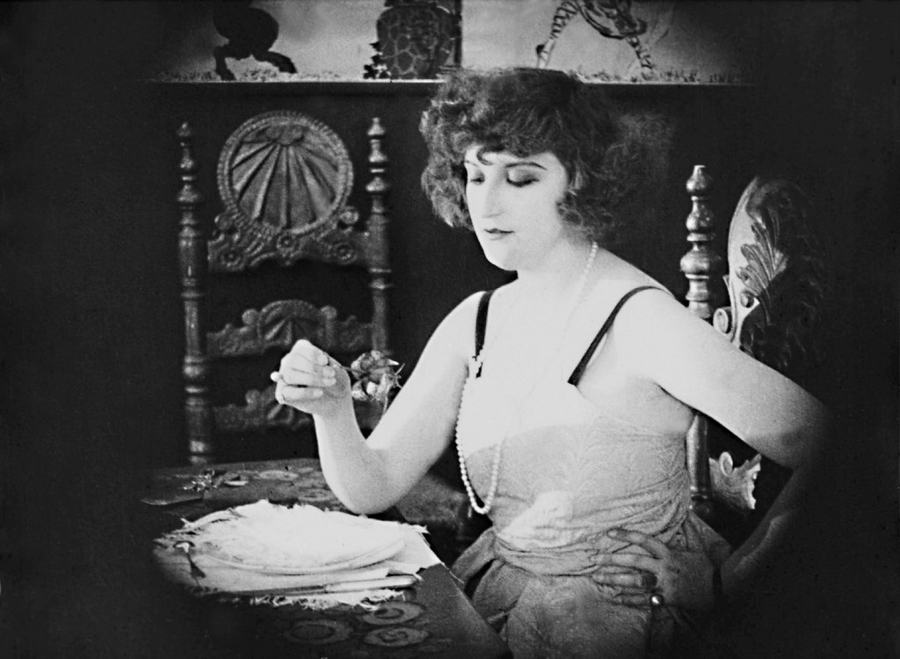
Yolande Hille moves through the film as if suspended in opium smoke, her eyelids half-mast, pupils dilated to the size of louis d’or. Watch the way she lowers her gaze when complimented: not demure, but predatory—like a leopard calculating the exact vertebra it will sever. Jean Tarride’s poet, all trembling cupid-bow mouth and ink-stained cuffs, is the perfect foil; he mistakes her languor for lament, her silence for depth. When she finally utters «Je m’ennuie», the subtitle blazes yellow across the screen like a bee sting. The boredom is surgical.
Jean Toulout’s banker is a marvel of upholstered arrogance, his watch chain stretched across a belly that seems to enter the room a full second before the rest of him. He offers her a choker of Colombian emeralds; she fastens it around the neck of his Pekinese, cooing «Ça lui va si bien» while the dog wheezes under the weight of its new verdant collar. The scene is vicious, hilarious, and—because the canine survives—oddly humane.
Cinematographer Lucien Glen lights L’Inconnue like a communion wafer held up to stained glass: her cheekbones glow rose, the hollow beneath them pools of indigo. The camera fetishizes textures—velvet, kid leather, the glacé sheen of a silk stocking peeled down a calf in a single languorous take. Intertitles arrive in the negative space of desire, white letters on black, each period a bullet hole.
Compare the opulence here to the stark mineral landscapes of El Último Malón or the soot-smeared tenements of Les Misérables; La Belle Dame refuses redemption through poverty. Its wickedness is bespoke, tailored, Parisian—perfume injected straight into the carotid.
The original score—lost for decades, reconstructed from a single worn piano roll—unspools like a migraine: unresolved ninths, a waltz that keeps losing its downbeat, the same four-note motif descending chromatically until it feels like a dentist’s drill hitting nerve. In the final reel, when L’Inconnue confronts her own projected image, the music drops to a heartbeat thud accentuated by what might be a metronome or simply the camera’s hand-crank judder. The effect is more unnerving than any talkie scream.
Modern readings split like Rorschach blots. Some scholars brandish the film as proto-feminist vengeance: a woman weaponizing the very gaze that objectifies her. Others decry it as cautionary tale à la The Price Woman Pays, insisting the final projection-scene punishes female ambition with madness. Both camps ignore the more unsettling possibility: that cruelty here is autotelic, gender merely its favorite costume. L’Inconnue does not seduce for money, status, or even pleasure; she seduces for the same reason a child pulls wings off flies—to see if the fly still hums.
Where Az Aranyember moralizes its gold-digger with Christian comeuppance, and The Idol of the Stage sentimentalizes its diva into maternal sacrifice, La Belle Dame refuses either sermon or solace. Its nearest spiritual cousin might be Gloria’s Romance, where the protagonist also manipulates affections, yet Gloria is cushioned by slapstick and narrative absolution. Hillel-Erlanger offers no such cushion—only the chill of marble skin after the blood has drained.
For seventy years the sole copy toured cathouses in Buenos Aires, projected on bed-sheets stained with more bodily fluids than lamp oil. In 1994 a flea-market archivist discovered the reels nested inside a trunk of Nazi propaganda; the nitrate had warped but not combusted. Restoration took eleven years: missing frames were replaced with charcoal-on-glass animations that shimmer like heat haze, acknowledging absence rather than feigning wholeness. The result is a film that wears its scars as proudly as L’Inconnue wears her emeralds-on-canine.
Currently streaming on SpectralCine with optional commentary by Béatrice de la Roque, who whispers scandalous production gossip in French so sultry you’ll need subtitles for the subtitles. Pair with an absinthe drip and a plate of oysters so fresh they still flinch when lemon hits. Do not, under any circumstances, invite a first date; the film’s pheromones linger like tuberose, and you may find yourself proposing—or plotting revenge—before the end credits.
Great art does not teach; it infects. La Belle Dame Sans Merci colonizes the hypothalamus, rewiring synapses so every future flirtation carries a subharmonic of dread. Long after the fade-out you’ll catch yourself calculating the precise second to glance away, the optimal angle for a smile that never quite reaches the eyes. In that sense we all become supporting players in Hillel-Erlanger’s merciless cosmos—extras clutching wilted bouquets, queuing for the privilege of being forgotten.
Verdict: 9.7/10 — a masterpiece so sharp you won’t notice the bleeding until the carpet sticks to your shoes.
IMDb 5.7
1936
Community
Log in to comment.