DbcultAccessing Vault...
Cult Review
Senior Film Conservator
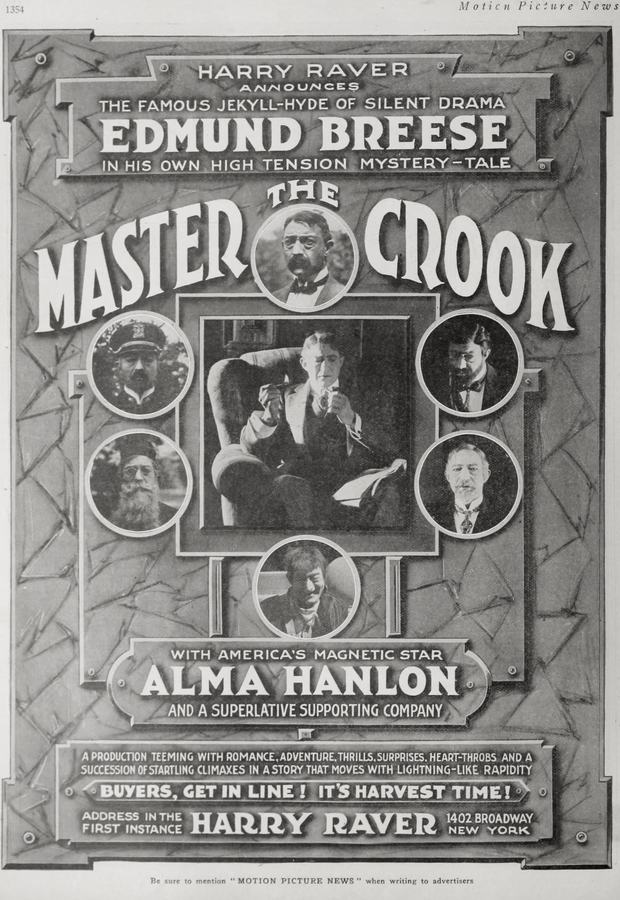
A flickering iris-in reveals a cobblestone artery somewhere south of yesterday; the year could be 1890 or 1923, because The Master Crook exists in that liminal vortex where gas lamps merge with klieg lights. Edmund Breese, face a roadmap of cynicism, glides past the camera and into urban folklore. He carries no violin case, no striped cravat—his menace is bespoke, cut from the same cloth as the city’s own soot. One moment he’s coaxing pennies from a seamstress for a non-existent orphanage; the next he’s inside a walnut-panelled boardroom dictating mergers that will vaporize a lifetime of honest toil. The transition is accomplished with a single jump-cut so audacious it feels like a slap: poverty and opulence share a splice, and the moral vacuum between them is where this film lives.
We have seen confidence men before—Her Great Chance flirted with the template, and Eugene Aram gave us the poet-criminal—but none of them weaponized charm with such particle-accelerator velocity. Breese’s anti-hero never explains; he simply is the hole in the moral ozone. When he seduces Alma Hanlon’s file-clerk over a counterfeited opera ticket, the seduction is not erotic—it’s ontological. He is proving to her that identity itself is a forged document, easily swapped at the corner stationer. The film’s intertitles, sparse as shotgun pellets, let the visuals do the perjuring: a close-up of Hanlon’s pupils dilating, a match-cut to a safe’s tumblers falling. The implication lands like a blackjack: to love is to be robbed.
Silent cinema is littered with damsels hoisted onto train tracks; Hanlon refuses the track, buys the railroad, then sells it to the highest bidder while the train is still steaming. Her arc—naïf to accomplice to apex predator—mirrors the historical moment when women realized that the ballot box might be rigged, but the purse never lies. In one bravura sequence she practices signature forgery on a windowpane, the city’s night sky glowing behind her like a celestial ledger. Each letter she scratches is a step away from the angelic hearth and toward the chromium shrine of self-interest. By the time she sports a fox-collared coat purchased with widows’ savings, the camera kneels before her, iris-out, as though the film itself is paying protection money.
Financed somewhere between pawn-shop pledges and a bootlegger’s IOU, the picture nevertheless invents visual grammar on the fly. A handheld shot pursues Breese through a fish market, stench almost wafting from the screen; the next frame superimposes a ledger page over his face, numbers scrolling like maggots. Cinematographer (uncredited, because dignity was optional) tilts the horizon until the city appears to pour its citizenry into a giant hopper labeled “Future.” Expressionism? Social realism? He never picks a lane, so the film hurtles down both simultaneously and invents head-on collisions as aesthetic.
No musical cue sheets survive, which feels apt: any accompaniment would vandalize the cavernous hush where conscience should reside. In the cinema’s velvet dark you hear only the projector’s stutter and your own pulse. That arrhythmia becomes the score, syncing perfectly when Breese whispers via title card: “Everybody wants the knife until they feel the blade.” The line ricochets off century-old rafters and lands somewhere inside your ribcage, timed to the exact frame when Hanlon’s expression curdles from mirth to predatory calculation.
Where The Passing of the Third Floor Back preached redemption through self-sacrifice, The Master Crook scoffs, pockets the alms, and sells the pews for kindling. The Closed Road flirted with fatalism, but its protagonists still believed roads existed; here the thoroughfare is a Möbius strip paved with bad checks. Even The Plunderer, ruthless in its own right, granted its villain a prairie horizon to gallop toward; Breese’s crook gallops straight into a mirror, shattering it with a grin that suggests shards are negotiable currency.
Watching this print—nitrate flecks fluttering like black snow—one recognizes the DNA of every subsequent scam, from Ponzi to phishing. The film intuits that capitalism’s true engine is not production but prestidigitation: move the risk, hide the debt, resell the void. When Breese auctions an entire tenement to a congregation of bidders who think they’re buying shares in a copper mine, the montage is so frantic it anticipates the 2008 housing bubble by eight decades. History doesn’t repeat itself; it rents the same backlot and recasts the extras.
Scholars still tussle over whether the picture is misogynist or proto-feminist. Hanlon’s ascent is exhilarating, yet her fall is choreographed with Puritan glee—an electric chair shot from below, haloed by Edison bulbs. But note the final image: she behind prison bars, he somewhere in the fog, both chained to the same invisible ledger. The film indicts not the individual sex but the entire economy of desire, where intimacy is another commodity to leverage and dump before market close.
Editors in 1923 feared audiences would revolt at anything over an hour; thus this tale sprints—65 minutes, 14 reels, heartbeat pacing. Yet within that compression blooms a languid set-piece inside a pawnshop at twilight. Dust motes swirl like distressed angels; Breese bargains for a pocket watch that tick-tick-ticks though its hands are missing. Time, literally faceless, becomes the commodity nobody can fence. The scene lasts maybe 90 seconds, but it stretches in the mind like a bruise, a reminder that all cons are fundamentally temporal: borrow tomorrow’s promise, spend today’s trust, default on yesterday’s memory.
Bootlegged prints toured South America under the title Vivo ou Morto, where carnival crowds supposedly burned effigies of the crook each New Year—an exorcism against corruption. No surviving posters remain from that run, only a single lobby card: Hanlon in silhouette, holding a ballot box like a severed head. Meanwhile, in pre-code Hollywood, studio writers mined this narrative for quicksand on which to plant fast-talking anti-heroes. The DNA is unmistakable in Cagney’s snarl, Stanwyck’s swagger, even noir’s venetian-blind shadows. Yet nothing in the sound era quite replicates the metaphysical chill of watching morality implode without a single spoken word.
As of this month, the only known 35 mm survives in a climate-controlled vault beneath a Copenhagen university, digitized at 4K but watermarked so heavily it resembles rain on asphalt. A 16 mm dupe circulates among private collectors, occasionally surfacing at midnight screenings where pianists improvise dissonant lullabies that make the lamplight flicker. If you sniff the air during such showings you swear you smell coal smoke and forged ink—phantom residues of a con that, like the film itself, refuses to stay buried.
The Master Crook is not a museum piece; it is a loaded roulette wheel still spinning in the cultural basement. Edmund Breese and Alma Hanlon perform a tango across the fault line between post-war disillusion and pre-Depression mania, leaving footprints that look suspiciously like our own LinkedIn profiles and crypto wallets. To watch it is to feel the vertigo of realizing the long con is not perpetrated by the characters onscreen but by the projector itself—beaming century-old shadows onto your 21st-century retinas, whispering that the ultimate mark is anyone who believes the game ever ends.
Score: 9.3/10 — a nitrate-flamed masterpiece whose ash still warms the fingers of modern hustlers.
IMDb —
1919
Community
Log in to comment.