DbcultAccessing Vault...
Cult Review
Senior Film Conservator
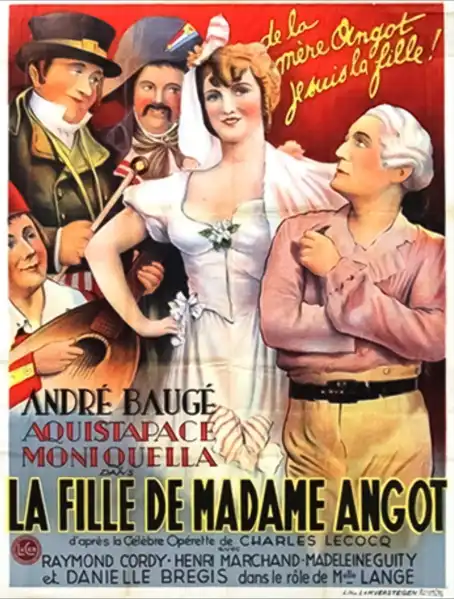
If you are in the mood for something light that feels like it was filmed inside a giant, dusty wedding cake, you should probably watch this. It’s one of those French movies from the mid-30s where everyone seems to be having a lot more fun than the audience might be, but it’s infectious anyway.
You’ll like it if you enjoy old-school operettas and people bursting into song while wearing very fancy wigs. You will probably hate it if you can't stand theatrical acting or if you want a plot that actually makes sense on the first try.
The story is about Clairette, the daughter of the legendary Madame Angot. She’s caught in this whole mess where she is promised to a hairdresser named Pomponnet, but her heart is set on Ange Pitou.
Ange Pitou is a poet who writes songs that make the government angry. It’s all very French Revolution chic, even though it takes place a bit after the main guillotine years.
The first thing I noticed was the sound. It’s got that 1935 crackle that makes everything sound like it’s happening behind a velvet curtain.
André Baugé plays the poet, and he has this very serious way of singing that feels a bit much for a comedy. He’s got a great voice, though.
There is a scene in a market early on where everyone is moving in these weird, synchronized patterns. It’s clearly choreographed for a stage, and the camera just sort of sits there watching it happen.
It’s not like Havoc where things feel intense and gritty. This is much more about the vibe of a party that never ends.
Robert Arnoux is in this too, and he’s doing a lot of heavy lifting with his facial expressions. He has this way of looking surprised that makes his eyes look like they might pop out of his head.
I found myself staring at the hats more than listening to the dialogue sometimes. The women wear these massive structures that look like they would tip a person over in a light breeze.
The movie gets way better once they get to the fancy party scenes. There is something about 1930s sets—they look so obviously like painted wood, but they have more character than modern green screens.
It reminded me a little bit of the energy in The Lottery Man, just with a lot more ruffles and French accents.
There’s a lot of talk about politics, but it’s the kind of movie politics that doesn't really matter. It’s just an excuse for people to get arrested or hide in closets.
One reaction shot of a soldier lingers for about four seconds too long. He’s just standing there looking confused while the main characters argue.
I think the writers, Paul Siraudin and the others, really just wanted to make sure all the hit songs from the original play were in there. The plot feels like it’s just a bridge between the musical numbers.
Danièle Brégis as Clairette is actually pretty charming. She has a very bright energy that keeps the movie from feeling too bogged down by the older actors.
There’s a moment where a character tries to climb a wall and it’s so clearly a small wooden prop that I laughed out loud. It’s those little things that make these old movies feel real.
The whole thing feels a bit like Captain Swift in the way it handles high-society drama, but with much less brooding.
Is it a masterpiece? No. But it’s a very specific kind of entertainment that we don't really make anymore.
The pacing is a bit weird in the middle. It feels like they forgot to move the plot forward for about ten minutes while people just sat around talking about their feelings.
Also, the ending happens very fast. One minute everything is a disaster, and the next minute everyone is singing and it’s all fine.
I wish there was more of Moniquella in the movie. She has a presence that cuts through the fluffiness of the rest of the cast.
If you’ve seen something like Men Before Marriage, you know how these old comedies can sometimes feel a bit dated in their logic. This one is no different.
But there is a warmth to it. It’s like a postcard from a version of France that only existed in theaters. 🎭
The costumes are definitely the star. I can’t emphasize enough how many ribbons are in this film.
It’s a bit like The Little Shoes in terms of having that simple, almost fable-like quality to the conflict.
One thing that annoyed me was a secondary character who kept making a whistling sound. It was supposed to be funny, but it just hurt my ears after the third time.
I think the director probably told everyone to "act bigger" because they were worried the camera wouldn't catch the nuances. As a result, everyone is always gesturing wildly.
It’s definitely a movie for a rainy Sunday afternoon when you don’t want to think too hard. You just want to see some people in 1790s clothes sing about their boyfriends.
The script has some clever lines, but a lot of them get lost in the shuffle of the music. You have to really pay attention to catch the insults.
The film ends on a high note, literally. It’s a big ensemble number that makes you want to go buy a tricorn hat.
If you're looking for something totally different from the usual Hollywood stuff, give it a shot. Just don't expect it to change your life.
Anyway, it was a decent way to spend ninety minutes. I’m still thinking about those hats.
IMDb —
1928
Community
Log in to comment.