DbcultAccessing Vault...
Cult Review
Senior Film Conservator
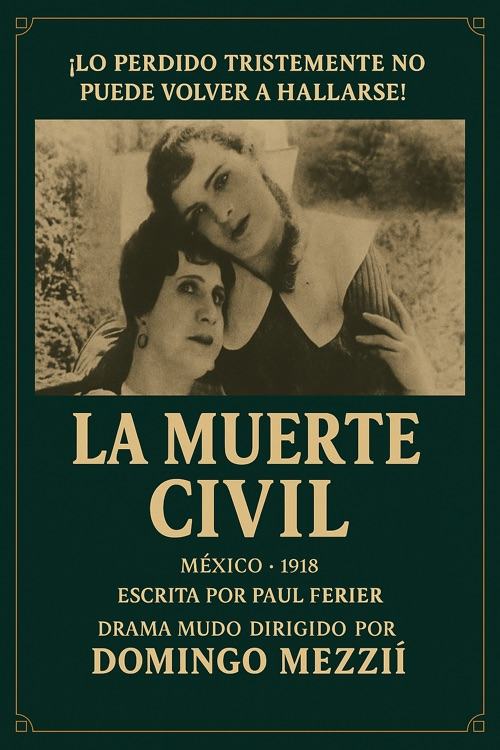
From the moment the opening rain‑drenched tableau settles on the screen, "La muerte civil" announces its intention to treat love not as a fireworks display but as a slow‑burning ember, one that can be smothered by routine, expectation, and the quiet erosion of communication. Mezzi, who also pens the script, demonstrates a rare confidence in allowing silence to speak louder than dialogue, a technique reminiscent of the restrained storytelling found in Charles IV, yet filtered through a distinctly contemporary Argentine sensibility.
The film’s architecture is built on a series of vignettes that, on the surface, appear mundane—a shared breakfast, a neighbor’s unsolicited philosophical ramble, a television program about historical conflict—but each is meticulously staged to reveal the fissures widening between Mateo (Domingo Mezzi) and Clara (Lupe Rivas Cacho). The cinematography, bathed in muted blues and grays, employs the sea‑blue hue #0E7490 in reflective surfaces, subtly reminding the viewer of the emotional depth that lies beneath the characters' stoic exteriors.
Salvador Uriarte’s cameo as the neighbor, a former university colleague of Mateo, functions as a narrative catalyst. His intermittent monologues about the concept of "civil death"—the legal continuation of a partnership that has ceased to be alive in any meaningful sense—provide a philosophical framework that elevates the personal drama to a universal meditation. This thematic thread aligns the film with the existential inquiries of The Black Stork, where the protagonist’s internal void mirrors a broader societal malaise.
Maria Luisa Escobar, portraying Clara’s mother, injects a generational perspective that underscores the weight of cultural expectations. Her occasional visits, marked by the clatter of porcelain and the scent of stale tea, serve as a reminder that the couple’s private turmoil is observed, judged, and, at times, reinforced by the older generation’s insistence on maintaining appearances. The mother’s presence is a subtle nod to the familial pressures explored in Her Sister's Rival, where familial duty collides with personal desire.
Mezzi’s performance as Mateo is a masterclass in restrained anguish. He conveys a spectrum of emotions—frustration, yearning, resignation—through micro‑expressions: a twitch of the left eyebrow, a fleeting glance at the empty chair opposite him, the way his hands linger on the kitchen counter as if searching for a tactile anchor. Lupe Rivas Cacho’s Clara, meanwhile, embodies a quiet strength that is both heartbreaking and defiant. Her silence is not passive; it is a deliberate act of self‑preservation, echoing the stoic resilience found in I Don't Want to Be a Man’s heroine.
The film’s pacing is deliberately languid, allowing the audience to inhabit the same temporal suspension that the characters experience. Scenes stretch, linger, and sometimes dissolve into one another, mirroring the way time blurs when one is caught in the throes of emotional inertia. This temporal elasticity is reminiscent of the narrative structure employed in Five Nights, where the passage of time becomes a character in its own right.
One of the most striking visual motifs is the recurring image of water—rain on the streets, a glass of water left half‑filled, a bathtub slowly filling with cold water. Water, in its many forms, symbolizes both cleansing and suffocation, a duality that underscores the film’s central paradox: the desire to wash away the past while simultaneously being drowned by it. The dark orange accent #C2410C appears sparingly, most notably in the glow of a streetlamp that illuminates Mateo’s silhouette as he stands alone in the final frame, a visual metaphor for the lingering ember of hope amidst the encroaching darkness.
The sound design deserves special mention. Ambient city noises—distant sirens, the hum of traffic, the occasional bark of a stray dog—are amplified just enough to remind the viewer that life continues beyond the apartment walls, indifferent to the personal apocalypse unfolding within. The score, a minimalist piano motif interwoven with low‑frequency drones, accentuates moments of tension without ever overwhelming the scene, a technique that aligns with the subtle auditory strategies used in Spooks.
When Clara finally leaves the handwritten note—"I am still here, but I am no longer us"—the film reaches its emotional apex. The note, smudged by the relentless rain that has been a visual leitmotif throughout, crystallizes the abstract concept of civil death into a tangible artifact. This moment is handled with a delicate balance of restraint and impact, avoiding melodrama while delivering a punch that reverberates long after the credits roll.
In terms of comparative cinema, "La muerte civil" shares a thematic kinship with The Dancing Girl, where the protagonist’s internal struggle is mirrored by external performance. However, while "The Dancing Girl" employs vibrant choreography to externalize inner turmoil, Mezzi opts for stillness, allowing the audience to feel the weight of unspoken words. Similarly, the film’s exploration of personal disintegration within a broader sociopolitical context echoes the narrative ambition of Allies' Official War Review, No. 1, albeit on an intimate, domestic scale.
The editing is seamless, with cuts that respect the rhythm of everyday life. A lingering shot of a clock ticking, a slow dissolve from a rain‑splattered window to a close‑up of Clara’s hand trembling over the note, these choices reinforce the film’s meditation on time, memory, and the inevitability of change. The decision to forgo a conventional climax in favor of an open‑ended conclusion invites viewers to contemplate the aftermath of civil death—what remains when the legal bond persists but the emotional contract has dissolved.
From a technical standpoint, the production design is understated yet purposeful. The apartment’s muted color palette—grays, off‑whites, and occasional splashes of the sea‑blue accent—creates a visual environment that feels lived‑in, authentic, and reflective of the characters’ emotional states. The occasional burst of the yellow accent #EAB308, such as the flicker of a streetlight or the glint of a photograph, serves as a visual reminder of moments of fleeting hope or nostalgia.
Mezzi’s dual role as writer and director yields a cohesive vision that feels both personal and universally resonant. His willingness to let scenes breathe, to trust the audience’s capacity for inference, positions "La muerte civil" as a work that rewards attentive viewing. The film does not preach; it observes, it records, it mourns, and ultimately, it invites reflection.
For viewers seeking a cinematic experience that delves beyond surface‑level romance into the nuanced terrain of emotional cessation, "La muerte civil" offers a richly textured, intellectually stimulating, and emotionally resonant journey. Its interplay of visual symbolism, restrained performances, and philosophical undercurrents makes it a standout entry in contemporary Argentine cinema, deserving of discussion alongside the likes of Enken and Priklyuchenie Liny v Sochi, both of which explore the quiet desperation that can accompany the end of an era.
In the broader landscape of films that interrogate the dissolution of intimate bonds, "La muerte civil" distinguishes itself through its meticulous craftsmanship, its commitment to authenticity, and its refusal to offer tidy resolutions. It stands as a testament to the power of cinema to capture the subtle, often invisible, moments that define the human experience.

IMDb 5.5
1925
Community
Log in to comment.