DbcultAccessing Vault...
Cult Review
Senior Film Conservator
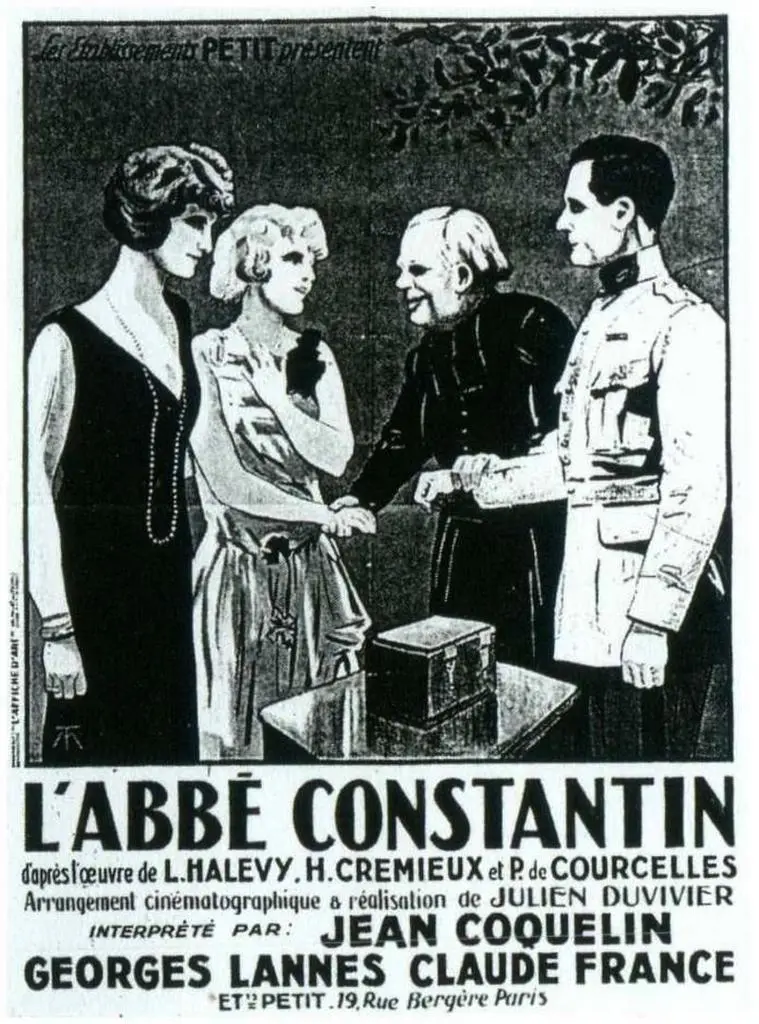
Is L'abbé Constantin worth watching today? Short answer: yes, but with significant caveats. This early French cinematic offering, while undeniably a product of its time, offers a surprisingly gentle exploration of tolerance and unexpected affection, making it a compelling watch for cinephiles interested in the evolution of storytelling and social commentary in film, but likely a challenging experience for those accustomed to modern narrative pacing and production values.
This film is ideally suited for those with an appreciation for silent cinema's unique rhythm and expressive acting, or anyone curious about how foundational narratives of social acceptance were portrayed on screen over a century ago. Conversely, viewers seeking fast-paced action, complex psychological depth, or contemporary production polish will find its deliberate cadence and stylistic conventions demanding, perhaps even tedious.
To truly engage with L'abbé Constantin, one must approach it not merely as entertainment, but as a historical artifact, a window into a bygone era of filmmaking and societal norms. Its enduring power lies less in technical prowess – though commendable for its time – and more in the universality of its core message.
The film, directed by Julien Duvivier, stands as an early example of his burgeoning talent, predating his more celebrated works by decades. It’s a quaint, unassuming piece that, for all its simplicity, manages to tackle themes that remain relevant even in our complex modern world.
This film works because its surprisingly progressive themes for its era, particularly its gentle advocacy for religious tolerance and the breaking down of social barriers, resonate even today. Its charm lies in the earnest performances and the simple, heartwarming narrative. This film fails because its pacing is undeniably slow by modern standards, and the technical limitations of early cinema can make it a difficult watch for contemporary audiences. The character development, while sufficient for the plot, lacks the depth we expect from later works. You should watch it if you are a film historian, a student of early French cinema, or someone seeking a quaint, character-driven story with a positive message about overcoming prejudice, and you have patience for silent-era conventions.
At its heart, L'abbé Constantin is a story about overcoming entrenched prejudice through genuine human connection. The titular Abbé, initially portrayed as a man of deep-seated, if mild, xenophobia and religious conservatism, finds his world upended by the arrival of American Protestants, Mrs. Scott and Bettina.
His initial dismay at the manor's new ownership is palpable, a subtle but clear expression of cultural and religious suspicion. This internal conflict, conveyed through the expressive acting prevalent in silent cinema, forms the backbone of the narrative. It’s a testament to the film's gentle touch that this prejudice is not depicted as malice, but rather as a product of insular tradition.
The film's most striking element is its deliberate dismantling of the Abbé’s preconceived notions. The American women are not caricatures; they are depicted with genuine warmth, open-mindedness, and respect for local customs. This willingness to embrace the 'other' is what truly drives the plot, allowing the Abbé to slowly, almost imperceptibly, shed his biases.
The burgeoning romance between Paul, the Abbé’s nephew, and Bettina serves as the narrative’s hopeful resolution. It’s a classic boy-meets-girl scenario, yet imbued with additional symbolic weight: a union that transcends cultural and religious divides. The Abbé’s eventual blessing of this interfaith relationship is the story’s emotional crescendo, signifying a triumph of love and understanding over narrow-mindedness.
One could argue that the resolution is almost too neat, too idyllic. The complete and swift transformation of the Abbé’s views, and the immediate acceptance of an interfaith marriage, might feel a touch simplistic to a modern audience accustomed to more nuanced portrayals of societal conflict. However, within the context of early 20th-century storytelling, this optimistic outlook served a clear purpose: to entertain while subtly advocating for progressive ideals.
The film doesn’t preach; it demonstrates. It shows, rather than tells, how simple kindness and shared humanity can bridge even the widest cultural chasms. This understated approach makes its message all the more resonant, avoiding the didacticism that often plagues films with overt moral agendas.
Julien Duvivier’s direction in L'abbé Constantin is a fascinating glimpse into the formative years of a director who would later achieve considerable acclaim. While the sophisticated visual grammar of films like El Verdugo (1963) is decades away, one can still discern a nascent talent for storytelling through image.
Duvivier employs a straightforward, clear directorial style, focusing on framing characters within their environment to convey status and emotion. His camera often holds steady, allowing the actors to perform with the grand gestures and exaggerated facial expressions characteristic of silent film, ensuring that even without dialogue, the audience grasps the emotional beats.
The performances, particularly that of Roberto Pla as Abbé Constantin, are foundational to the film's success. Pla embodies the good priest with a blend of initial skepticism and eventual, heartwarming benevolence. His transformation, from a man burdened by tradition to one embracing modernity and love, is subtly conveyed through shifts in posture and the softening of his gaze. One particular scene, where he first meets Mrs. Scott and Bettina, captures his internal struggle perfectly – a polite smile masking evident discomfort.
Angèle Decori as Mrs. Scott and Louisa de Mornand as Bettina bring an effervescent charm to their roles. They are not merely plot devices; they are vibrant, independent women who challenge the Abbé's world without intending to. Decori’s Mrs. Scott exudes a mature grace, while de Mornand’s Bettina possesses a youthful vivacity that makes Paul’s immediate attraction entirely believable. Their interactions with the Abbé highlight the cultural clash, yet also the inherent good nature on both sides.
It’s surprising how well some of the emotional nuances still translate despite the complete absence of spoken dialogue. The actors, trained in a different school of performance, use their entire bodies to communicate. A raised eyebrow, a slight tilt of the head, a hand placed gently on another's arm – these small, deliberate actions carry significant weight, often more profound than pages of contemporary script could achieve.
The visual aesthetic of L'abbé Constantin is quintessentially early 20th-century French cinema. The cinematography, while not groundbreaking by later standards, effectively establishes the film’s pastoral setting and intimate atmosphere. Shots often favor medium to wide frames, capturing the quaint charm of the village and the grandeur of the manor house.
Lighting, primarily naturalistic or achieved with rudimentary studio setups, lends an authentic, if sometimes stark, quality to the scenes. There's a particular sequence featuring the manor's garden, bathed in what appears to be soft daylight, that beautifully underscores the newfound tranquility and blossoming relationships. It's simple, but effective.
However, the pacing is where many modern viewers will find their patience tested. Silent films operate on a different temporal logic. Scenes unfold deliberately, allowing time for audiences to absorb visual information, read intertitles, and process the exaggerated emotions on screen. There are no quick cuts, no rapid-fire dialogue exchanges to propel the narrative forward at breakneck speed.
For those accustomed to the relentless momentum of contemporary blockbusters, this can feel like watching paint dry. Yet, to dismiss it entirely would be to miss the point. This measured pace encourages contemplation, inviting the viewer to linger on expressions, gestures, and the subtle shifts in character dynamics. It works. But it’s flawed for a modern audience.
The film's visual storytelling relies heavily on tableaux and carefully composed shots that function almost like moving photographs. The scenes of social gatherings at the manor, for instance, are meticulously arranged to showcase the interactions between characters, with close-ups reserved for moments of significant emotional impact or revelation. It's a style that demands a different kind of engagement from its audience.
Absolutely, but with the right mindset. L'abbé Constantin
IMDb —
1932
Community
Log in to comment.