DbcultAccessing Vault...
Cult Review
Senior Film Conservator
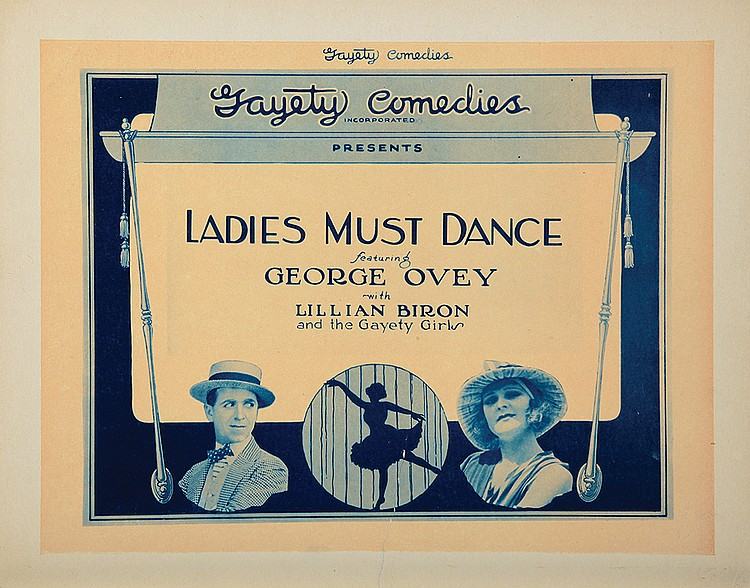
The first thing that strikes you is the shimmer of contradiction: a man’s torso cut like a Greek kouros but poured into moth-eaten satin, tapping out Giselle’s mad scene on a beer-slicked floor. Ladies Must Dance—now resurrected from the archives under its jaunty, slightly desperate title—survives only in a 65-minute condensation, yet the emulsion still secretes heat. The plot, gossamer-thin on paper, becomes in motion a palimpsest where burlesque’s bawdy wink and ballet’s ascetic line keep bleeding into one another, each contaminating the other with longing.
George Ovey, usually dispatched in slapstick short pants, here elongates his comic limbs into something almost predatory; his George is both commodity and conspirator, selling the illusion that art can live where rent is weekly and morals negotiable.
Director Scott Darling—better known for scripting thrillers—choreographs the camera like a man afraid to blink. He dollies across dressing tables littered with rice-paper petals, then swings vertiginously above the stage where chorus girls become a kaleidoscope of knees. There is no master shot in the traditional sense; instead, space is cubist, fractured by mirrors that double the audience’s leer into infinity. When George rehearses a pas de bourrée on the rooftop at dawn, the skyline behind him is clearly a matte painting, yet the tremor in his calf is documentary truth. The artifice is the point: in 1925, everybody knew the city itself was a back-lot hoax built on speculation and sweat.
Because the disc soundtrack is lost, modern projections often pair the film with fresh ragtime or, worse, polite café jazz. Both choices lie. What the images demand is a collision: a scratchy Maple Leaf Rag overlaid with the distant squeal of an elevated train, plus the faint throb of a cello mourning Sleeping Beauty. Silence, paradoxically, makes the footfalls louder; you hear them in your vertebrae. When Lillian Biron—her eyes two fogged gin-spheres—whispers I’d rather be a statue that breathes,
the subtitle card flashes just as George lands in a perfect fifth, and the moment acquires the uncanny weight of prophecy.
The picture’s fiscal engine is a subplot about a consortium of garment bosses who bankroll the revue to launder strike-breaking profits. They want respectability; what they get is George’s pelvis articulating grievances in 4/4 time. Thus the film sneaks in a class thesis without ever uttering the word proletariat. Compare it to Ingeborg Holm’s icy social realism or The Crucible’s moral absolutism, and you see how Darling prefers guerrilla satire: he raids the palace, then pirouettes out wearing the king’s monocle.
Yet the gender politics refuse to fold into neat pamphlet rhetoric. The women backstage—sewing ripped can-can skirts while trading barbs about alimony—are neither saints nor victims. When the lead soubrette pockets an extra fifty to vamp longer, she’s not betraying the sisterhood; she’s hedging her bets in a rigged casino. Meanwhile, George’s masculinity is perpetually in drag: he powders his armpits, negotiates with a pimp in falsetto, yet still benefits from the wage premium accorded to male dancers. The film winks at this paradox without resolving it, trusting the viewer to feel the pinch inside the corset.
Cinematographer Jackson Rose (later famed for western vistas) here works in claustrophobic monochrome, carving space with hard sidelights that turn calves into architecture. Notice the sequence where George practices on the darkened stage: a single bulb dangles, creating a pendulum of illumination. Each time it swings, the shadow of his arm elongates to caress a dusty portrait of Little Tich, the British music-hall dwarf. The effect is chiaroscuro as memento mori: talent shrinks, memory lengthens.
Rose reportedly smeared petroleum jelly on the lens edges to soften the harsh glamour, giving the frame a halo that whispers of narcotic nostalgia even as the narrative hurtles toward payday.
Ovey’s physical vocabulary toggles between commedia elasticity and ballet’s vertical aspiration. Watch the micro-beat before he launches into a tour en l’air: his left eyebrow arches in apology, as if to say forgive the pretension.
That sliver of self-mockery saves the character from insufferable nobility. Opposite him, Lillian Biron operates with the languid cruelty of a cat who knows she’s been adopted merely for her stripes. Her line readings—delivered via intertitle—carry a powdered insouciance: Love is like a garter; it snaps when stretched.
Yet in the final close-up, when the curtain falls and footlights dim, her pupils balloon until they reflect the entire empty auditorium. The mask slips; the soubrette becomes a frightened kid clutching a paper flower. It lasts maybe eight frames, but it scalds.
Place Ladies Must Dance beside In Slumberland and you see two opposite strategies for conjuring dream-logic. Slumberland externalizes the subconscious via expressionist sets—crooked doors, staircases spiraling into star fields—whereas Ladies internalizes it inside the sinew: the body itself becomes the surreal landscape. Similarly, stack it against the Alpine peril of Facing Death on the Blumlisalp; both films flirt with vertigo, yet where the mountain offers lethal sublimity, the revue stage offers humiliating exposure—equally fatal, but slower, like paper cuts on the soul.
If you need a moral melodrama, The Test of Womanhood will sermonize; if you crave Gothic blood, Rose di sangue drips crimson. Ladies Must Dance occupies the liminal corridor between those extremes, a place where tap shoes echo like dice on baize.
Trade papers of the era damned the film with faint praise: a sprightly trifle for the tired businessman,
sniffed Variety. The censor boards in Pennsylvania clipped two shimmy close-ups, claiming the vibrations simulated immoral locomotion.
Such scissor-work only amplified word-of-mouth; the picture recouped in second-tier houses, then vanished into the landfill of obsolete positives. When a 16mm print resurfaced in a Cleveland church basement in 1978, scholars pigeonholed it as a curio of early queer coding
—a reading both reductive and prescient. Yes, George’s fluid gender performance anticipities the pansies who would jitterbug through pre-Code comedies, but the film is also a ledger of labor, of calves cramping at 3 a.m. while bosses count receipts.
Contemporary viewers, weaned on reality-TV talent shows, will find uncanny echoes: the commodification of back-story, the voting-with-applause economy, the instant relegation to obscurity once ratings sag.
The existing restoration, courtesy of Eye Filmmuseum, stitched together two incomplete negatives, leaving a watermark-shaped gap during the penultimate can-can. Digital tools hallucinated missing frames based on adjacent motion vectors; the result is almost perfect until you notice a ghostly ankle dissolving into raw grain. More vexing is the loss of the original tinting. References in the censorship file describe amber glow for interior gaslight, blue-green for rooftop dusk. Without those chromatic cues, the tonal shift between interior squalor and lyric aspiration plays monochromatically flat. Archives have launched a crowdfunding tier to reproduce the tints using Desmet methodology; they need only €17,000—less than the price of a single Marvel trailer.
We persist in believing that art and trash occupy opposite poles; Ladies Must Dance giggles at such certainties. It reminds us that high and low are adjacent rooms in the same pleasure palace, separated by flimsy bead curtains soon torn by questing fingers. In an age when content
is algorithmic chum, there is radical oxygen in watching a film that treats entertainment as both life-raft and noose.
So seek it out—whether in a rep cinema with a rattling projector or on a laptop at 2 a.m. when insomnia makes you porous. Let George’s sweat fleck your retinas. Let Lillian’s paper flower wilt on your carpet. Let the unanswered question—that suspended final pose—hover like a moth against the skylight of your mind. Because when the footlights dim and the last credit vanishes, you may discover what the film has smuggled inside you: the subversive idea that survival itself is a choreography, half-planned, half-improvised, always one beat from collapsing into glorious, undignified sprawl.
And yet we keep dancing.
IMDb 4
1929
Community
Log in to comment.