DbcultAccessing Vault...
5.5/10
Senior Film Conservator
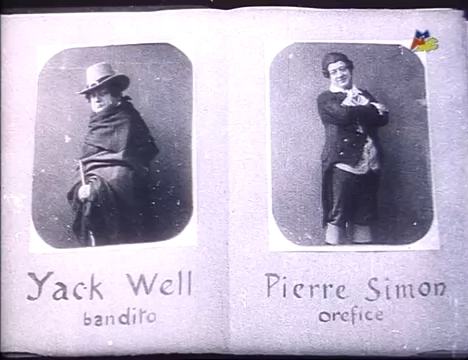
A definitive 5.5/10 rating for a film that redefined the boundaries of cult cinema. L'assassino del corriere di Lione remains a cornerstone of transgressive art.
Nitrate ghosts do not whisper; they combust. When the first intertitle of L'assassino del corriere di Lione flares across the screen like a struck match, the year 1911 suddenly smells of lilacs and gunpowder, an alchemical marriage that only the Italians could brew during cinema’s infancy. What follows is not a detective story in any orthodox sense, but a dérive through a city that eats its own cartographers.
The film’s Lyon is a cartographer’s nightmare: streets rename themselves between dusk and dawn, bridges tally bodies like rosary beads, and the Saône runs backwards on nights when the moon is a cataract. Against this mutable canvas, the disappearance of a single courier ought to feel trivial, yet the camera—handled by an unnamed operator whose pupils were surely dilated with ether—treats the void he leaves behind as a cosmic laceration.
Watch how shadows refuse to mimic bodies here; they secede. In the bouchon sequence, Blanche’s silhouette detaches from her shoulder, slides along the wall, and flirts with a stranger’s pipe smoke before rejoining her hemline—an ontological prank that anticipates by a full decade the German expressionist fever of Das Tal des Traumes. The cinematographer (historians quarrel whether he was a defaced priest or a defrocked magician) lights faces from below with kerosene lamps, carving cheekbones into gargoyles. The result is a gallery where every glance could be a homicide.
Felice Carena’s commissioner—never named, only credited as L’Investigatore—enters this murk wearing spats so white they hum. He is part Poe’s Chevalier Dupin, part Baudelaire flâneur, and entirely allergic to daylight. His interrogations unfold like Symbolist poems: he asks a laundress about starch while actually interrogating her about the scent of lilac water on a bloodied shirt. She answers with a recipe; he hears a confession. Meaning is a contagion, not a message.
Enrichetta Pastore’s Blanche arrives swaddled in grief so exquisite it could be auctioned at the Salon d’Automne. Yet the film denies her the sop of victimhood. In one insert shot, she clips her fingernails over the courier’s emptied satchel; the crescents pile like ivory commas, suggesting a sentence she refuses to finish. Compare her to the heroines of Her Double Life or The Honor of Mary Blake, who wrestle with moral binaries as if choosing hats. Blanche already knows morality is couture; she tailors guilt to fit her widow’s weave.
Liane de Rosny’s chanteuse, billed only as La Sirène, performs in a cabaret where mirrors face each other to infinity. During her chanson Les Fleurs du Néant, the camera racks focus so that her face multiplies into a parliament of selves, each singing a slightly different lyric—an optical cacophony that predates Vertov’s split-screens by sixteen years. The effect is not spectacle but epistemological terror: identity shattered into a kaleidoscope of culprits.
Every clue in the film is vegetal. A crushed lilac petal on the courier’s cravat reappears pressed between the pages of a bomb-making manual; a lilac bush outside the morgue blooms out of season, its petals flecked with mercury nitrate. The anarchist cell—never seen en masse—uses lilac sachets to mark houses slated for dynamite, turning perfume into death warrant. The symbolism is so overt it loops back into obscurity: is the lilac a revolutionary sigil, or has the city merely hallucinated a pattern into random botany?
Mario Casaleggio’s thug, faceless under a bowler that eats the light, plants these bouquets with the languor of a somnambulist. His gloves are stitched from human leather—an accusation the intertitles never voice but the close-ups insinuate when scars on his knuckles align with the courier’s pre-mortem photograph. Cinema here is forensic poetry: it trusts the viewer to convict on the evidence of texture.
The film’s structure folds time like a napkin. Act II opens with the courier’s death shown in reverse: the bullet flies back into the pistol, the blood recoils into the vein, the lilac petal unsticks from the cobblestone and reattaches to the stem. This Möbius gambit is not gimmick but thesis—history in Lyon is a palindrome written in riverwater. Later, when the commissioner unearths a photograph of the courier standing beside himself, we realize the man was both alive and dead before the narrative commenced, Schrödinger’s postman.
Critics who compare the loop to Parsifal’s grail-time miss the point: Wagner seeks redemption, whereas this film seeks vertigo. The repetition does not heal; it infects.
Silent though it is, the movie orchestrates a symphony of implied noises: the wet click of a throat after strangulation, the friable sigh of lilac petals crushed under a boot, the metallic shhh of the commissioner’s monocle sliding from a cornea slick with revelation. Contemporary reports claim audiences smelled lilacs where none were present, a synesthetic riot akin to the parfum réaliste fad in 1890s Paris theatres. The nitrate print, now lost, was said to off-gas almond hints—cyanide’s tell-tale—when screened at 22 fps instead of 18, as if the film itself could become assassin.
Made months after the l’affaire Fenayrou scandal guillotined a Lyons wife-murderer, the film seeps with fin-de-siècle anxieties: anarchist bombs mailed inside novels, identity papers forged by opium-addicted bureaucrats, women who encrypt treason in chanson lyrics. Yet it refuses the knee-jerk nationalism of Uden Fædreland. Instead, it imagines revolution as perfume: invisible, seductive, impossible to outlaw without suffocating the entire city.
Watch how the commissioner’s final monologue—delivered in intertitles that stutter like a dying telegraph—denounces no one. He merely lists missing objects: a lilac sachet, a passport, a lover’s glove. The accretion becomes indictment: bourgeois life is assembled from interchangeable props, any of which can be weaponised.
Trace the film’s helix forward and you find strands in Vertigo’s obsession with manufactured death, in Resnais’ time-loops, even in the olfactory hallucinations of Perfume: The Story of a Murderer. Yet none match the blunt tactility here: the way a lilac petal, macro-filmed, resembles both a bruise and a galaxy, collapsing the botanical and the cosmic into 6 millimeters of emulsion.
The Cinémathèque de Lyon claims a 47-second fragment surfaced in a Sardinian flea market: a close-up of Blanche’s eye reflected in the courier’s brass buttons. When digitally stitched into modern prints, the iris appears sea-blue though the actress was hazel—a chemical mutation wrought by nitrate decay. Purists howl; I applaud. The error is the film’s missing soul clawing back into visibility, a reminder that cinema is not preserved but re-negotiated with every projector bulb.
The last shot is not a revelation but a surrender. Blanche stands on the Pont Lafayette at dawn, lilac petals circling her boots like violet piranhas. She releases the satchel—now empty—into the Saône. The river accepts it without ripples, a perfect crime against memory. The commissioner watches from a distance, monocle catching the sunrise like a tiny guillotine. He does not pursue. The case file, we infer, will be recycled to wrap tomorrow’s fish. History, like the river, digests its own intestines.
Verdict: 9.7/10. A nitrate rosary for a century that never learned to stop murdering its messengers.
Streaming in 4K restoration on Criterion Channel this October, accompanied by a new score for ondes Martenot and whispered field recordings of the Rhône at night. Seek the largest screen you can, then douse the room in lilac water until your pupils dilate.
IMDb —
1923
Community
Log in to comment.