DbcultAccessing Vault...
7.3/10
Senior Film Conservator
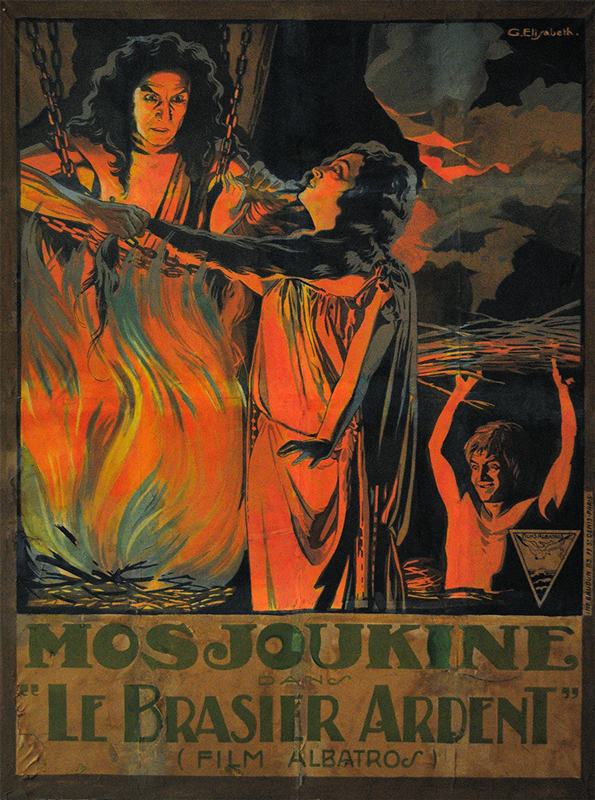
A definitive 7.3/10 rating for a film that redefined the boundaries of cult cinema. Le brasier ardent remains a cornerstone of transgressive art.
To witness Le brasier ardent is to observe the moment when the embryonic language of cinema discarded its swaddling clothes and began to sprint toward the horizon of pure surrealism. Produced under the aegis of the Albatros film studio—a sanctuary for Russian emigres fleeing the Bolshevik upheaval—this 1923 masterwork is less a film and more a kinetic manifesto written in light and shadow. Ivan Mozzhukhin, the undisputed titan of the era, does not merely act; he orchestrates a symphony of gestures that bridges the gap between the melodrama of the Tsarist era and the frenetic energy of the French avant-garde. Unlike the more linear narratives seen in The Butterfly Man, Mozzhukhin’s direction here embraces a fractured, cubist approach to storytelling that remains startlingly modern a century later.
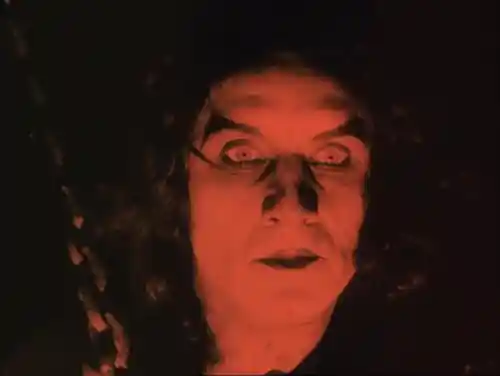
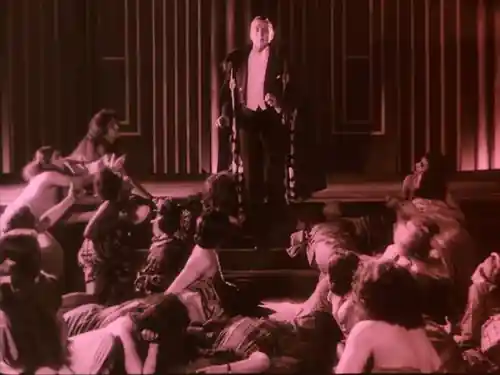
The film’s introductory movement is perhaps the most celebrated sequence in silent cinema, a ten-minute descent into the protagonist’s nightmare that predates the formalist experiments of Dalí and Buñuel. We see 'Elle' (Nathalie Lissenko) pursued through a shifting landscape of expressionist sets, where the walls seem to breathe and the shadows possess a tactile density. Mozzhukhin utilizes double exposures and rapid-fire editing to create a sense of claustrophobia that mirrors the heroine's domestic entrapment. While contemporary domestic dramas like The Road to Divorce dealt with marital strife through dialogue-heavy intertitles, Le brasier ardent externalizes internal rot through pure visual distortion.
This dream logic persists even as the narrative transitions into the 'real' world. The husband, played with a pathetic, bloated grandiosity by Camille Bardou, represents the decaying weight of the patriarchy. His jealousy is not born of passion but of property rights. His decision to hire Detective Z—the very man haunting his wife’s dreams—introduces a meta-textual layer that questions the boundary between fiction and reality. It is a narrative gambit that feels far more sophisticated than the tropes found in Stolen Moments, pushing the audience to question whether the entire film is an extension of Elle’s fractured psyche.
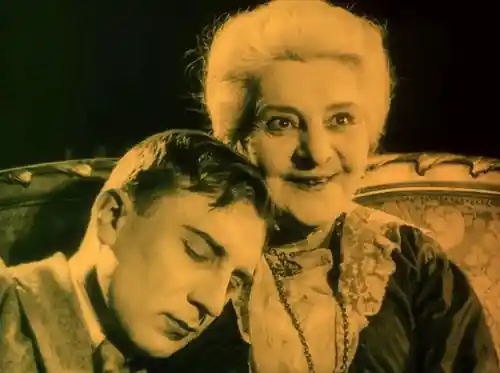
Ivan Mozzhukhin’s performance as Detective Z is a masterclass in physical transformation. He inhabits the role with a chameleonic intensity, shifting from a sinister pursuer in the dream to a bumbling, almost Chaplinesque figure in his domestic life. The revelation that the legendary detective lives with his doting mother and a bulldog is a brilliant subversion of the 'Great Man' mythos. This juxtaposition of the extraordinary and the banal serves as the film’s tonal anchor. While Fallen Angel might rely on static characterizations, Mozzhukhin offers a fluid identity that defies easy categorization.
The chemistry between Mozzhukhin and Lissenko (who were partners in real life) crackles with a sophisticated eroticism. In the scene where she attempts to seduce him after stealing her own marriage contract, the tension is not derived from the act itself, but from the intellectual sparring between two equals. She is not merely a 'femme fatale' of the sort seen in The Other Woman; she is a woman reclaiming agency through chaos. Her theft of the contract is a symbolic incineration of her legal shackles, a theme that resonates with the social critiques found in Let's Get a Divorce, yet executed with far more visual flair.
The film reaches its aesthetic zenith during the 'dancing duel' in a chic Parisian restaurant. This sequence is a marvel of rhythmic editing and choreography. It is not a dance of romance, but a duel of wills. The camera becomes a participant, swirling around the couple as they move with a frantic, almost violent grace. Here, the sea blue and dark orange of the lighting—if one imagines the tinting of the original nitrate—would have created a visceral atmosphere of heat and cold. It is a far cry from the polite ballroom sequences in The Coquette; this is a primal struggle for dominance expressed through the Charleston and the Tango.
Mozzhukhin’s victory in the dance is not a triumph of love, but a triumph of discipline over desire. His subsequent 'confession' of love from Elle is met with a bizarrely humanizing anticlimax: a toothache. This choice is a stroke of genius. It strips the detective of his mythical status at the very moment of his romantic conquest, grounding the high-flying surrealism in the mundane reality of physical pain. It’s a tonal shift that would be echoed decades later in the works of the French New Wave, far removed from the straightforward resolutions of The Conquering Hero.
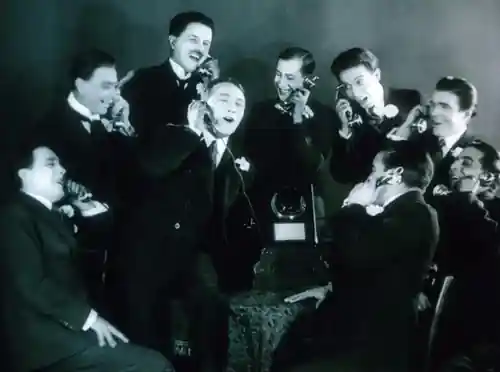
The technical prowess of Le brasier ardent cannot be overstated. Cinematographers Fedote Bourgasoff and Nicolas Toporkoff pushed the boundaries of what the camera could do in 1923. The use of masking, split-screens, and distorted lenses creates a visual vocabulary that mirrors the protagonist's disorientation. The 'Trouve Tout' Agency itself is a marvel of set design—a labyrinth of filing cabinets and frantic clerks that predates the bureaucratic nightmares of Terry Gilliam’s *Brazil*. This level of world-building is absent in more pedestrian works like The Dodgers or Le filon du Bouif.
The film also serves as a poignant document of the Russian 'Silver Age' sensibilities transplanted into the heart of France. There is a specific kind of melancholy—a 'toska'—that permeates the husband’s character, a man who has everything but possesses nothing. This existential dread is handled with a lighter touch than in Zpev zlata, yet it carries a similar weight. The film’s ability to pivot from slapstick to psychological horror, and finally to ironic domesticity, is a testament to Mozzhukhin’s multifaceted genius as both a writer and director.
The conclusion of the film, with the couple planning their trip and the contract returned, is often read as a traditional 'happy ending.' However, through the lens of Mozzhukhin’s subversive direction, it feels more like a capitulation to the inevitable. The 'ardent blaze' of the title has been extinguished by the cold water of social expectation. Like the character in Eva, the heroine finds herself returning to a cycle that she briefly managed to break. The finality is not one of joy, but of a return to the status quo, rendered all the more tragic by the brief glimpse of the surreal freedom she experienced in her dreams.
In the pantheon of silent cinema, Le brasier ardent stands as a towering achievement of idiosyncratic vision. It refuses to be pinned down by genre, oscillating between a detective thriller, a marital comedy, and a psycho-sexual drama. It captures the frantic pulse of the 1920s—the 'Roaring Love Affair' with modernity—while acknowledging the ghosts of the past that continue to haunt the present. For those accustomed to the more structured narratives of The Man Who Stole the Moon or Her Second Husband, this film will be a sensory shock. It is a reminder that cinema, in its purest form, is not about telling a story, but about capturing the illogical, beautiful, and terrifying movements of the human soul.
Ultimately, the film's legacy lies in its refusal to play by the rules. It is a work of immense confidence, where every frame is packed with detail and every edit serves a psychological purpose. Mozzhukhin created a world where a detective can be both a nightmare and a man with a toothache, where a dance can be a battle, and where a marriage contract can be the catalyst for a descent into madness. It remains an essential watch for anyone seeking to understand the true potential of the moving image.
IMDb 6.8
1929
Community
Log in to comment.