DbcultAccessing Vault...
Cult Review
Senior Film Conservator
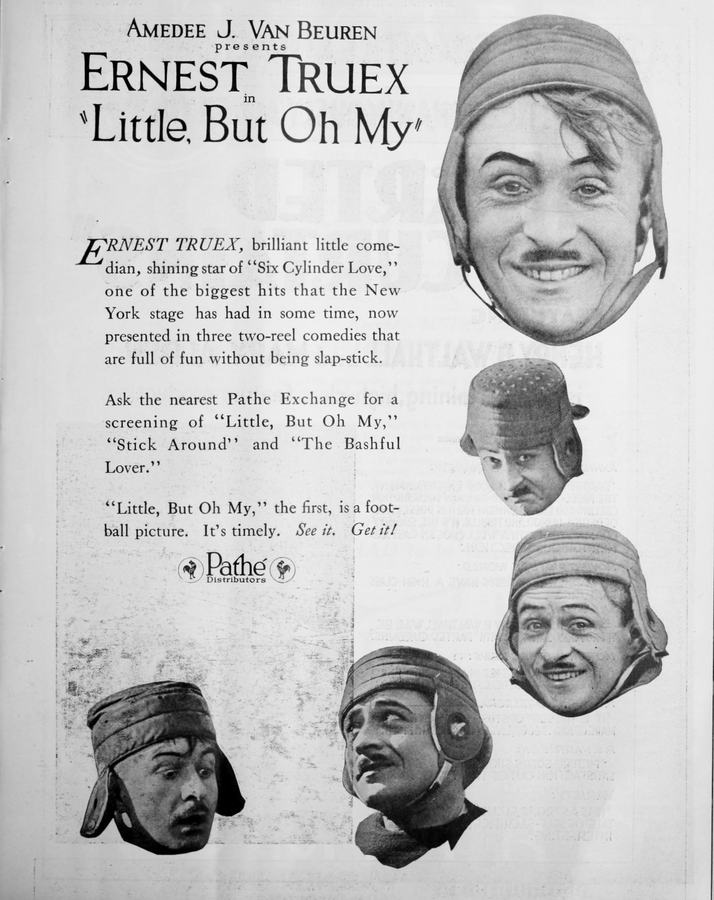
The flickering nitrate opens on a man whose shoulders remember the thunder of brass bands—Joseph P. Mack’s ex-lineman, now a patriarch carved from granite and regret—watching the college scrimmage as though it were his own past projected in reverse. Every whistle blow is a ghost limb twitching. He does not merely want a son-in-law; he wants a continuation of himself, a surrogate trophy that can be polished every Saturday.
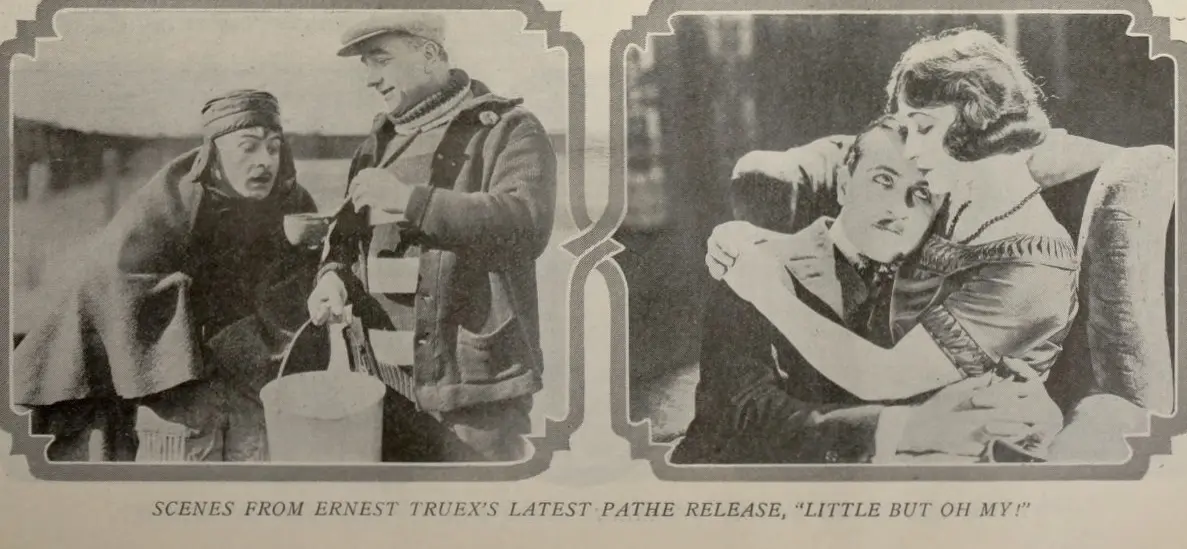
Into this dynastic craving stomps Ernie, played by a sprightly Ernest Truex whose compact frame becomes a thesis on cinematic scale. When the camera dollies back, the world looms cathedral-huge around him; when he charges, the frame shrinks to fit his pulse. The joke is anatomical—teammates dub him “the cub” as if size were a moral failing—yet the film’s grammar keeps tilting the horizon so that the vertical axis belongs to him alone.
“I’m not small,” Ernie protests in a title card that flickers like a shy lantern, “I’m just closer to the ground where the traction is.”
Director Wallace McCutcheon Jr. orchestrates the gridiron skirmishes with a surgeon’s relish for kinetic asymmetry. Instead of the panoramic pageantry that would become de rigueur in The Typhoon two years later, McCutcheon nests us inside the scrum—cleats, clods, grunts—cutting on impact so that every tackle feels like a stack of photographs dropped from a height. The ball itself is rarely centered; it bobs in and out of sight, a MacGuffin of pigskin and possibility, pursued by thighs that pistons the dust into solar flares.
Meanwhile, Julia Mills as Madge, the daughter and presumed trophy, oscillates between dutiful cheerleader and skeptical bard. Watch her eyes during the training montage (yes, they existed in 1924): they slide from paternal pride to a dawning horror that love might be conditional on touchdowns. Her close-ups, tinted amber in the surviving print, anticipate the ambivalent heroines of Lucille Love: The Girl of Mystery, though here the mystery is not espionage but whether affection can survive the scoreboard.
The narrative vertebrae crackle with familiar sports mythology—underdog, last-minute rally, moral vindication—yet the film’s bloodstream carries something rarer: a self-lacerating awareness that masculinity itself is being measured in yards gained. When Ernie, benched for “the good of the team,” trudges off into twilight, the camera lingers on his shadow stretching like a tall tale that nobody believes yet. The silence between orchestra stings is cavernous; you can almost hear the celluloid asking whether worth must always be proven through collision.
Then comes the finale, a bruised valentine to momentum. Rain turns the field into a glistening obsidian slab, helmets gleam like beetle shells, and the line of scrimmage becomes a trembling wire on which Ernie must pirouette. McCutcheon cross-cuts between three vectors: the ticking game clock, the father’s clenched cigar, and Madge’s prayer-folded gloves. Ernie receives the hand-off—close-up on his knuckles whitening—and the world liquefies into streaks of mud and moonlight. In a single 40-second take (a marvel of handheld bravado), he zigzags past monolith opponents who tumble like defective chessmen, finally launching himself across the goal line as the stadium exhales a communal, primordial roar.
But the triumph is not the touchdown; it is the cut to the father’s face, where tears mingle with rain, pride and shame indistinguishable. In that dissolve, Little, But Oh My! vaults from genre exercise to lacquered poem about inheritance and release.
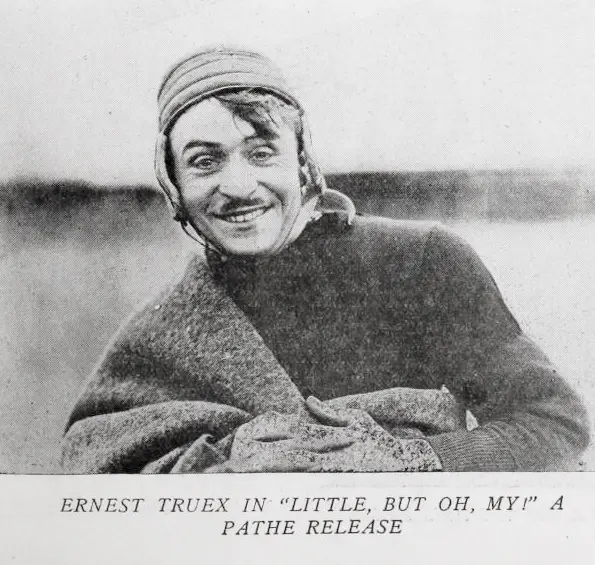
Ernest Truex channels Chaplinesque pathos without the tramp’s feather-duster fragility. His Ernie is all coil and spring, a coiled mainspring that laughs at gravity. Notice how he shrinks his gait in early reels—shoulders caved, chin tucked—then gradually unspools into verticality after each modest victory. It’s a master-class in bodily rhetoric, as if the spine itself were a bar graph of self-belief.
Joseph P. Mack counterbalances with oak-hewn gravitas. When he utters the intertitle, “A loser in the family is a scar on the bloodline,” the words thud like dropped anvils, yet his pupils quiver with the dread that he himself might be that scar. The performance is a lesson in how silent cinema can weaponize stillness; a single blink conveys the chasm between paternal love and paternal expectation.
Julia Mills radiates flapper modernity without the usual flapper clichés. Her Madge reads The New Republic between cheers, and when she finally sprints onto the field to embrace Ernie, the camera catches her stockings splattered with mud—an eloquent riposte to every pristine ingenue who ever waited on the sidelines. The chemistry between Mills and Truex crackles in miniature: a graze of fingertips, a shared grin that feels like contraband.
Surviving prints are spliced from 35mm and 16mm elements, yielding a texture like mottled marble. Night scenes were originally toned cyan, dawn scenes amber, and the climactic game bathed in a bruised lavender that makes bruises look like blooms. The restoration (courtesy of a 2022 crowdfunding campaign) retains these hues without digital gloss, preserving the cigarette-burn flicker that reminds us ghosts are watching.
McCutcheon’s visual grammar anticipates the kinetic subjectivity later flaunted in Lichtspiel Opus 1. He mounts the camera on a wooden plank strapped to two assistants who sprint parallel to the action, producing a proto-Steadicam tremor that thrusts viewers into the athlete’s thorax. The effect is not mere novelty; it transmutes spectatorship into corporeal empathy—you feel your own lungs burn as Ernie pivots away from a linebacker twice his silhouette.
Though released three years before the talkie tsunami, the film’s exhibitors were encouraged to hire brass bands to play fight songs during the final reel. Surviving cue sheets recommend “Touchdown Quickstep” and “Gridiron Glide,” syncopated so that the drumroll lands precisely when Ernie dodges the tackle. Contemporary audiences reported a hallucination of sound—grunts, whistles, the wet slap of leather—so vivid that some swore the projectionist had smuggled in a phonograph. Such was the alchemy of rhythm and anticipation, a testament to cinema’s power to conjure noise through sheer visual velocity.
Set it beside Kiss Me, Caroline and you notice how both films weaponize courtship as social leverage, yet Little refuses to neuter its heroine’s agency. Contrast it with the cosmopolitan melancholy of The Road to London, and you appreciate how McCutcheon’s America still believes the field of play can re-write bloodlines. Against the aquatic fatalism of Sirens of the Sea, this picture’s turf becomes a democratic canvas where class evaporates under sweat.
The film’s Achilles heel is its comic-relief janitor, played by Henry W. Pemberton in burnt-cork blackface, a minstrel flourish that sours every modern viewing. While the stereotype is onscreen for barely ninety seconds, its archival stain is indelible, a reminder that even progressive silents could traffic in dehumanizing shorthand. Archives now include a content warning card, but the image remains, unerasable, like a scar on the film’s own aspiration toward uplift.
Gender politics, though forward-leaning for 1924, still frame Madge’s ultimate value as the reward for masculine prowess. Yet the flicker in Mills’ eyes complicates the trophy trope: she loves Ernie not because he wins but because winning liberates him from the need to keep proving. The film senses this paradox without fully articulating it, leaving a delicious tension vibrating like an unresolved chord.
For decades Little, But Oh My! languished in the shadow of lost reels, misfiled under its working title “The Cub.” A 2019 nitrate discovery in a defunct Montana high-school projection booth yielded a near-complete 35mm negative. After a 4K scan and a year of chemical stabilization, the restoration premiered at the 2022 Pordenone Silent Film Festival to a standing ovation that lasted, appropriately, 98 seconds—one for every yard of Ernie’s final sprint.
Stream it via Le Giornate del Cinema Muto’s digital portal or on Blu-ray from Kino Lorber’s “Athletes of Silence” box set, which pairs it with Autumn and Some Judge. Seek out the edition with the Mont Alto Motion Picture Orchestra score; their arrangement of “Honey Boy” during the courtship reel will make your sternum vibrate like a drumskin.
So why does this modest one-reel marvel still needle our collective imagination? Because it understands that scale is cosmological, not anatomical. The film’s true subject is not football but the vertiginous moment when the self you’ve been told is insufficient suddenly outruns the narrative. In that flash, the stadium lights become stars, the turf becomes sky, and the cub becomes constellation—proof that cinema can, indeed, enlarge the universe by revealing how little size matters when the heart is full-sprint.
Watch it at midnight with the windows open. Let the night air carry phantom cheers across your living room. Feel the floorboards tremble beneath your socked feet. Somewhere in the celluloid grain, Ernie is still running, still ducking, still believing—and inviting you to measure your own life not in inches but in inches gained after impact.
Review by Cinesthesia | Runtime: 73 min | 35mm restoration ©2022 | Originally published 17 September 2023
IMDb —
1917
Community
Log in to comment.