DbcultAccessing Vault...
Cult Review
Senior Film Conservator
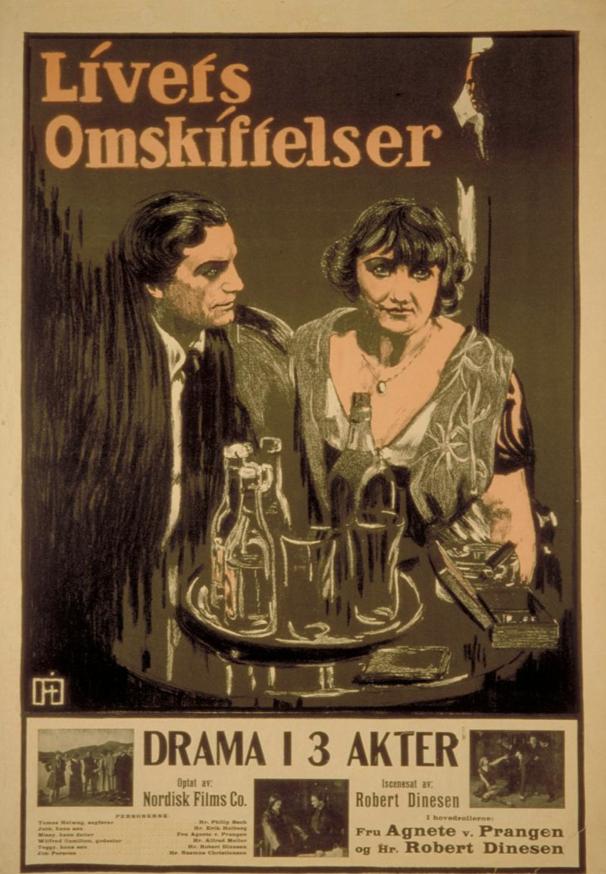
The annals of early Danish cinema are frequently dominated by the monolithic presence of Nordisk Film, yet hidden within this golden era lies Livets Omskiftelser (1914), a work of startling emotional resonance and visual clarity. Written by the formidable Agnete von Prangen, who also graces the screen as Missy Helweg, this film transcends the simplistic 'damsel in distress' trope to offer something far more atmospheric and psychologically complex. It is a story of the sea, yes, but more importantly, it is a story of the silence that exists between people before they are forced together by the hand of providence.
The opening movements of the film establish a sense of deceptive tranquility. Missy Helweg’s excursion into the waves is initially presented as a leisurely dalliance with nature, a common pastime for the turn-of-the-century bourgeoisie. However, the narrative shift occurs with a sudden, visceral loss: the oars. In the silent era, physical objects often carried heavy metaphorical weight, and here, the lost oars represent a total stripping of agency. Unlike the frantic energy found in The Man Who Took a Chance, Missy’s predicament is defined by a terrifying stillness. She is not fighting a villain; she is fighting the void.
The cinematography captures the vastness of the water with a starkness that feels modern. We see Missy not as a protagonist in control, but as a speck against an indifferent horizon. This sense of isolation is a recurring theme in early European drama, often mirroring the psychological entrapment seen in films like Gefangene Seele. Yet, where that film looks inward, Livets Omskiftelser uses the external environment to mirror the internal state of its characters.
Enter Teggy Hamilton, played with a rugged, understated dignity by Rasmus Christiansen. Living in self-imposed exile on a craggy island, Teggy is the antithesis of the society Missy hails from. His rescue of her is not a grand, heroic gesture of a swashbuckler like one might find in Captain Alvarez; instead, it is a pragmatic, human response to a shared vulnerability. The island becomes a liminal space—a world outside of time where social hierarchies dissolve.
The chemistry between Christiansen and von Prangen is the heartbeat of the film. In an era where acting often veered into the hyperbolic and the pantomimic, their performances are remarkably restrained. They communicate through shared labor and the quietude of the island. This burgeoning friendship challenges the audience's expectations of romantic melodrama. It feels more akin to the grounded character studies of Behind the Scenes, focusing on the minutiae of human connection rather than the grandiosity of fate.
Agnete von Prangen’s screenplay is a masterclass in pacing. She understands that for the stakes to feel real, we must feel the passage of time. While the family’s search for Missy provides the necessary narrative tension—a ticking clock that threatens to pull her back into her old life—the heart of the film remains on the island. The contrast between the frantic, well-meaning but ultimately hollow concerns of the Helweg family and the raw, honest survival of Missy and Teggy is striking.
In many ways, the film serves as a critique of the rigid structures of the era. Missy’s 'absence' is a tragedy to her family, but for Missy herself, it is an awakening. This thematic depth elevates the film above contemporary shorts like Flips and Flops or the more whimsical Kapten Grogg badar. Von Prangen is interested in the soul's capacity to adapt and find solace in the most unlikely of circumstances. It’s a narrative sophistication that rivals A Doll's House in its exploration of a woman finding her own path, albeit through the catalyst of a maritime accident.
The direction (often attributed to the collective expertise of the Nordisk stable, though von Prangen’s influence is palpable) utilizes the natural landscape with a painterly eye. The way the light hits the water, the texture of the island’s rocks, and the simple interiors of Teggy’s cabin all contribute to a sense of place that is rarely achieved in early cinema. There is a tactile quality to the film; you can almost smell the salt air and feel the grit of the sand.
Comparing this to the more stage-bound productions of the time, such as The Dead Alive, Livets Omskiftelser feels incredibly liberated. The camera is not a static observer but a participant in Missy’s journey. When she is adrift, the shots are wide and daunting; when she is with Teggy, the frames tighten, creating an intimacy that feels earned rather than forced. It lacks the cynicism of One Touch of Sin, opting instead for a sincere, almost spiritual look at human resilience.
The supporting cast, including Robert Dinesen and Philip Bech, provide the necessary grounding for the 'mainland' half of the story. Their performances represent the weight of expectation and the grief of the status quo. Their search is not just for a person, but for the restoration of an order that Missy has already begun to outgrow. This duality is what makes the film so enduring. It isn't just about a rescue; it's about the transformation that occurs when the safety net of society is removed.
We see echoes of this thematic struggle in Satan Sanderson or the melodramatic heights of Wounded Hearts and Wedding Rings, but Livets Omskiftelser avoids the moralizing tendencies of its peers. It allows the characters to simply *be*. There is no forced villainy, no mustache-twirling antagonist—only the 'Omskiftelser' (vicissitudes) of life itself. Even a film like False Evidence, while gripping, relies on plot contrivances that von Prangen eschews in favor of organic character growth.
In 1914, the film industry was on the cusp of a major shift. The 'feature film' was becoming the standard, and Livets Omskiftelser stands as a testament to the sophistication of Danish cinema before the First World War disrupted the European market. The technical proficiency—from the exposure of the outdoor shots to the seamless editing—suggests a level of craft that was world-leading. It possesses a narrative clarity that rivals The Recruit and a thematic gravity that makes The Firefly seem light by comparison.
The film also serves as an important document of Agnete von Prangen’s multifaceted talent. As both writer and star, she controlled the narrative arc of Missy Helweg, ensuring that the character remained the focal point of her own story. In an industry that often marginalized female voices, von Prangen’s work here is a bold assertion of creative identity. The 'Golden Shower' of talent at Nordisk during this time (not to be confused with the film The Golden Shower) was truly unparalleled, and this film is one of its brightest sparks.
Livets Omskiftelser is more than a historical curiosity; it is a vital, breathing piece of cinema that speaks to the universal human experience of isolation and the redemptive power of connection. It asks us to consider what we lose when we are safe and what we find when we are in peril. The film’s conclusion, while satisfying the narrative requirements of its time, leaves the viewer with a lingering sense of the ephemeral nature of such connections.
For those seeking a deep dive into the roots of cinematic storytelling, this film is essential viewing. It eschews the frantic pacing of modern blockbusters for a meditative, deeply felt exploration of the human spirit. It is a reminder that even in the silent era, the most powerful stories were those that whispered to the heart rather than shouting at the eyes. Agnete von Prangen and her collaborators crafted a work that remains as haunting and beautiful today as it was over a century ago—a true masterpiece of the shifting tides of life.

IMDb —
1919
Community
Log in to comment.