DbcultAccessing Vault...
6.6/10
Senior Film Conservator
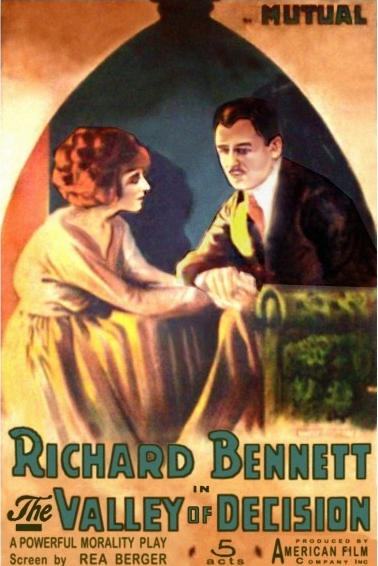
A definitive 6.6/10 rating for a film that redefined the boundaries of cult cinema. The Valley of Decision remains a cornerstone of transgressive art.
In the nascent years of American cinema, specifically around 1916, the medium was grappling with its own potential as a vessel for moral instruction and social critique. The Valley of Decision, directed and written with a heavy hand by Richard Bennett (in collaboration with Clifford Howard), stands as a monumental, if somewhat forgotten, artifact of this era. It is a film that dares to tread into the murky waters of political ambition, the ethics of social reform, and the deeply personal trauma of domestic expectation. Unlike the more straightforward narratives of the time, such as The Upstart, Bennett’s work here is layered with a theatricality that borders on the operatic, utilizing a prologue of personified vices that sets a tone of high-stakes morality from the first frame.
The film’s opening is a masterclass in silent-era symbolism. By presenting Ambition and Greed as living entities, Bennett warns the audience that the drama to follow is not merely a tale of one man, but a universal struggle of the human soul. Arnold Gray, played with a simmering intensity by Richard Bennett himself, is introduced as a paragon of the Progressive Era. His fight against child labor mirrors the real-world anxieties that birthed films like The Miner's Daughter and Out of the Darkness. Yet, Gray is a flawed protagonist, susceptible to the siren call of power personified by Rhoda Lewis.
Rhoda, portrayed with a chillingly effective poise, represents the antithesis of the domestic ideal. She is the "clubwoman" whose own ambitions find a proxy in Arnold. Her influence is insidious, shifting Arnold’s focus from the altruistic goal of the child-labor bill to the self-serving goal of the governorship. This tension between public service and private ego is the central axis of the film. It reminds one of the thematic weight found in Other People's Money, where financial gain often eclipses human value.
The introduction of Jane Morton, a "respected writer," is a fascinating choice for 1916. In a period where female characters were often relegated to the role of the damsel or the domestic drudge—think of the archetypes in Tess of the Storm Country—Jane is an intellectual peer. Her marriage to Arnold is initially presented as a union of minds. However, the screenplay quickly pivots to the biological reality of pregnancy, which acts as the ultimate disruptor. The film’s handling of this topic is surprisingly modern and deeply uncomfortable. The suggestion that a child would be an "encumbrance" to a political career is a blunt admission of the sacrifices demanded by public life.
The psychological warfare waged against Jane by both Arnold and Rhoda is depicted with a stygian gloom. Jane’s descent into acute depression is not merely a plot point; it is a visceral exploration of the loss of agency. When she visits Dr. Brainard, the film adopts a tone of confession and existential dread that predates the psychological thrillers of the later 20th century. The lighting in these scenes shifts toward a more expressionistic style, reminiscent of the shadows found in Tsar Ivan Vasilevich Groznyy, though applied here to a domestic interior rather than a royal court.
One cannot discuss The Valley of Decision without acknowledging the extraordinary presence of the Bennett family. With Richard, Adrienne Morrison, and their daughters Joan, Barbara, and Constance all appearing, the film serves as a historical document of a theatrical dynasty in transition. The chemistry on screen is palpable, yet there is a strange, meta-textual layer to seeing a real family act out the dissolution of a fictional one. Richard Bennett’s performance is particularly noteworthy; he avoids the histrionics common in silent cinema, opting instead for a performance defined by internal conflict and eventually, a crushing remorse.
The contrast between the Bennett family’s cohesion and the film’s narrative of a fractured home is striking. While other films of the era, like The Girl from His Town or Fine Feathers, often dealt with the superficiality of high society, The Valley of Decision digs deeper into the pathological nature of ambition. It suggests that the desire for legacy (the governorship) can ironically lead to the destruction of one's actual legacy (the child).
The climax of the film is its most controversial and discussed element. After Jane’s death, Arnold’s victory as governor is hollow—a Pyrrhic triumph that leaves him wishing for death. The sequence where he dreams of his unborn son is hauntingly beautiful, utilizing double exposures and soft-focus lenses to create an ethereal atmosphere. This spectral child serves as a silent judge, a manifestation of the future Arnold traded for a title. When Arnold awakens to find Jane alive, the film shifts from a tragedy to a cautionary tale.
This "it was all a dream" trope is often criticized in modern screenwriting, but here it serves a vital didactic purpose. It allows the audience to witness the full consequence of Arnold’s choices without permanently destroying the protagonist. It functions as an anagnorisis—a moment of critical discovery—not just for Arnold, but for the viewer. It is a narrative device that echoes the moral weight of The Price of Vanity, where the protagonist is given a glimpse into a ruinous future to correct their present course.
Technically, the film is a marvel of its time. The use of location shooting for the political rallies provides a sense of verisimilitude that contrasts sharply with the stylized, almost theatrical sets of the prologue. The cinematography captures the duality of Arnold’s life: the bright, harsh lights of the public arena and the shadowed, claustrophobic corners of his private home. This visual dichotomy is essential to understanding his psychological state. In many ways, the film’s aesthetic is more sophisticated than contemporaries like The Patchwork Girl of Oz, which, while imaginative, lacks the emotional gravitas and chiaroscuro depth presented here.
The editing, too, deserves praise. The cross-cutting between Arnold’s political success and Jane’s physical and mental decline creates a rhythmic tension that is almost unbearable. It forces the audience to equate his gain with her loss. This technique was pioneered in early social dramas but is executed here with a precision that rivals the works of Griffith or even the later European masters seen in Sangue blu.
To watch The Valley of Decision today is to engage with a period of cinema that was unafraid to be overtly philosophical. While its moralizing may seem quaint to the cynical modern eye, its core message remains uncomfortably relevant. We still live in a world where the pursuit of professional accolades often comes at the expense of human connection and ethical integrity. The film does not offer easy answers; even the happy ending is tinged with the memory of the trauma we just witnessed.
Arnold Gray’s journey through the valley of his own ego is a harrowing one. The film reminds us that every decision has a shadow, and every ambition has a cost. It stands alongside other complex silent dramas like Salomy Jane and The Dishonored Medal in its attempt to elevate the medium beyond mere entertainment. For those interested in the evolution of cinematic storytelling, or for those who simply appreciate a well-crafted moral play, this film is an essential viewing experience. It is a haunting, beautiful, and ultimately hopeful exploration of the human condition that deserves a place in the pantheon of early 20th-century art.
In the end, The Valley of Decision is a testament to the power of the dream—not just as a narrative gimmick, but as a space for moral reckoning. It suggests that perhaps we all need a nightmare now and then to remind us of what truly matters before we reach the point of no return. It is a film that, much like A Suspicious Wife, dissects the nuances of trust and betrayal, but on a grander, more allegorical stage.
IMDb 6.5
1923
Community
Log in to comment.