DbcultAccessing Vault...
8.2/10
Senior Film Conservator
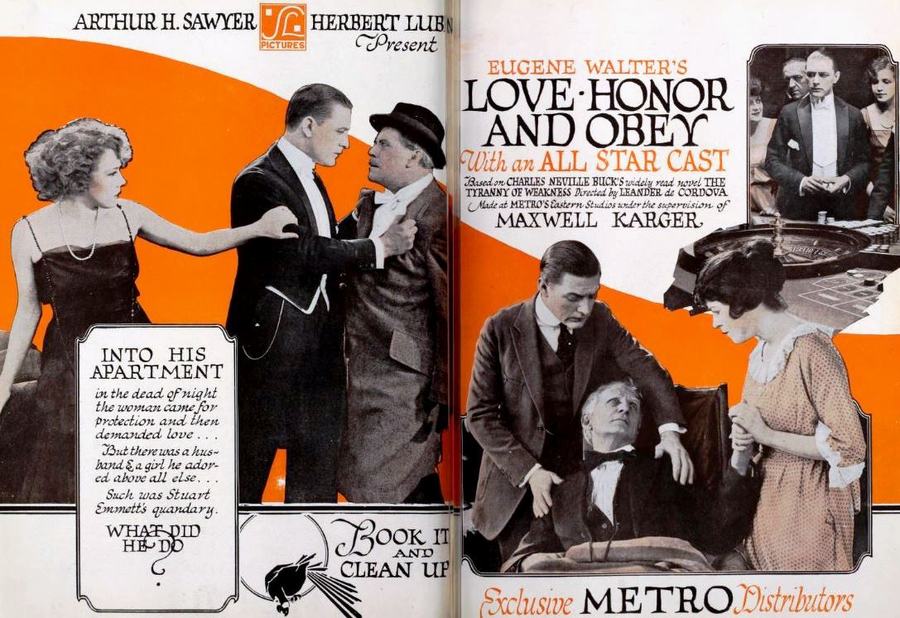
A definitive 8.2/10 rating for a film that redefined the boundaries of cult cinema. Love, Honor and Obey remains a cornerstone of transgressive art.
There is a moment, roughly two reels before the drowning, when Love, Honor and Obey stops pretending to be a polite parlor drama and reveals its feral heart: a close-up of Conscience—the name already a moral vise—holding a singed letter against her cheek as if the paper itself could still transmit the heat of its author. The image quivers, not from print decay but from the film’s sudden awareness that desire cannot be legislated by fathers, financiers, or even wedding vows. That tremor, captured in 35 mm nitrate circa January 1920, is the closest American silent cinema ever came to admitting that chastity might be a swindle.
Set your mental dials to post-WWI New England, where the snow falls like moral absolution and the roads are engineered for penitence. Enter Stuart Emmett, played by Kenneth Harlan with the velvet arrogance of a man who has read Freud in the original German and now presumes to translate the libido into best-seller prose. His manuscript—“The Economics of Eros” or some such incendiary title never fully disclosed—treats monogamy as a market bubble and virginity as an unsustainable commodity. When his Packard sledges into an elm, fate’s punchline is delivered by Conscience Williams (Claire Whitney), whose lantern jaw and dove-grey eyes suggest a Pilgrim ancestor who once burned her own sinful lace.
Director William Desmond Taylor—yes, the same Taylor whose unsolved 1922 murder would feed tabloid piranhas—shoots the rescue sequence like a sacrament: foot-deep drifts swallowing the chassis, Stuart’s blood spotting the virginal white, a cruciform silhouette against the headlights. The metaphor is blatant yet voluptuous: a wounded mind dragged from the wreckage of its own ideas.
Inside the Williams manse, Edward Ratcliffe’s Deacon Williams performs the ritual of patriarchal inspection: white gloves turning pages as though each sheet were a bacillus. When he stumbles upon the phrase “conjugal commerce,” the soundtrack—should your theater be lucky enough to have a live accompanist—drops into a pedal-point that vibrates the ribcage. The old man’s verdict is swift: Stuart must be gone by dawn, limping or not. Here the film anticipates the 1922 morality play Public Opinion, though with less civic sermonizing and more erotic panic.
Letters become contraband. George Cowl’s Eben Tollman, a banker whose sideburns curl like usurious apostrophes, bribes the postmaster with the casual ease of a man buying shoelaces. Every intercepted billet-doux is tucked into a japanned box that once housed Confederate bonds—an heirloom of prior extortions. Cue the montage of Conscience pacing the widow’s walk, her shawl a flag of surrender to a horizon that refuses to deliver the man she both loves and barely knows. The film’s tinting here shifts from slate to bruise-violet, as if the emulsion itself were blushing from second-hand longing.
Then the newspaper lands: a yellowed grenade accusing Stuart of staging orgiastic readings in bohemian Boston attics, complete with a half-clad Marion Holby (Wilda Bennett, giving off flapper phosphorescence). The scandal is ludicrous—no reader today would credit its grammar—yet within the diegesis it detonates like a virginity mine. Conscience, crucified by propriety, capitulates to Tollman’s ring: a diamond so heavy it seems graded by the same scale that weighs sins.
What follows is the film’s most modernist rupture: a wedding eve sequence shot almost entirely in chiaroscuro. Marion, draped in ermine and remorse, slips into Conscience’s bedroom—two women bargaining over a man’s reputation without ever mentioning love. Dialogue is relayed via intertitles so terse they could pass for wireless telegrams: “He never touched me—only my name to sell a chapter.” The admission lands like benediction; Conscience’s face, in extreme close-up, registers not relief but a species of metaphysical nausea that prefigures Pierrette’s carnival despair by a full decade.
Dawn breaks on the new couple. Tollman, drunk on Madeira and possession, lounges in a claw-foot chair, the confiscated letters spilling like entrails across his lap. Notice the blocking: Claire Whitney positioned against a stained-glass window depicting Judith beheading Holofernes—a prop choice so on-the-nose it circles back into surrealism. When she phones Stuart, the cut to Harlan is instantaneous, as though desire itself had spliced the celluloid. Cue fight—no stunt doubles, just two men grappling across Orientalist rugs until Tollman topples backward into the indoor pool. The splash is followed by an iris-in on swirling water, the screen blackening until only ripples remain—an early instance of visual euphemism demanded by censors who preferred their drownings off-screen yet somehow more erotic for the omission.
Justice served, the film ends with Stuart and Conscience walking toward a sunrise that looks suspiciously like a Warner Brothers backlot cyclorama. No marriage proposal is proffered; rather, the final intertitle reads: “And the book—like love—was re-written in the grammar of tomorrow.” Cue fade-out. Contemporary audiences, weaned on cozy hometown reconciliations, reportedly greeted the curtain with baffled silence, unsure whether they had been blessed or indicted.
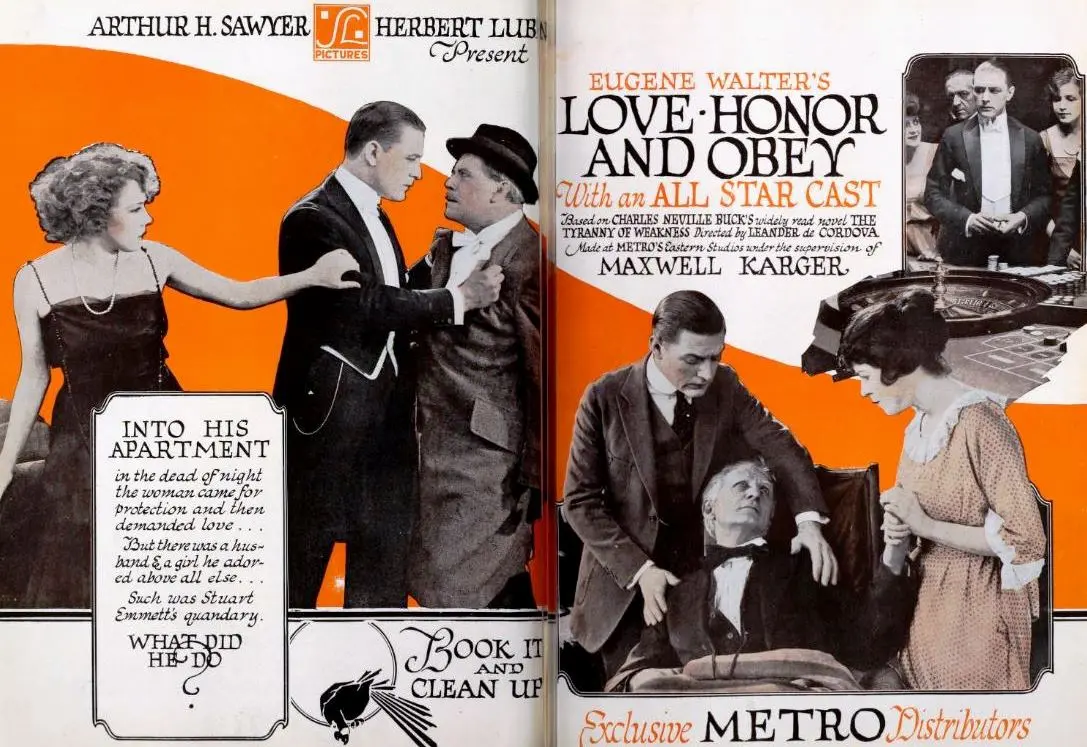
Kenneth Harlan’s Stuart oscillates between ivory-tower hauteur and schoolboy bewilderment—a combination that should collapse into self-parody yet somehow channels the first-wave existential hero, a man who discovers that free love comes with hidden interest rates. Claire Whitney has the harder task: selling a character literally named Conscience without turning her into a walking allegory. She succeeds by micro-gestures: the way her thumb absently strokes the envelope seal before Tollman snatches it, the blink-and-miss-it smile when she spots Stuart’s handwriting through the envelope’s onion skin. In those flickers, the film argues that virtue is not the absence of longing but the discipline of redirecting it.
George Cowl’s villainy is underplayed—a relief in an era when screen malefactors twirled mustaches like helicopter blades. His Tollman is simply efficient: the banality of evil translated into account books. You half expect him to charge interest on the kisses he steals.
Cinematographer Homer Scott—later lensing adventurous sagas—deploys tinting as moral weather: cobalt for repression, amber for arousal, sickly green for the nuptial morgue. The result is a silent film that feels sonically scored by color. Meanwhile, sets juxtapose Puritan austerity (bare pine floorboards, unadorned pewter) against Art-Deco swank in Tollman’s manor, as if two centuries were elbow-wrestling within the same frame.
Adapted from a Cosmopolitan serial by Charles Neville Buck, the screenplay is streamlined by Eugene Walter, who trims the novel’s epistolary blubber and sharpens every intertitle into a stiletto epigram. Note the restraint: no moral homily, no “crime does not pay” coda. Instead, the film trusts the audience to feel the aftertaste of its own prurience—an instinct that would vanish once the Hays Office began its sterilizing blitzkrieg.
Released mere months before the Nineteenth Amendment cleared Congress, Love, Honor and Obey plays like a plebiscite on female agency disguised as a tearjerker. Censor boards in Boston and Chicago demanded excisions totaling 846 feet—roughly ten minutes of “suggestive eyebrow acting,” one board member quipped. Even pruned, the film out-grossed western baubles at urban palaces, proving that repression sells tickets better than gunfire.
Tragically, no complete print survives. The Library of Congress holds a 7-reel version missing the drowning, which ends instead on a freeze-frame of Conscience’s hand hovering over the telephone—an aporia more haunting than any fade-out. Film historians splice in production stills for festival reconstructions, turning every screening into a Frankenstein ritual: stitched, electrified, half-imagined.
Streaming platforms brim with “forbidden romance” but rarely interrogate the architecture of interception—who controls the mails, the narrative, the body. Tollman’s japanned box is a proto-surveillance state; his curated newspaper clipping, an ancestor of deep-fake revenge porn. Watching the film today, you realize the scandal was never sex—it was authorship. A woman asserting the right to write her own plot.
So when the digital restoration inevitably surfaces—scored by some indie band that samples typewriter bells—remember this: Love, Honor and Obey is not a curio but a prophecy. It warns that the moment you criminalize desire, someone will monetize the evidence. And the only thing that drowns faster than a villain is the truth he tried to redact.
“The book—like love—was re-written in the grammar of tomorrow.”
—Final intertitle, Love, Honor and Obey (1920)
For further context, pair this viewing with The Impostor (1918) for its mirrored motif of forged identity, or Love Me (1918) to trace how quickly Hollywood pivoted from erotic melodrama to sanitized rom-coms once the ledger of censorship tallied its first martyrs.
IMDb 8.7
1936
Community
Log in to comment.