DbcultAccessing Vault...
Cult Review
Senior Film Conservator
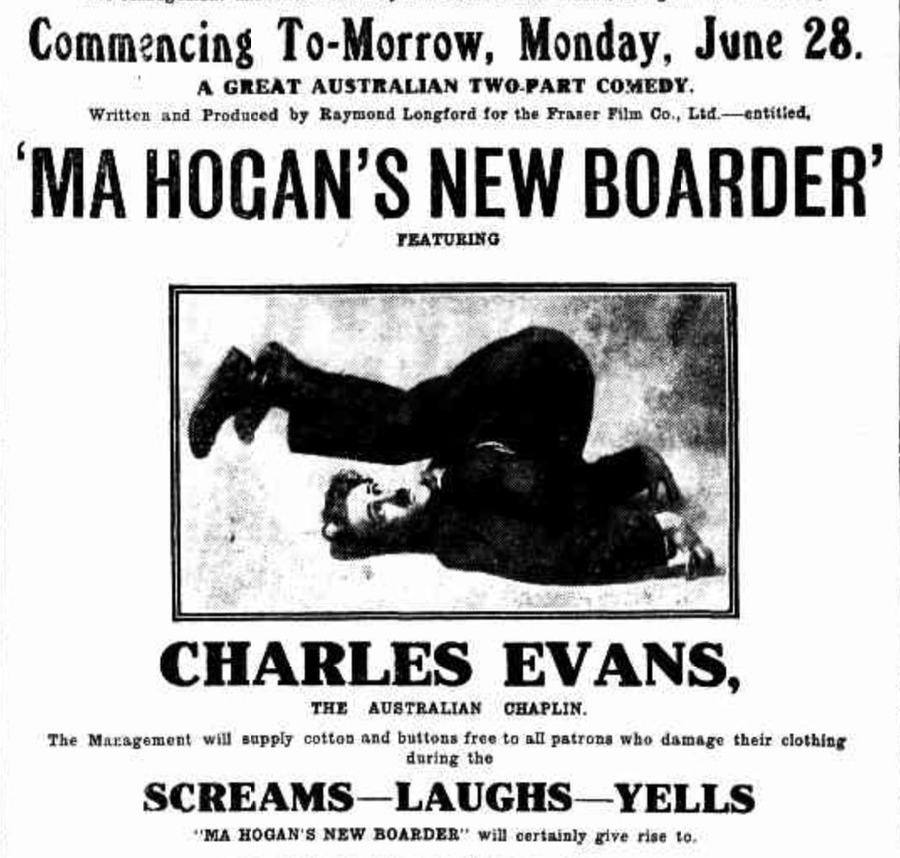
Stepping back into the nascent decades of cinematic artistry, one encounters a fascinating period of experimentation, rapid innovation, and an almost insatiable hunger for novel entertainment. Amidst this fertile ground, the phenomenon of the celebrity impersonator took root, capitalizing on the burgeoning fame of pioneering figures. One such fascinating artifact from 1915 is Raymond Longford’s ‘Ma Hoggan’s New Boarder,’ a film whose primary allure rests squarely on the shoulders of Charles Evans, a performer celebrated for his uncanny—and undoubtedly commercially shrewd—impersonation of the then-ascendant Charlie Chaplin. This isn't merely a historical curiosity; it's a window into the cultural zeitgeist, a testament to the immediate and widespread impact of Chaplin's 'Little Tramp' persona.
The film itself, a relatively brief affair typical of its era, offers a delightful glimpse into the mechanics of early silent comedy. The plot, as described, is intentionally minimalist: the lead character, portrayed by Evans, arrives at Ma Hoggan’s establishment and proceeds to 'display his antics and mannerisms.' This concise synopsis belies the intricate physical choreography and expressive pantomime that must have been central to Evans' performance. In an age where narrative often took a backseat to spectacle and character-driven vignettes, the very premise suggests a structure designed to showcase Evans’ particular talents, allowing him ample room to embody the clumsy grace and mischievous charm that defined the iconic tramp.
The decision to cast a Chaplin impersonator was a stroke of marketing genius for the time. Chaplin, having only burst onto the scene with Keystone in 1914, had already become a global sensation. His particular brand of pathos-infused slapstick resonated deeply with audiences, creating a demand that studios, eager to cash in, were quick to exploit. Charles Evans was one of several actors who rose to prominence by adopting the familiar bowler hat, cane, oversized shoes, and distinctive waddle. What distinguishes Evans, and what ‘Ma Hoggan’s New Boarder’ ostensibly sought to capture, was not just a mimicry of appearance, but an absorption of the very spirit of the Little Tramp.
One can only imagine the sheer delight of a 1915 audience witnessing Evans’ interpretation. The 'antics' he displays would likely have involved a series of escalating comedic mishaps: perhaps a struggle with a recalcitrant piece of furniture, an accidental entanglement with a fellow boarder's possessions, or a comically botched attempt at a simple task like setting a table or carrying a tray. The beauty of such physical comedy lies in its universality, transcending language barriers and appealing directly to fundamental human experiences of clumsiness, aspiration, and the occasional, inevitable failure. Films like Rule G, while perhaps not directly comedic, often featured characters navigating strict social codes or challenging circumstances, where physical reactions and non-verbal communication were paramount to conveying emotion and narrative progress, much like the exaggerated expressions required of a Chaplin impersonator.
Raymond Longford, a significant figure in early Australian cinema, directed ‘Ma Hoggan’s New Boarder.’ His involvement lends the film an additional layer of historical interest. Longford was known for his versatility, directing everything from melodramas to comedies. In this context, his direction would have focused on framing Evans effectively, ensuring that the comedic timing of his physical gags translated well to the screen. The pacing of silent comedy was crucial; scenes needed to be edited to allow gags to land, yet maintain a brisk enough tempo to prevent boredom. Longford's expertise would have been invaluable in orchestrating the chaos and ensuring that Evans' performance remained the focal point.
A. Wright, credited as a writer, would have been responsible for structuring the sequence of 'antics' and providing the narrative framework, however slight, that allowed Evans to shine. In early silent film, scripts were often more akin to detailed outlines or scenarios rather than full-fledged screenplays. Wright's contribution would have involved conceptualizing the specific comedic situations and character interactions that would best highlight Evans' impersonation. Perhaps there was a running gag involving mistaken identity or a recurring prop that became a source of endless amusement. The simplicity of the premise, a new boarder causing mild mayhem, is a classic comedic setup, providing fertile ground for a performer like Evans.
The enduring appeal of slapstick, so vividly demonstrated by films like ‘Ma Hoggan’s New Boarder,’ lies in its ability to tap into a primal sense of humor. It’s the comedy of the unexpected, the exaggerated, and the slightly absurd. Watching a character stumble, fall, or inadvertently create a mess provides a cathartic release, a shared moment of laughter that transcends societal norms. This film, with its focus on Evans’ ‘antics,’ is a pure distillation of this comedic form. It doesn't aim for deep psychological insights or complex narrative arcs; its sole purpose is to entertain through physical comedy. This is a stark contrast to more dramatic fare of the era, such as La signora delle camelie or The Marble Heart, which delved into the tragic complexities of human relationships and societal constraints.
The boarding house setting itself is a rich comedic backdrop. It’s a microcosm of society, a place where disparate personalities are forced into close proximity, leading to inevitable clashes and humorous situations. Ma Hoggan, presumably the long-suffering proprietor, would have served as the perfect foil for Evans’ character, her exasperation providing a grounded counterpoint to his boundless energy. Pearl Bambury, the other credited cast member, would likely have played a secondary role, perhaps another boarder or a maid, whose interactions with Evans’ character would have further fueled the comedic fire. Her reactions, whether of amusement, annoyance, or bewilderment, would have been crucial in amplifying the humor of Evans’ performance.
Regrettably, like many films of this vintage, ‘Ma Hoggan’s New Boarder’ is a work that exists primarily in historical records and critical discussion rather than readily available prints. The fragility of early nitrate film, coupled with the often-casual attitude towards preservation in the early days of the industry, means that countless cinematic treasures have been lost to time. Yet, the very mention of its existence, and the details surrounding its production and star, offer invaluable insights into the burgeoning film industry of the 1910s.
The film’s significance, therefore, extends beyond its potential entertainment value. It serves as a historical marker, illustrating the rapid evolution of film as a popular art form and a commercial enterprise. It highlights the power of star personas, even those built on impersonation, to draw audiences. It underscores the foundational role of physical comedy in establishing cinematic grammar and engaging a diverse global audience. Consider the dramatic intensity of films like Der Eid des Stephan Huller - II or the romantic sweep of Pesn torzhestvuyushchey lyubvi; these films, while vastly different in tone, share with 'Ma Hoggan's New Boarder' the common thread of pushing the boundaries of what cinematic storytelling could achieve, each in its own genre.
1915 was a pivotal year for cinema. D.W. Griffith’s ‘The Birth of a Nation’ redefined epic storytelling, while countless shorter films, like ‘Ma Hoggan’s New Boarder,’ continued to fill the nickelodeons and early picture palaces. The industry was still finding its footing, experimenting with narrative length, directorial techniques, and the very concept of film stardom. Evans’ role here is a testament to the immediate and overwhelming impact of Chaplin, whose character became so universally recognizable that even an impersonator could headline a feature. This era also saw a multitude of films exploring various facets of human experience, from the moral dilemmas in The Cup of Life to the social commentaries in The Cotton King, indicating a blossoming diversity in cinematic themes.
The specific 'antics and mannerisms' Evans displayed would have been carefully crafted to evoke Chaplin without being a mere photocopy. A good impersonator doesn't just replicate; they interpret and infuse their own personality into the borrowed persona. Evans would have needed impeccable timing, a facility for expressive facial contortions, and a mastery of physical comedy to truly captivate an audience already well-versed in the original Tramp's routines. The film, therefore, acts as an intriguing case study in the early days of intellectual property (or lack thereof) and the dynamic interplay between original creation and popular emulation.
The choice of a boarding house as the primary setting is particularly apt for a silent comedy focused on character interaction. These establishments were common fixtures in early 20th-century urban life, serving as temporary homes for a diverse array of individuals. This inherent variety of personalities and occupations provided a natural comedic crucible, a confined space where the eccentricities of one character could bounce off the reactions of many others. Imagine the scene: Evans’ character, perhaps attempting to impress a pretty boarder (Bambury), accidentally spills tea on Ma Hoggan’s prize rug, or, in a misguided attempt to help, tangles himself in a clothesline in the communal yard. The possibilities for visual gags are endless, each one contributing to the overall chaotic charm of the film.
The film’s title itself, ‘Ma Hoggan’s New Boarder,’ instantly establishes the central conflict and character dynamic. Ma Hoggan is the anchor, the voice of reason (or exasperation), against whom the new boarder’s antics are measured. Her reactions, whether a raised eyebrow, a sigh, or a full-blown chase scene, would have been integral to the comedic rhythm. This dynamic, where a disruptive force enters an otherwise orderly environment, is a timeless comedic trope, seen in countless films and theatrical productions across history. Even contemporary dramas like From Dusk to Dawn or mysteries like The House of Tears, while vastly different in genre, rely on the introduction of an external element to disrupt established norms and drive the narrative.
While the physical film may be lost, its historical echo resonates. ‘Ma Hoggan’s New Boarder’ stands as a testament to the dynamic, often chaotic, and endlessly inventive early years of cinema. It reminds us that entertainment has always been driven by compelling personalities and that audiences have always appreciated a good laugh, especially when delivered with the unique blend of vulnerability and resilience characteristic of the Chaplin-esque persona. The film, in its very essence, embodies the spirit of an industry in its infancy, eager to explore every avenue of storytelling and performance.
The simplicity of its premise, coupled with the star power (albeit borrowed) of Charles Evans, suggests a film that was likely a crowd-pleaser in its day. It offered a familiar, comforting comedic archetype in a fresh package, delivered by a performer who clearly understood the nuances of the character he was portraying. It is these seemingly minor films, often overlooked in favor of grander productions, that collectively paint the most complete picture of cinema's foundational years. They show us the everyday fare that audiences consumed, the performers they cheered for, and the comedic sensibilities that shaped an entire generation of filmgoers. Even in the absence of the film itself, the critical analysis of its context and proposed content allows us to reconstruct a vibrant piece of cinematic history, a small but significant chapter in the grand narrative of film's evolution.
The film, therefore, is not merely a forgotten title but a crucial piece of the puzzle, illuminating the commercial strategies and artistic currents of a bygone era. It highlights the ingenuity of filmmakers like Longford and writers like Wright, who, with limited resources, crafted entertainment that resonated deeply with the masses. It underscores the profound and immediate cultural impact of figures like Chaplin, whose influence spawned not just imitators but an entire sub-genre of physical comedy that continues to echo in various forms today. The story of Ma Hoggan's beleaguered boarding house and its rambunctious new tenant, even if only glimpsed through the lens of historical accounts, remains a compelling narrative about the very essence of early cinematic humor.
IMDb 6.7
1931
Community
Log in to comment.