DbcultAccessing Vault...
6.9/10
Senior Film Conservator
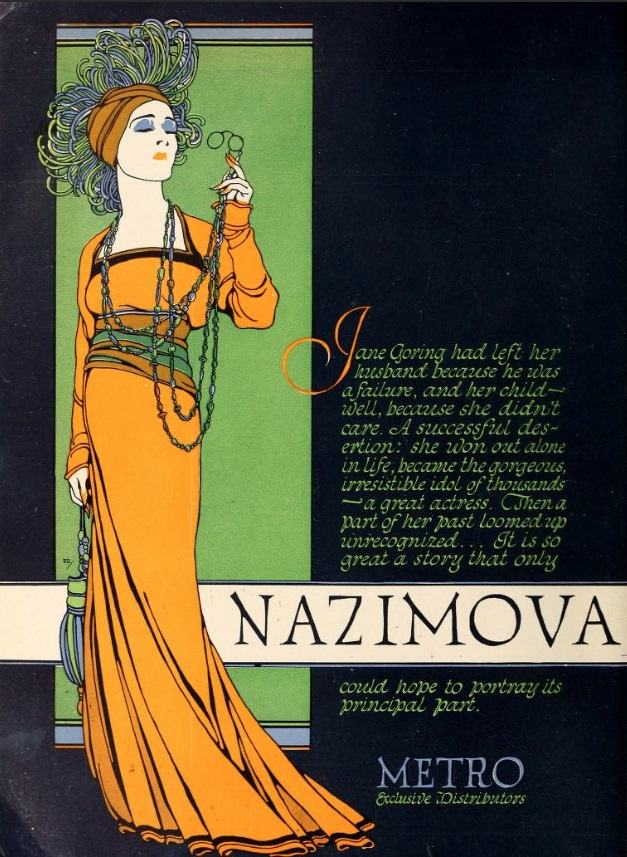
A definitive 6.9/10 rating for a film that redefined the boundaries of cult cinema. Madame Peacock remains a cornerstone of transgressive art.
Alla Nazimova storms into 1920 like a sulphuric storm cloud in Madame Peacock, a backstage carnivore’s ball that feels at once ancient and unborn. She co-writes, produces, stars, and practically exhales the celluloid into existence, gifting us a heroine who would rather pickle her heart in brine than watch it soften for mere mortals. The result is a silent fever dream that chews up the maternal melodrama template and spits out sequined shrapnel.
Imagine Anna Karenina remixed by She’s H. Rider Haggard, then lacquered in Beloved Cheater cynicism—Jane Goring’s saga is that unholy hybrid. We first spy her swaddled in sable, descending from a chauffeured Pierce-Arrow as if stepping from a Caravaggio canvas: light devours her cheekbones, leaving the chauffeur in Rembrandt darkness. Minutes later she is tearing off her wedding ring with the same nonchalance one might discard a ticket stub. The script, co-sculpted by Nazimova and novelist Rita Weiman, refuses to garnish this abandonment with moral spoon-feeding; instead it lets the act hang in the air like guillotine blade, daring us to blink.
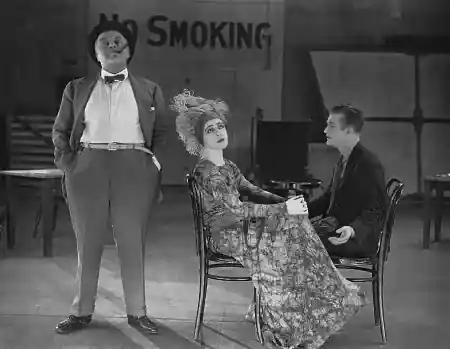
Jump-cut to a sanitarium corridor in Colorado where tuberculosis wheezes through the rafters. Robert McNaughton—once Jane’s leading man in life, now a bit-player in death’s wings—coughs up petals of blood that splash against his daughter’s picture book. That child, Gloria, will sprout into a flaxen rival whose very existence is a theatrical upstaging. Nazimova’s structural gambit here is delicious: act two of the film folds time like origami, letting mother and daughter orbit the same stage without recognizing shared helixes of DNA until the spotlight fuses them.
Cinematographer George Probert treats shadows like velvet nap, stretching them across opulent parlors until they swallow doorknobs whole. Jane’s boudoir is a mausoleum of peacock feathers—each iridescent eye a mute witness to her crimes—while Gloria’s dressing room glows in sea-blue chastity, an undersea grotto of hope. When Jane finally recognizes her offspring, the palette tilts: sudden amber flares scorch the frame, as though someone has ignited nitrate inside a reliquary.
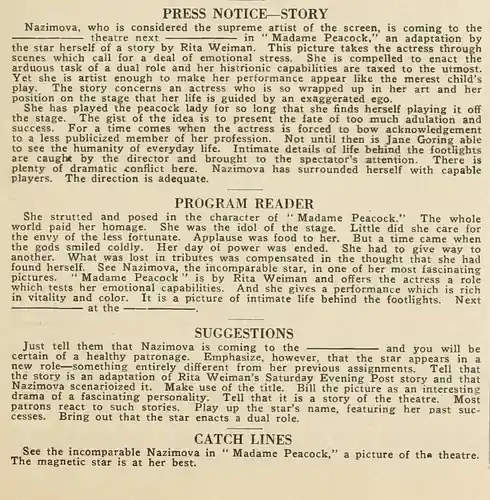
“A diva’s remorse is still a performance,” Nazimova seems to whisper, her kohl-smudged gaze daring us to applaud the tears.
Forget the semaphore eyebrow acting of many silents; Nazimova works in micro-quakes. Watch her pupils dilate when Gloria receives the ovation Jane coveted—that millisecond tremor contains whole mythologies of hubris and hurt. Later, alone with her mirror, she peels off false lashes one by one, each strip a shed snakeskin, until what remains is not penitence but terror of obsolescence. She achieves what few actors dare: making narcissism both magnetic and radioactive.
Rex Cherryman’s Robert is a study in consumptive gallantry—every inhalation sounds like crushed glass. As the sanitarium doctor, Albert R. Cody exudes Presbyterian steel, the moral counterweight Jane refuses to heed. Meanwhile William Orlamond’s theatre manager supplies sardonic greasepaint, forever calculating receipts in the margins of human tragedy.
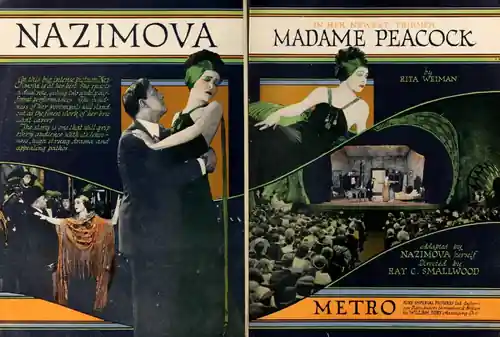
In 1920, women writing their own star vehicles was rarer than Technicolor; Nazimova does it twice over, penning a narrative that indicts the very ego required to survive a male-run studio system. Note how Jane’s downfall is engineered not by patriarchal punishment but by karmic mirroring—her daughter becomes the author of her humiliation. The film thus smuggles a proto-feminist dialectic: ambition is not sinful in women; denial of empathy is.
Place Madame Peacock beside Child of M’sieu and you’ll see both trade in maternal abandonment, yet where the latter pleads for sentimental absolution, Nazimova courts an existential hangover. Conversely, pair it with South’s tropical fever dream and you’ll detect shared motifs of self-annihilating passion, though Peacock’s chill art-deco cruelty feels closer to Poe than to plantation-gothic.
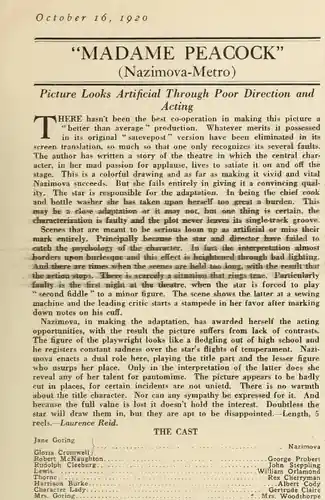
Archival scores often sand away nuance, yet the recent restoration features a new accompaniment—strings, brushed percussion, distant accordion—that breathes like the very sanitarium wind. During Jane’s climactic breakdown, the orchestra drops to heartbeat timpani while a single violin holds a note so long it seems to snap time itself.
Editor John Steppling employs iris-ins like peacock tail feathers opening—a visual pun on the title—then fractures continuity with flash-frame flashbacks that last barely four seconds yet exhume entire childhoods. The effect anticipates the stroboscopic memory bursts in mid-century Bergman.
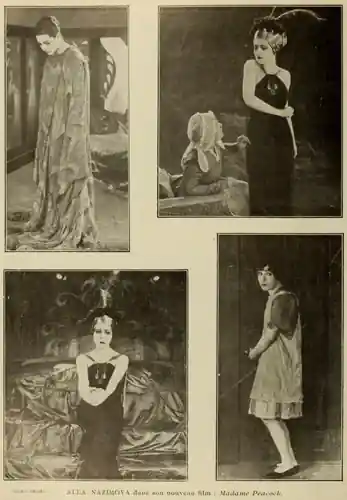
Without Madame Peacock there is no Trick of Fate’s ruthless showgirl, no Gray Ghost’s predatory diva, and certainly no Anya Kraeva’s ballerina spinning into madness. Even the sound-era sirens—Sunset Boulevard’s Norma Desmond, All About Eve’s Margo Channing—wear Jane’s peacock feathers tucked into their psychological plumage.
Let us not hallucinate a flawless relic. The Colorado sanitarium sequences rely on studio snow so cottony it resembles bathroom tissue, and one title card resorts to dime-store Freud (“The heart pays debts the mind forgets”). Yet these wrinkles feel like beauty-marks on a marble statue—proof of human chisel-work.
Without the cultural context of 1920 Broadway mania, the stakes of theatrical stardom could scan as quaint. But substitute social-media follower counts for curtain calls and the parable scalds anew: a woman trades family for relevance, only to discover relevance is a hall of mirrors she cannot exit.
For decades the only surviving print languished in a Romanian monastery archive, mislabeled as Washington’s Sky Patrol. A 2022 4K photochemical restoration now streams on boutique platforms and screens in repertory houses; Blu-ray supplements include a video essay on Nazimova’s Salome-era costume parties—proof life imitated art-imitating-life ad infinitum.
Watching Madame Peacock is akin to sipping absinthe laced with ipecac: hallucinatory, nauseating, yet perversely clarifying. It asks whether art justifies atrocity and answers—not with a moralizing thud—but with the hollow echo of a curtain descending on an empty house. Nazimova, ever the sorceress, refuses to tell us if Jane’s remorse redeems her; instead she fixes us with a stare that whispers, “You clap, therefore you connive.” I left the screening both shattered and electrically alive, feathers clogging my throat, applause clawing to escape.
—Review by Celluloid Siren, NYC, 35mm nitrate survivor
IMDb 5.8
1933
Community
Log in to comment.