DbcultAccessing Vault...
5.5/10
Senior Film Conservator

A definitive 5.5/10 rating for a film that redefined the boundaries of cult cinema. Maharadjahens yndlingshustru I remains a cornerstone of transgressive art.
There is a moment, barely twenty-three minutes into Maharadjahens yndlingshustru I, when the camera forgets to blink: Elly’s fingers unfurl over the gunwale, pearls of fjord water trembling like tiny crystal balls, and the maharajah’s turban silk brushes her wrist—an accidental meteor shower. The shot lasts three heartbeats yet excavates an archaeology of colonial longing that most 1910s pictures needed reels to articulate. That micro-gesture is why cinephiles still hunt this otherwise mist-teased Danish curio.
Director Svend Gade, fresh off West-End stagings of Hamlet, imports a thespian dynamism that pirouettes between tableau vivant and proto-expressionist fragmentation. Interiors were shot in the old Nordisk pavilion where stray sunbeams filtered through muslin, turning every surface into honey-drenched alabaster; exteriors exploit the white nights of Copenhagen summer, letting twilight linger so long it feels like a held breath. Note how Kuno’s naval uniform—indigo so deep it verges on bruise—contrasts the maharajah’s saffron sash, a chromatic duel that telegraphs the men’s rivalry more efficiently than any intertitle.
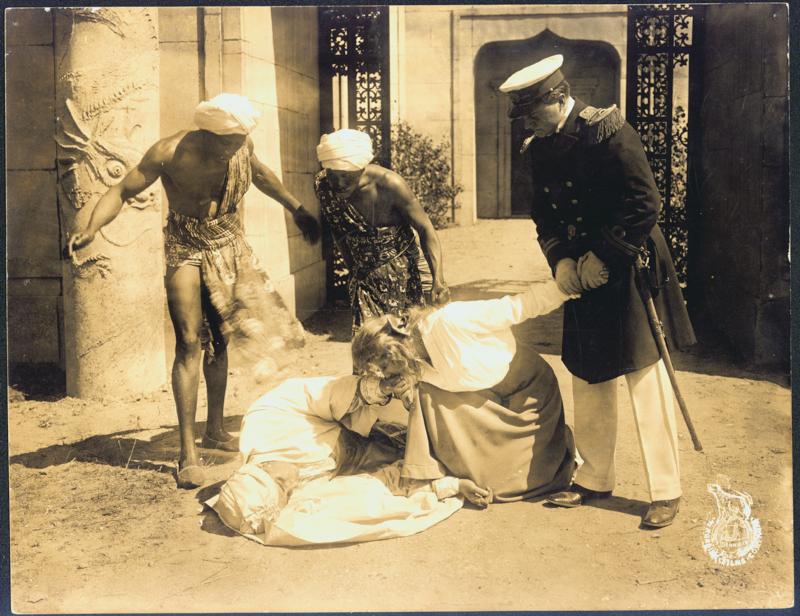
The film’s erotic circuitry is Nordic cool rather than Latin fever. Elly’s glances ricochet like skates across ice, never quite landing where we anticipate. When she steps into the rowboat, Gade frames her against a horizon line tilted five degrees off true; the world itself seems to slide toward sensual capitulation. We, like Kuno, are left on the pier of the rational, watching certainty drift seaward.
Carlo Wieth plays Kuno with the brittle rectitude of a man whose backbone has been cast in naval brass; his grief, once ignited, resembles a slow fuse on damp gunpowder—never explosive, but smoldering until the final frame. Opposite him, Jonna Anker Kreutz gifts Elly a porcelain hysteria: her smiles arrive pre-cracked, as though she already hears the palace drums that will soundtrack her exile.
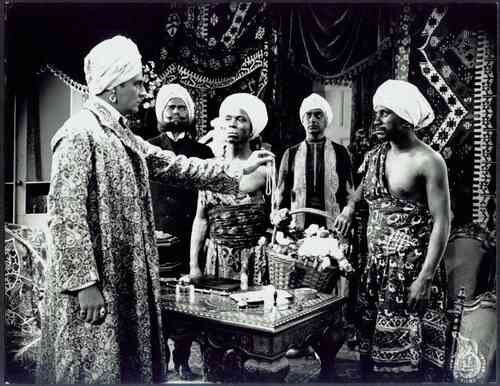
Gunnar Tolnæs’ maharajah could have slid into caricature—yet watch the way his pupils dilate when Elly accepts his proposal, the hunger so raw it borders on embarrassment. The performance whispers: I have purchased empires, yet this moment is the only transaction that terrifies me.
Modern sensibilities, rightly attuned to post-colonial critique, will flinch at the maharajah’s introduction: a gong crash, a cut to incense swirling like opium snakes, a title card labelling him Østens rigdommens vogter (“Guardian of the East’s riches”). Yet the film’s heart is less sycophantic to Empire than riddled with ambivalence. The Orient functions not as prize but as void—an elsewhere so magnetically blank it swallows Elly’s agency. Gade denies us establishing shots of palaces, harems, bazaars; we remain in Denmark, stranded with Kuno’s imagination. The strategy turns the narrative into a ghost story: the colony haunts the metropole without ever showing its face.
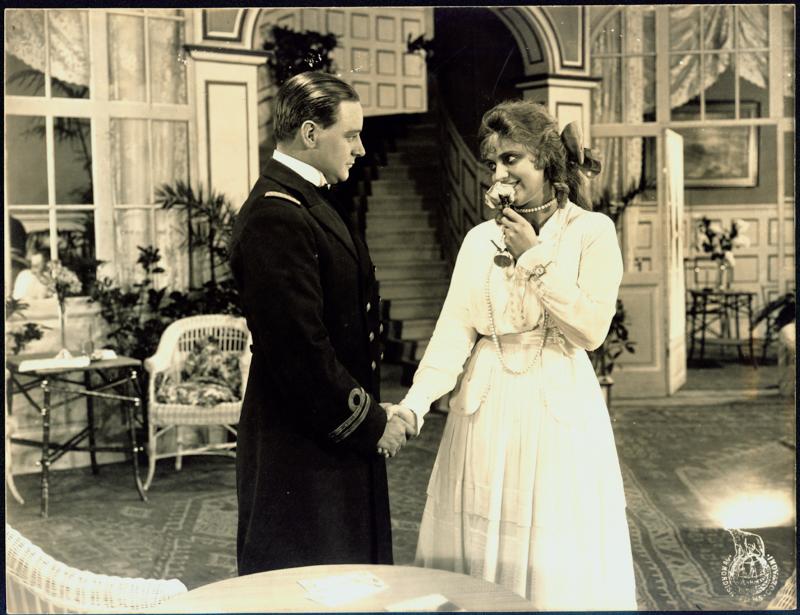
That lacquered skiff, bobbing in silvery Scandinavian dawn, becomes the film’s central organ. Cinematographer Marius Holdt lenses it from below, its hull looming like a whale’s belly—simultaneously coffin and cradle. When Kuno lifts the sodden scarf, the image rhymes with later news-footage grief: a lover clutching relic after disaster. In 1917 audiences would not yet have the vocabulary of Titanic-era trauma, yet the resonance feels eerily prescient.
Where The Primrose Ring cushions heartbreak beneath pastoral petals, Maharadjahens lets heartbreak ferment in saltwater. Its closest tonal cousin might be Even As You and I, another tale of erotic mirage, though that film opts for occult mysticism where Gade stays grounded in maritime realism. Meanwhile, Shoe Palace Pinkus lampoons social mobility through slapstick; Gade achieves the same critique by letting wealth seduce off-screen, never allowing the audience to taste it directly.
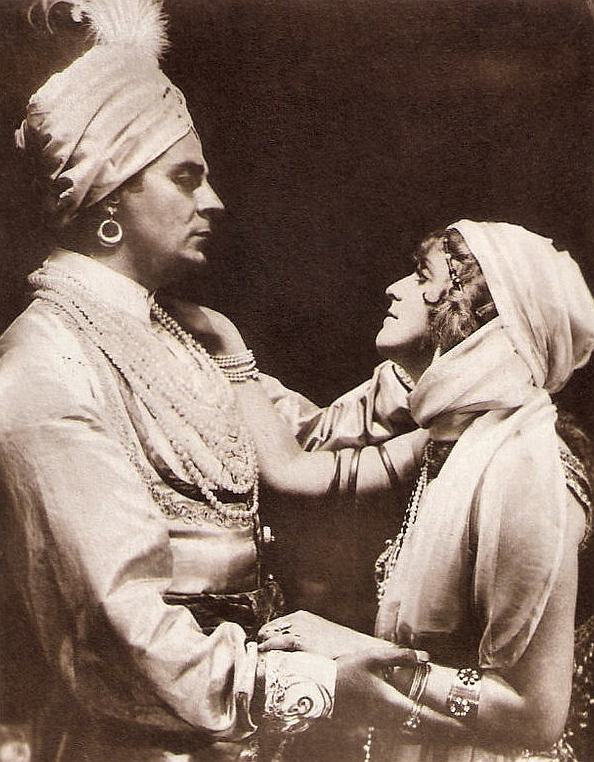
Seen beside The Day—a parable of apocalyptic reckoning—our Danish yarn locates apocalypse not in fire but in erasure: a woman deleted from her own genealogy.
Archival records note the original Copenhagen premiere featured a zither-piano hybrid, its strings brushed with eucalyptus leaves to simulate monsoon moisture. Contemporary restorations often substitute tabla-and-violin improvisations, yet I urge curators to revisit Nordic folk: the hardingfele’s droning strings would echo the fjord fog, keeping the Orient an imagined chord rather than exotica-on-demand.
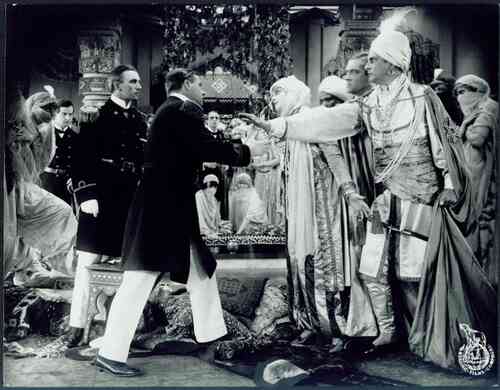
Elly’s disappearance detonates a gendered chasm: men inherit the narrative, women inherit the periphery. Yet within that silencing, Kreutz crafts micro-rebellions. Watch her pupils during the acceptance scene—two black darts that seem to say, I choose the periphery; maps bore me. In 1917 Denmark, where women would not attain suffrage for another two years, such a flicker of self-ownership feels incendiary.
Only a 35 mm nitrate positive—speckled like a leopard—survives in the Danish Film Institute vault. A 4K scan was completed in 2021, though the palette leans toward umber due to chemical fading. Do not be deterred; the decay itself rhymes with the plot’s entropy. English intertitles are digitally grafted, yet retain the original’s Fraktur rhythm, a typographic heartbeat that keeps the past palpable.
Casual viewers sometimes dismiss Nordic silent cinema as Bergman prologue. Gade’s work complicates that teleology: his visual grammar anticipates not only Stiller’s Gösta Berling but also the aquatic fatalism of von Trier’s Breaking the Waves. The rowboat anticipates Bess’s oil-rig hallucination; both films weaponize maritime vastness to interrogate female sacrifice.
What lingers is not melodrama but mist—the kind that blurs responsibility. Did Elly drown, emigrate, or simply tire of cousinly embraces? Gade refuses verdict, handing us the oar. In an era when algorithms flatten viewing into scrollable gifs, Maharadjahens yndlingshustru I reintroduces the delicious ache of ambiguity. Watch it at 2 a.m., window cracked, fjord fog—or its suburban equivalent—curling inside. You will hear oars knocking, faintly, like memory against bone.

IMDb —
1931
Community
Log in to comment.