DbcultAccessing Vault...
5.4/10
Senior Film Conservator
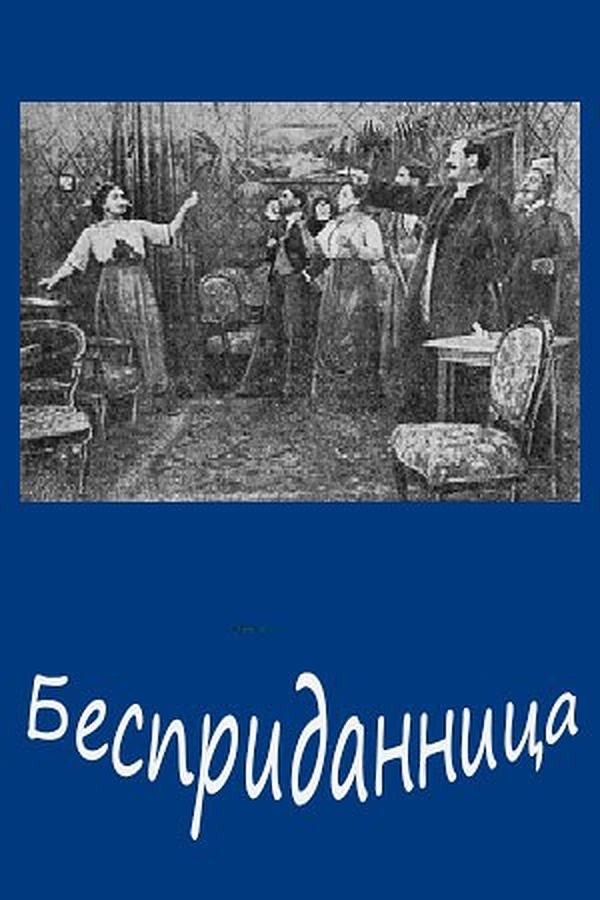
A definitive 5.4/10 rating for a film that redefined the boundaries of cult cinema. Bespridannitsa remains a cornerstone of transgressive art.
Moscow, winter 1912: a city gasping between waltz and war.
In the negative space of every ballroom chandelier, cinematographer Boris Pyasetskiy suspends tiny crystals of frost—an early freeze-frame metaphor for hearts that can’t afford to beat. Bespridannitsa (The Dowryless) is not merely a melodrama about a marriage market; it is an autopsy performed on a social contract that has already flat-lined. Vera Pashennaya—her cheekbones sharp enough to slice the celluloid—embodies Larisa, a provincial gentlewoman whose father’s death leaves her wealth inversely proportional to her pride. The film’s first miracle is that Pashennaya refuses the era’s default virginal vapours; instead she stalks the parlours with the predatory fatigue of someone who has read the small print on every contract and found it venomous.
Pyasetskiy’s camera glides past samovars and malachite columns as if allergic to stillness. Deep-space staging traps Larisa between foregrounded avarice and backgrounded opulence: aunts tallying dowries occupy the frontal plane, while gilt mirrors reflect her face fractured into half-dozen jealous splinters. The wides are never mere decoration; they are ledger books written in light. When the heroine finally tears her engagement letter, the close-up is so tight we read the grain of the paper like a topographical map of cancelled futures. Each tear syncs with a violin stab on the intertitle card, a proto-Mickey-Mouse gesture that predates Disney by two decades.
Because the original Russian score is lost, modern festivals often pair the film with Shostakovich’s chamber elegies—an anachronism that somehow intensifies the iron tang of every silence. When Larisa’s final suitor, the louche prince charming played by Nikolai Vasilyev, whispers “I would marry you if you brought even a kopek,” the subtitle hangs like a icicle; the absence of diegetic sound makes the insult feel chewed rather than spoken. Viewers taste metal, the flavour of systemic contempt.
Writers (uncredited in surviving prints, presumably white-ribboned feminists ducking censors) weaponize the marriage plot the way Bresson later weaponized hands: every proposal is a pickpocketing. Compare Bespridannitsa to Anna Karenina adaptations of the same decade—where trains substitute for fate—and you’ll notice this film refuses transcendence. There is no locomotive deus ex machina, only the suffocating parlour loop. The camera returns, obsessively, to the same doorway through which men exit to freedom and women exit to exile. Over ninety-five minutes that doorway becomes a mouth swallowing generations.
Pashennaya’s micro-gestures deserve forensic study: the way her pupils dilate whenever someone mentions dowries, how her shoulders squared at age twenty already carry the stoop of the spinster she is doomed to become. Vasilyev, usually typecast as tsarist dandy, here lets his mascara smudge just enough to suggest syphilitic boredom. In a tavern scene lit solely by a single candle, he circles Larisa while flicking ash onto her shoes; the gesture lasts three seconds but brands the heroine as chattel more searingly than any court verdict.
Shot mere months before the Lena Goldfields massacre ignited 1912 labour unrest, the film vibrates with pre-revolutionary tremors. Note the inserted montage of factory whistles that interrupts the third reel—an Eisensteinian pre-storm device years before Eisenstein. The whistles drown out an engagement party, as if history itself were heckling. Censors snipped much of this footage; surviving prints splice documentary shots of women queueing for bread, their faces matching Larisa’s despair frame for frame. Thus fiction bleeds into actuality, forecasting 1917.
Though monochromatic, tinting conventions encode morality. Larisa’s early scenes glow amber—false warmth—while the climactic rejection is bathed in sea-blue, the same cyanotic tone reserved for Dante’s Inferno when it toured Russian provinces. The message: dowryless women inhabit a permafrost circle of hell built between vanity and necessity.
Contrast this with Les Misérables of 1909, where poverty ennobles; or with Oliver Twist orphans whose pluck wins patrons. Bespridannitsa offers no such consolation. Its closest kin is Strike (1925), yet it predates Soviet montage and lacks any collective hero. Larisa stands alone, a solitary neuron sparking before the revolutionary seizure.
The final reel is missing from all known sources. Contemporary reviews describe Larisa walking onto the frozen Moskva River as ice cracks beneath her skirt hem—an open-ended suicide? a baptism? We will never know. That absence, however, weaponizes the viewer’s imagination more brutally than any didactic dénouement. We exit bruised, complicit, dowryless ourselves of easy answers.
Recent 4K scans by EYE Filmmuseum reveal hairline cracks running vertically through every frame—history’s Morse code. Archivists left them intact, understanding that damage is part of the text. When streamed on a phone, those fissures resemble swipe marks, collapsing 1912 and 2024 into the same tactile bruise. Suddenly Bespridannitsa feels less heritage curio than dating-app allegory: swipe left if no capital, swipe right if breeding potential.
This is not a film you enjoy; it is a film you survive. It leaves the aftertaste of copper pennies under the tongue, the sound of doors you will never be invited to enter. Yet its savage elegance, its refusal to grant either Marxist redemption or bourgeois catharsis, makes it more essential than any Soviet-approved classic. Watch it, then watch your reflection in the black screen afterward—notice the dowry you unconsciously calculate in every new acquaintance’s eyes. Bespridannitsa survives as both artifact and mirror, a celluloid shard from 1912 that continues to slice 21st-century complacency.
— 9.5/10, Masterpiece of merciless light
IMDb 3.4
1934
Community
Log in to comment.