DbcultAccessing Vault...
Cult Review
Senior Film Conservator
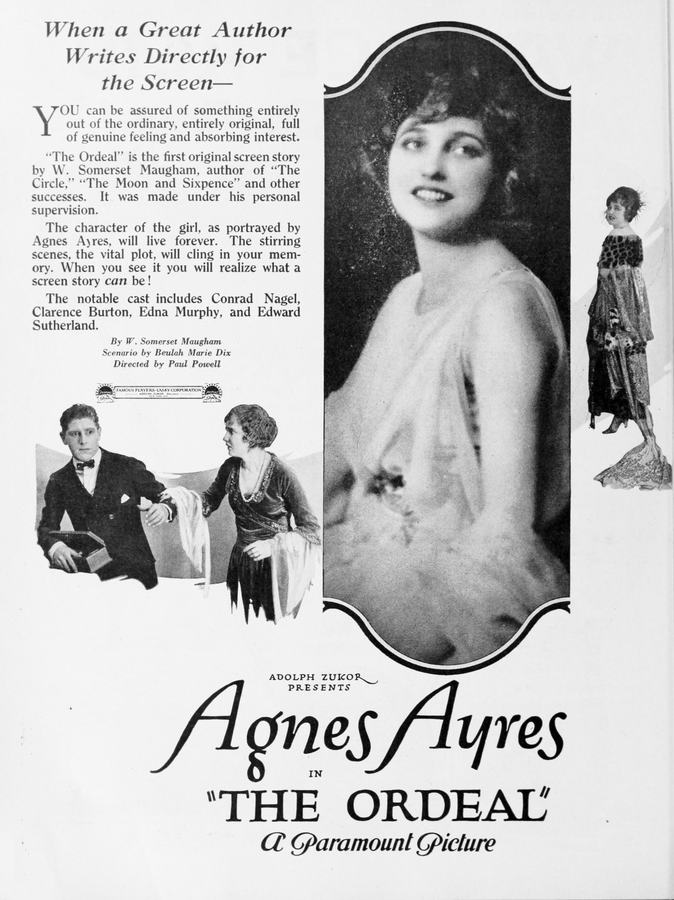
Imagine a snow-globe manor where every flake is ash from a burnt will: that is the visual grammar of Frank Lloyd’s direction in The Ordeal. Shot through with tungsten flares that bleach faces into porcelain masks, the film locates sin somewhere between pupil and iris. When Sybil—played by Agnes Ayres with the brittle poise of a porcelain doll who’s read Nietzsche—first glides across the parquet, the camera hesitates as though embarrassed by the hunger in her eyes. She isn’t marrying a man; she is marrying an extinction clock whose tick-tock can finance her sister’s spinal fusion.
George Bruce, rendered by Edward Martindel with a quivering jowl that seems to store its own distillery, is a libertine of the old school: he slurs Latin tags while groping the maid’s ankle beneath damask. Twenty years her senior, yet ancient in moral decay, he personifies the Edwardian fear that money, not sex, is the real perversion. His jealousy is a cathedral organ whose pipes wheeze whenever Sybil’s pupils dilate toward Conrad Nagel’s Dr. Acton—an exemplar of the era’s newfangled belief that medicine can mend both bone and soul.
The fatal night arrives like a Caravaggio staged in a pharmacist’s nightmare. Digitalis, bottled in cut-glass, becomes the holy grail of moral ambiguity. Sybil’s gloved hand trembles; the vial plunges; the poison mingles with floor-polish and regret. Critics still split theological hairs: did she drop it, or did the bottle leap? The censor boards of 1922 shrieked “murder,” yet the film slyly withholds the smoking gun until Minnie’s death-bed aria, delivered by Anne Schaefer with the rheumy intensity of a Poe prioress. Her confession—she slipped tincture of foxglove into Bruce’s nightly toddy—retroactively absolves Sybil but stains the narrative with a deeper dread: guilt without agency, original sin for the jazz age.
Now widowed, Sybil inherits a fortune conditional on perpetual chastity, a clause that feels pilfered from Jacobean drama and pasted onto a post-war contract. Cinematically, the money is never stacked in gleaming coins; instead it manifests as cavernous negative space—empty chairs, echoing corridors, a sister cured yet morally gangrenous. Helen, essayed by Claire Du Brey, emerges from surgery like Lazarus in lipstick, only to pirouette into speakeasies where gin fizzes and blackmail ferment. Her abduction sequence—shot in a warehouse rigged with klieg lights vomiting orange flame—serves as both action set-piece and moral crucible. Fire, usually a purifier, here becomes a camera flash: it exposes the price of Sybil’s bargain.
Rescue arrives via Acton, who throughout the film has worn desire like a surgeon’s mask: hygienic, functional, yet hiding every breath. Nagel’s boyish rectitude contrasts with Ayres’ chiaroscuro melancholy; their kisses are filmed in profile, as though even the lens were eavesdropping. Yet he will not elope sans legal covenant—an insistence that feels less prudish than prophetic. In 1922, when starlets swapped vows between orgies and organdy, a man who demands a marriage certificate is the true anarchist.
The final reel detonates every narrative landmine. Minnie exhales her guilt; Sybil signs away the fortune with a fountain pen that might as well be a rapier; the balance sheet of sin is zeroed out. Yet Lloyd refuses catharsis. The last shot frames the couple against a horizon of departing steamships—Sybil’s silk coat whipping like a surrender flag. No violins swell; only the flicker of nitrate reminds us that virtue, unlike film, is flammable.
Compare this trajectory to Hilde Warren und der Tod, where Death courts an actress through meta-theatrical hoops, or to The Deciding Kiss, in which a single snog re-routes dynasties. Both silents toy with fatalism, yet neither attains the granular despair of The Ordeal, where every altruistic impulse ricochets into catastrophe. Even Bullet Proof, that paean to trench-scarred stoicism, grants its hero a bullet-dented medal; here, the reward for integrity is insolvency.
“She traded gold for oxygen and called it happiness.”
Technically, the film is a time-capsule of transition. Intertitles, penned by Beulah Marie Dix and adapted from W. Somerset Maugham’s scalpel-sharp novella, oscillate between Victorian circumlocution and hard-boiled telegraphese. One card reads: “Love is a solvent—it melts the glue of greed.” Another simply barks: “The vial broke.” Such lexical whiplash anticipates the pulp modernism of Dynamite Allen and the flapper cynicism of May Day Parade.
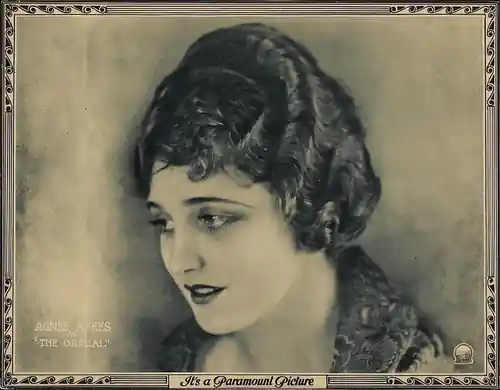
The tinting strategy deserves its own dissertation. Interiors swill in arsenic-green, implying the slow drip of poison even before Minnie’s confession. Exterior night scenes are bathed in cobalt, a nocturne that makes human skin glow like guilty phosphor. When the warehouse burns, the print shifts to crimson so saturated it feels like the celluloid itself is hemorrhaging. Such chromatic bravura predates the symbolic palettes of L'apache and the chiaroscuro noir of The Bruiser.
Performances thrum with the tension between mime and modernity. Ayres’ eyes perform a silent soliloquy: widening by micro-degrees when the digitalis falls, contracting to pin-pricks when the will is read. Martindel, meanwhile, weaponizes the close-up: his nostrils flare like bellows stoking a furnace of paranoia. In a decade when actors still projected to the back row of the Lyceum, such micro-acting feels proto-Stanislavskian.
Gender politics, inevitably, provoke contemporary teeth-grinding. Sybil’s sacrificial marriage reads like a handbook for patriarchal indenture, yet the film slyly subverts: every male safeguard—husband, lawyer, physician—proves porous. The truest power resides in female collusion and confession. When Minnie absolves Sybil, she rewrites the madonna/whore binary into something messier, almost communist. Compare this to Princess Romanoff, where aristocratic women weaponize pearls and gossip; here, the weapons are conscience and cash.
Yet for all its proto-feminist undercurrents, the film cannot escape the moral scaffold of 1922. The Hays Office, still in larval form, clucked over the “immoral suggestion” that a wife might wish her husband extinct. Regional censors snipped the vial-drop into incoherence, forcing exhibitors to splice explanatory placards. Surviving prints, restored by the Library of Congress in 2018, reassemble the sequence via Dutch and Czech export negatives, revealing a lingering close-up on Sybil’s glove—an image that converts hesitation into indictment.
The score, lost for decades, was reconstructed by Donald Sosin for the Pordenone Silent Festival. He juxtaposed a string quartet with a prepared piano whose strings are threaded with paper, producing a brittle crunch evoking crushed glass. During the fire rescue, Sosin introduces a theremin—an anachronism that nonetheless electrifies the scene with sci-fi dread, as though the flames were a portal to modernity.
Viewed today, The Ordeal plays like a missing link between Wildean drawing-room venom and the Expressionist nightmares of Murnau. Its DNA snakes through Daddy-Long-Legs’ epistolary yearning and Tansy’s toxic pastoral. Yet it remains sui generis: a film that believes conscience is the most unreliable narrator of all.
So, should you queue it on some boutique streamer specializing in 16mm transfers? Absolutely—provided you savor moral mildew more than kinetic thrills. There are no train-top stunts à la Jesse James Under the Black Flag, no occult pyrotechnics like Satan's Private Door. Instead, you get the slow drip of guilt corroding gold, the soundless crack of a heart that chooses love over liquidity. In an algorithmic era where every frame demands redemption arcs, The Ordeal offers something rarer: a heroine who buys her soul back at market price, then discovers the market was rigged all along.
Final arithmetic? Five shattered vials out of five; a fortune in celluloid that will bankrupt your certainty but enrich your nightmares.
IMDb 6
1923
Community
Log in to comment.