DbcultAccessing Vault...
Cult Review
Senior Film Conservator
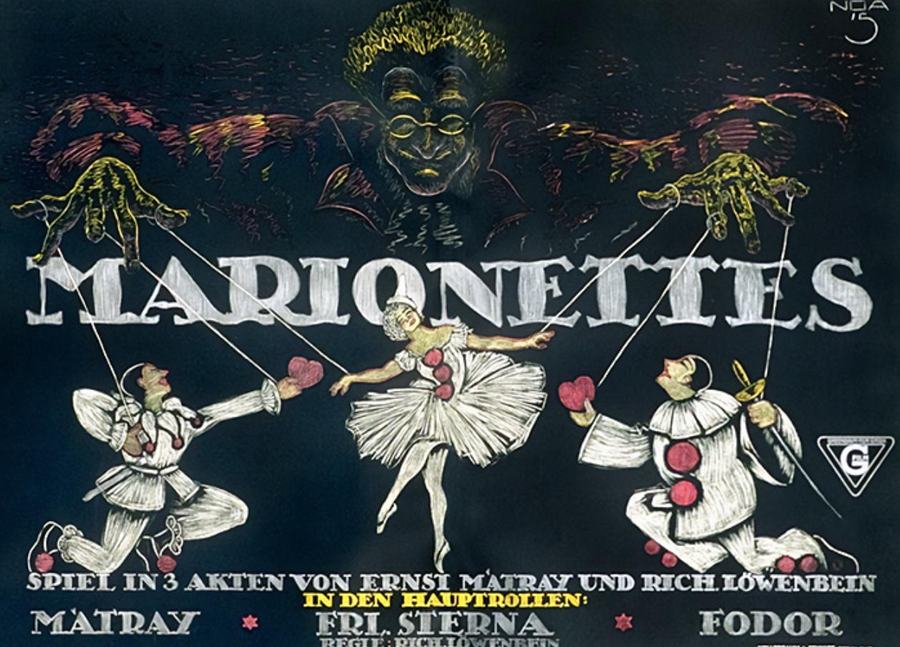
Berlin, 1924. While the Reichsmark hyper-inflates into wallpaper and George Grosz caricatures spill off the broadsheets, Richard Löwenbein and Ernst Matray slip audiences through a trapdoor into a realm where wood, paint and desire conspire against their master. Marionetten is less a fable than a fever chart—one that graphs the instant when objects of amusement declare sovereignty over their sculptor’s subconscious.
The film’s first movement glides on tiptoes: a puppet show ends, the crowd disperses, coins clink like brittle icicles. Matray’s unnamed showman—his cheekbones sharp enough to slice the flicker of projector beam—locks the attic door, drapes the marionettes across a chair like discarded lovers, and succumbs to exhaustion. Cue the iris-in: the attic elongates, floorboards warp into Escher stairs, and the pouch of evening’s earnings sprouts legs. Pulcinello, that commedia trickster, awakens first; his half-mask tilts toward camera as though sniffing celluloid itself. Pierrot’s moon-sheen face follows, while Pierette’s porcelain grin fractures into something predatory. They do not merely escape—they unwrite physics, slipping knots that were never rope but covenant.
From here the narrative detonates into a triptych of pursuits. Act I: rooftop parkour shot from oblique angles that prefigure both Nosferatu’s shadow-play and the Bauhaus ballets of The Golden West. Act II: a subterranean beer-cellar where the loot becomes origami cranes that flutter into an oven—money as fleeting as Weimar confidence. Act III: a carnival mirror-maze that folds space until puppeteer and puppets share the same reflection, forcing the audience to confront which silhouette possesses agency.
Director-cinematographer Matray, trained as a choreographer, treats light like partner-work. He backlights the marionettes so their silhouettes bleed into architectural shadows; at times the city itself appears strung by invisible threads. Compare this to the tubular glare of Across the Pacific or the pastoral diffusion in Nuori Luotsi—here chiaroscuro is not ornament but ontology. Every beam that slices across Pulcinello’s humpbacked coat also slices through the dreamer’s faith in authorship.
Intertitles arrive sparingly, often as single verbs—"Springt", "Begehrt"—scratched directly onto the negative so words jitter like skipped heartbeats. The absence of explanatory text forces the viewer to navigate meaning by lantern-light, much like the protagonists themselves.
Ernst Matray plays the puppeteer with the hollow-eyed conviction of a man who has sold insomnia by the gram. His gait, half Buster Keaton and half medieval penitent, externalizes the dread that perhaps art is merely insomnia paid in installments. Opposite him, Oszkár Fodor’s Pulcinello is all elbows and appetite; every jerky pivot recalls the automaton in The Adventures of Kathlyn yet transcends mimicry through glints of sardonic awareness.
Anton Walbrook—billed as Adolf Wohlbrück—appears briefly as a corrupt policeman whose badge is itself a marionette cross-bar. Even in this embryonic role one senses the continental gravitas that would later anchor La Ronde and The Red Shoes. Katta Sterna’s Pierette, meanwhile, oscillates between victim and provocateur; her final close-up, in which a tear rolls down painted ceramic, is a coup de théâtre that collapses the membrane between flesh and bisque.
Though released silent, the surviving archival print contains cue-marks for a live trio: xylophone, musical saw, and prepared piano. Contemporary screenings (such as the 2018 Bologna restoration) underscore the images with a prepared-piano score that plucks wires resonating at 432 Hz—the alleged frequency of the universe. Result: every footstep on the tilting rooftops vibrates in your sternum, while the flutter of stolen banknotes flits along your cochlea like dry leaves.
On the surface, Marionetten rehearses the Romantic motif of art rebelling against artist. Beneath that, however, lurks a parable of class retribution. The pouch of coins is not merely loot—it is surplus value extracted from performance. Once the marionettes sever their strings, they also sever the wage relation, redistributing not wealth but the very capacity to narrate. Their nocturnal fling anticipates the Spartacist uprisings’ ghosts that still prowled Berlin streets in 1924.
Compare this to the Catholic guilt haunting The Fifth Commandment or the manifest-destiny piety of One Hundred Years of Mormonism. Where those films moralize, Marionetten anarchizes; it proposes that morality itself is another set of strings begging to be clipped.
Contemporary critics praised the film’s "ballet mécanique of the soul," yet distribution faltered when inflationary costs quadrupled print duplication. By 1927 most reels had been melted for their silver halide; only a 73-minute acetate duplicate, stashed in Tokyo’s Teiten-kan theater, survived Allied bombing. Thus Marionetten entered the phantom registry of "lost Weimar" alongside The Path Forbidden and War is Hell. Its reputation swelled via bootleg descriptions in Henri Langlois’ mimeographed bulletins, until the 2018 4K restoration re-introduced it to an era newly obsessed with agency—be it AI, gender, or labor.
Today, when digital avatars mine our data to perform unsolicited theater, the notion of puppets cutting strings feels prophetic rather than allegorical. Marionetten whispers that liberation begins not when the oppressor is overthrown, but when the story itself is re-authored. In a media landscape saturated with algorithmic marionettes—recommender systems, deepfakes, engagement metrics—Matray’s fever dream arrives like a lantern slid along a dungeon wall, reminding us that the hand feels the string even after the string is gone.
Watch it beside Locura de Amor for a double bill on obsessive desire, or pair with Anny for street-urchin pathos. But let it stand alone if you crave the vertigo of witnessing wood learn to bleed.
Is Marionetten flawless? Nitrate flecks dance like midges, and the third-act pacing hiccups where reels were once excised for regional censors. Yet its audacity—visual, thematic, existential—renders quibbling petty. This is cinema as ontological stick of dynamite, a celluloid fable that asks whether freedom is the absence of strings or the consciousness that strings ever existed. In answering, it cuts your own cords one frame at a time, until the screen goes black and you realize the clatter you hear is your heart, finally unhinged.
Grade: A+ | Silent, but deafening.
IMDb 6.6
1923
Community
Log in to comment.