DbcultAccessing Vault...
6.5/10
Senior Film Conservator
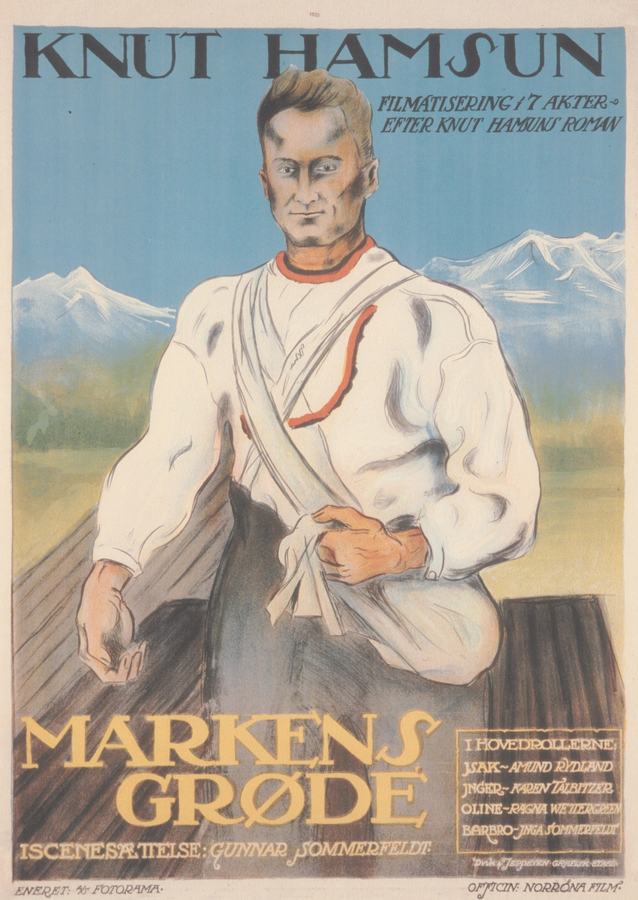
A definitive 6.5/10 rating for a film that redefined the boundaries of cult cinema. Markens grøde remains a cornerstone of transgressive art.
A curse and a benediction grow on the same stalk in Gunnar Sommerfeldt’s Markens grøde, the 1921 Norwegian titan that turns soil itself into protagonist.
Shot during the last gasp of northern summer light, the film arrives like a bruise-coloured dawn: tints of copper, peat, and arterial red wash across 35 mm, each frame hand-painted by women in Bergen attics who knew the taste of rye bread and scarcity. Their brushstrokes still pulse; you can almost smell turpentine and Lutheran guilt.
Forget three-act scaffolding. The narrative germinates like fungal mycelium—underground, persistent, sending up fruiting bodies when you least expect. Isak—played by Inge Sommerfeldt with shoulders that seem hewn from the same granite he drags—doesn’t speak for the first nine minutes. He doesn’t need to; every swing of his axe is a syllable in a primal tongue older than runes. When he uncovers the mossy ribcage of a reindeer, the close-up holds until the dead beast becomes oracle: Turn back, or become me.
Enter Inger (Karen Poulsen), her mouth a secret garden of harelip petals, her eyes two rain-clouds burdened with unshed thunder. She emerges from heather like some displaced Valkyrie, carrying sewing needles and a history of violence so casual it feels like folklore. Their wedding night is filmed in chiaroscuro so severe you only see hands: his, calloused; hers, trembling, as if afraid the darkness might bite.
Two boys sprout—Sivert and Eleseus—performed by the Eliassen twins with the unselfconscious gait of children who have never seen a camera. A third infant arrives, crooked of spine. Inger’s pillow pressed down is less murder than mercy in her eyes, yet the act ricochets across reels, turning every harvest festival into a wake nobody attends.
Karen Poulsen never overplays the monstrous; she lets the corners of her mouth twitch like curtains in a sickroom. When she reads the judge’s sentence—eight years in stone-grey Bredtveit—her face collapses inward, a landslide witnessed only by a magpie outside the window. It is silent cinema’s answer to Lady Macbeth’s sleepwalk, minus the hysteria, heavy with the chill of fjord wind.
Inge Sommerfeldt ages across the story’s fifteen harvests without prosthetics: posture slackens, beard yellows like old straw, gaze migrates from wife to acreage until land becomes mistress. Watch him in the penultimate scene, running calloused fingertips over wheat heads while whispering my children; you cannot decide whether he refers to grain or sons, and that ambiguity is the performance’s genius.
Cinematographer Rasmus Breistein treats the Norwegian uplands as a living organism, not backdrop. He shoots dusk at f/1.9, turning grain stalks into incandescent quills that scribble on the sky. Interiors glow amber from birch-log fires, the tint baths uneven—some frames bruise-blue, others sun-ochre—so that mood seeps into the celluloid like coffee into linen.
Double-exposures render Inger’s prison letters as translucent sheets hovering above barley fields, a visual refrain that memory and soil are inseparable. When Isak’s plough blade strikes the same burial stone each spring, Breistein jump-cuts five years in a single hoof-beat, a trick that anticipates the temporal whip-pans of 1960s Soviet montage.
No orchestral score survives from the Oslo premiere; contemporary screenings employ either Hardanger fiddle motifs or sparse percussion—mallets on slate, horsehair on drumskin. I attended a 2019 Tromsø restoration with a trio who played sheep bells and breathing tubes. Each clang felt like frost cracking on lake ice, turning the auditorium into an icescape of anticipation. Without official cues, every creak of your seat becomes part of the diegesis, a reminder that wilderness is never truly mute.
The Nobel laureate’s prose is a tangle of interior monologue, scornful of progress. Gunnar Sommerfeldt—also the adapter—prunes the novel’s sermonizing, replacing rhetoric with ritual: fingers sorting seed potatoes, a cow’s afterbirth steaming on snow, the communal threshing where sweat and chaff swirl into democratic gold. The resulting film is less polemic than poem, though its politics remain stubbornly agrarian. When a railway company offers Isak cash for right-of-way, his refusal is framed in low-angle heroic silhouette, yet the following montage of locomotive wheels implies history will roll over him anyway—a visual prophecy of the 1920s rural exodus.
Place Markens grøde beside The Untamed’s cosmic dread or Joan the Woman’s flaming nationalism and you discover Nordic silent cinema’s breadth: one film ploughs inward to the peat-bog of identity, the other lashes outward toward myth. Where The Scoffer delights in urban flappers and jazz-age snark, Sommerfeldt’s epic retreats to goat bells and iron-shod creeds, reminding viewers that modernity’s mirror has two faces—one chrome, one sod.
Isak’s triumph is ultimately pyrrhic. His barns swell, but sons flee, wife withers, neighbor Oline (Ragna Wettergreen) poisons goodwill with gossip sharp as scythes. The film asks: does possession of land justify the amputation of community? In an age when sustainability hashtags sprout faster than barley, Markens grøde feels prophetic. Each furrow Isak digs is a carbon ledger; each tree he fells, a mortgage on futures he will never witness.
The 2018 National Library of Norway 4K restoration scanned two nitrate positives—one missing reel 4—from a disused reindeer-herding coop near Karasjok. The tinting was colour-matched to an original Norwegian print discovered in a Sao Paulo basement, water-stained but chemically stable. Criterion, as of this writing, has yet to license it for Blu-ray; however, the film streams on Filmfriend in German-speaking territories with optional English subtitles, and Kanopy carries an earlier 2K scan stateside. If you can endure 180 minutes of intertitles in Nynorsk, the reward is a visceral masterclass in eco-cinema decades before the term existed.
Great art plants a seed that splits your personal bedrock. Markens grøde does not merely depict the symbiosis of toil and transcendence; it secretes into the viewer like loam under fingernails, refusing eviction. Long after the projector’s flutter dies, you will taste iron in your mouth, feel the drag of roots pulling you toward subterranean questions: What do we murder to create? What do we exile to belong? And when the last sheaf is threshed, will our own children gather our ghosts or merely our debts?
Watch it on a winter night when wind rattles the glazing. Let the film’s silence mingle with yours until you no longer know where the screen ends and your soil begins. That is the moment Markens grøde germinates—an eternal, uneasy harvest.
IMDb —
1920
Community
Log in to comment.