DbcultAccessing Vault...
6.7/10
Senior Film Conservator
A definitive 6.7/10 rating for a film that redefined the boundaries of cult cinema. The Uncovered Wagon remains a cornerstone of transgressive art.
In the pantheon of early American cinema, the year 1923 is often recalled for the monumental scale of James Cruze’s The Covered Wagon. It was a film that sought to instill a sense of nationalistic pride through the grueling depiction of the Oregon Trail. However, for every action in the cinematic universe, there is an equal and opposite reaction—usually in the form of a scathing parody. Enter The Uncovered Wagon, a Hal Roach production that doesn’t just poke fun at its predecessor; it systematically dismantles the entire visual language of the Western frontier. Directed with a keen eye for the absurd, this film stands as a testament to the era’s capacity for self-reflection and biting wit.
The brilliance of this work lies in its commitment to anachronistic collision. While films like One Hundred Years of Mormonism attempted to document the expansion of the West with a somber, almost hagiographic tone, The Uncovered Wagon opts for the derisive power of the 'Tin Lizzie.' By replacing the stoic oxen with the Model T Ford, the film transforms the existential dread of the wilderness into the frantic, mechanical anxiety of the early automotive age. This isn't merely a gag; it is a profound observation on how technology fundamentally alters the human experience of space and time.
The opening sequences establish a rhythm that is distinctly different from the slow-burn tension of The Tiger or the high-stakes morality found in The Greater Profit. Here, the pioneers are portrayed by a cast of comedic stalwarts including Mark Jones and James Parrott, the latter being the brother of the legendary Charley Chase. Their performances are grounded in a frantic energy that mirrors the internal combustion engines they are supposedly piloting across the desert. The 'flivver'—a slang term for the cheap, ubiquitous Ford—becomes a character in its own right, a coughing, sputtering beast that demands more attention than the survival of the group itself.
Writers Tay Garnett and H.M. Walker demonstrate a sophisticated understanding of the genre’s tropes. In a traditional Western, the wagon train is a symbol of civilization’s fragile unity. In The Uncovered Wagon, it is a mobile disaster zone. The sight of these cars attempting to ford rivers or climb rocky inclines provides a slapstick counterpoint to the 'rugged individualism' usually associated with the genre. It reminds the viewer that the conquest of the West was as much about logistical frustration as it was about manifest destiny. This subversion is as sharp as any social critique found in Hypocrites, albeit delivered with a much lighter touch.
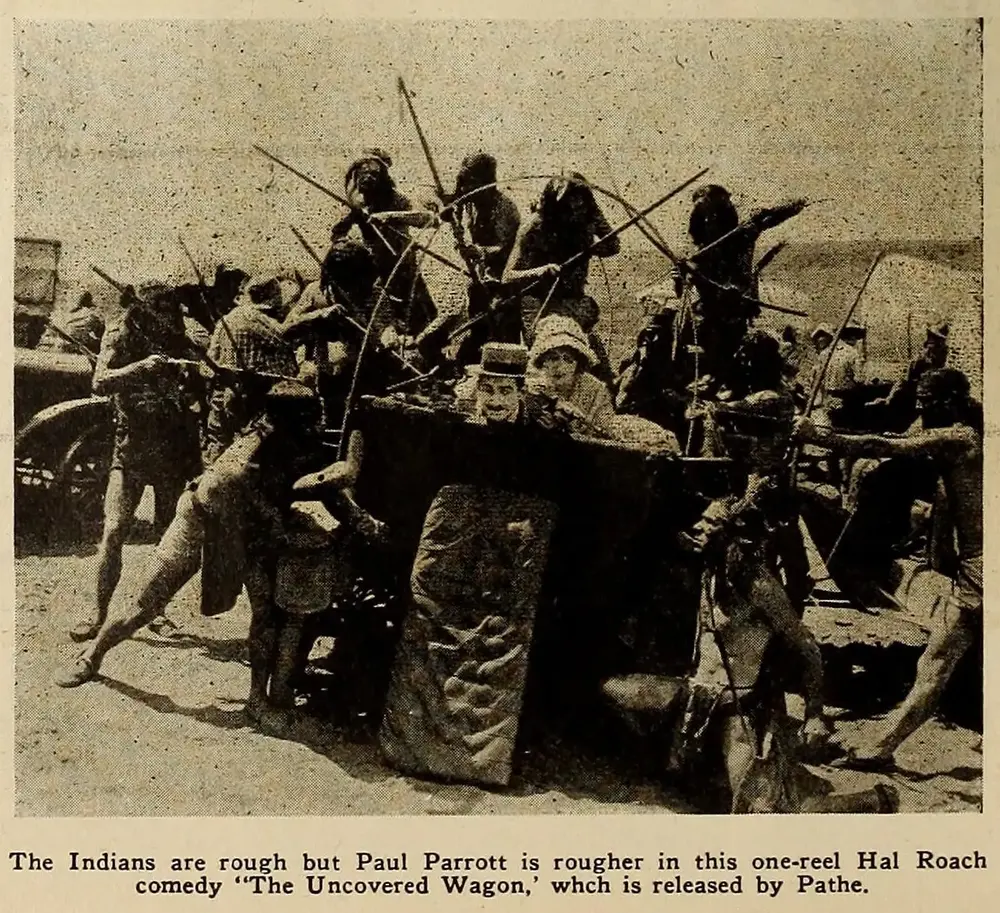
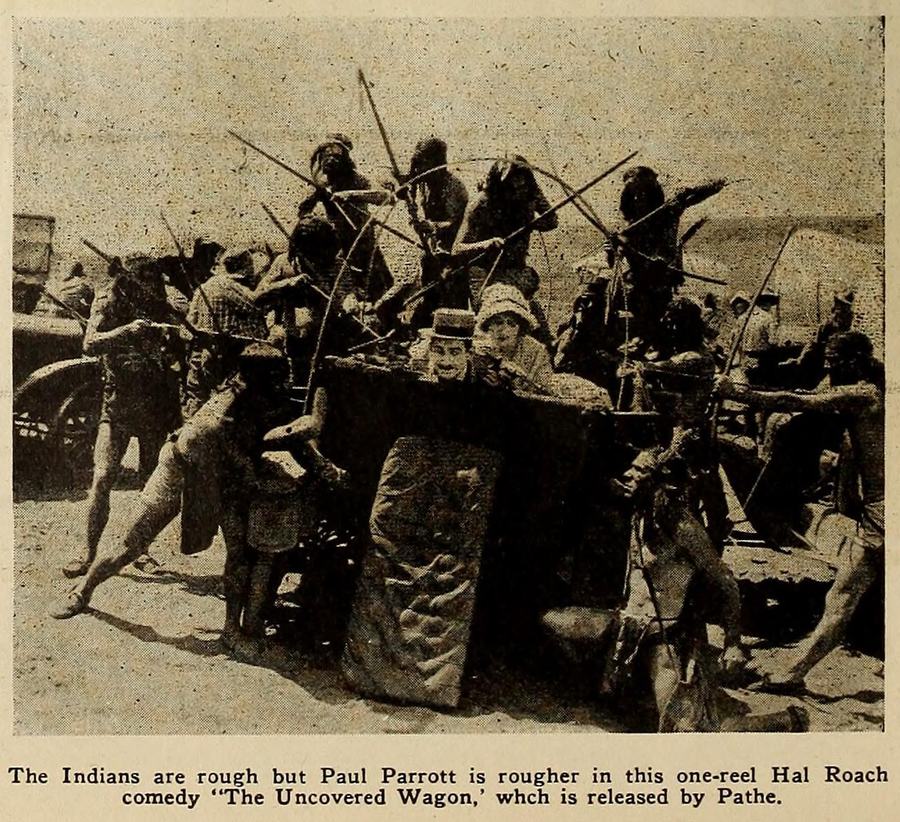
Perhaps the most iconic—and controversial—element of the film is the depiction of the indigenous population. In a move that predates the meta-humor of Mel Brooks by decades, the 'Indians' in this film do not ride horses. Instead, they charge across the plains on bicycles. From a contemporary perspective, this visual gag is a complex layer of satire. It mocks the Hollywood tendency to use indigenous people as mere props for action by giving them the most absurdly 'modern' transport available at the time. It breaks the fourth wall of historical immersion, forcing the audience to acknowledge the artifice of the Western itself.
When compared to the dramatic tension of The Perils of Pauline, where the threats are treated with grave sincerity, The Uncovered Wagon revels in the impossibility of its own premise. The bicycle chase is choreographed with a precision that rivals the best work of Buster Keaton. The juxtaposition of traditional war paint and feathers with the spinning spokes of a bicycle creates a cognitive dissonance that is both hilarious and intellectually stimulating. It asks: if we can accept the 'magic' of the cinema to recreate the past, why can't we accept a bicycle in 1848?
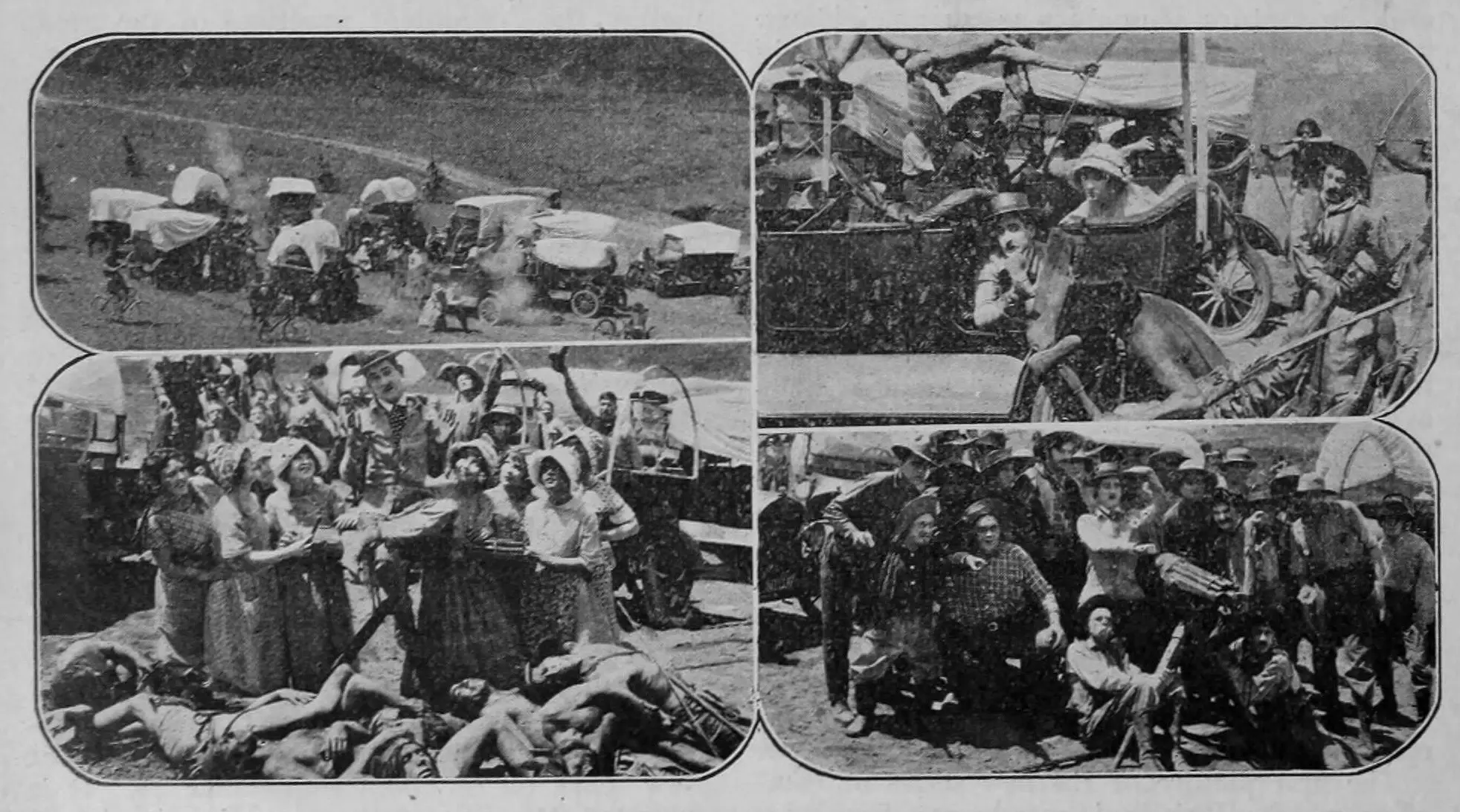
As the film reaches its crescendo, the logic of the narrative completely dissolves into a glorious fever dream. The pioneers, pursued by the cycling warriors, find salvation not in a fort or a cavalry charge, but in a trolley car. This trolley, running on tracks that have seemingly manifested out of the dirt, represents the ultimate intrusion of the urban into the pastoral. It is a moment of pure Dadaism. While a film like Pay Day deals with the drudgery of the modern working man, The Uncovered Wagon suggests that even the most remote corners of history are not safe from the reach of the municipal transit system.
The presence of the trolley car acts as a 'deus ex machina' that is intentionally unsatisfying and ridiculous. It mocks the convenient endings of melodramas like Anna Karenina or Indiscretion. By providing such a nonsensical escape, the filmmakers highlight the inherent absurdity of the 'happily ever after' trope in frontier narratives. The pioneers board the trolley, leaving the 'wild' West behind for a commute that feels more like a trip through downtown Los Angeles than a journey across the Great Divide.
The cast, featuring Sammy Brooks and Katherine Grant, operates with a level of synchronicity that was the hallmark of the Hal Roach studio. Unlike the intense character studies in The Sin That Was His or the sophisticated thievery of Raffles, the Amateur Cracksman, the acting here is broad, physical, and relentlessly paced. Noah Young, often a foil for Laurel and Hardy, provides a ruggedness that is constantly undercut by the script’s refusal to let him be a hero.
Special mention must be made of George Rowe and Wally Howe, whose reactions to the technological anomalies around them provide the film’s emotional (if we can call it that) anchor. They play the 'straight men' in a world that has lost its mind. Their bewilderment at the bicycles and the trolley car serves as a proxy for the audience’s own surprise. This dynamic is essential for parody; without the anchor of the 'normal,' the 'absurd' has nothing to push against. It is a much more effective comedic strategy than the scattershot approach seen in Misfits and Matrimony.
Visually, the film mimics the sweeping vistas and low-angle shots of the epic Western, only to ruin the majesty with a puff of exhaust smoke or a ringing bicycle bell. This 'visual sarcasm' requires a high level of technical skill. The camerawork manages to capture the scale of the landscape, making the smallness of the flivvers even more pathetic and funny. This is a far cry from the claustrophobic tension of The Deadlier Sex or the exoticism of The Parisian Tigress. The Uncovered Wagon is distinctly American in its self-deprecation.
As we look back from a century later, the film’s influence is palpable. It paved the way for the 'anachronism comedy' that would later define films like Blazing Saddles. It understood that the myths we tell ourselves—about our origins, our bravery, and our 'progress'—are often ripe for a comedic pruning. While The Road to the Dawn or The Turn of the Wheel might offer more traditional narrative satisfaction, they lack the sheer, unbridled audacity of this two-reeler.
In conclusion, The Uncovered Wagon is a vital piece of film history. It is a reminder that even in the infancy of the medium, filmmakers were already questioning the stories they were being told. It is a loud, messy, mechanical riot that refuses to show the 'Old West' any respect, and in doing so, it captures the spirit of the 1920s more accurately than many of its serious contemporaries. If you want to see the frontier through a lens of pure, unadulterated madness, this is the wagon you need to hitch your star to.
IMDb 5.8
1935
Community
Log in to comment.