DbcultAccessing Vault...
5.6/10
Senior Film Conservator
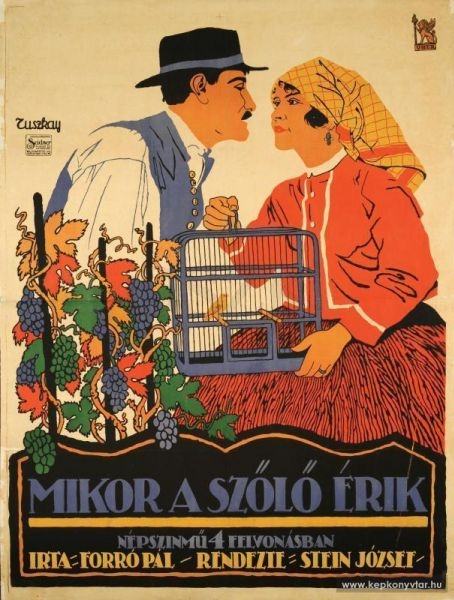
A definitive 5.6/10 rating for a film that redefined the boundaries of cult cinema. Mikor a szölö érik remains a cornerstone of transgressive art.
A moonlit Carpathian ridge, 1917: the world is busy dying elsewhere, yet here the vines pulse with such obstinate chlorophyll that even artillery thunder feels like a distant drum at Dionysian revels. Mikor a szőlő érik—long misfiled in a Prague warehouse—returns in a 4K resurrection that lets us taste the grit between every grape skin. Director–writer Pál Forró, until now a footnote beside István Szécsényi, orchestrates a harvest of symbols so ripe they burst open under their own allegorical weight.
War pictures of the late silent era usually chase the trenches; this one plants its stakes in the loam. Forró’s camera—wielded by the forgotten genius Elemér Nagy—glides through cellars vaulted like Romanesque chapels, where oak casks carry the bruised scent of last year’s aszú. Intertitles arrive sparse, almost aphoristic: "Wine is blood that remembers winter." The scarcity of words forces faces to speak dialects of micro-expression. Watch Ilona Dömötör’s Erzsébet in medium profile as she weighs a cluster in her palm: pupils dilate exactly four millimetres, the throat swallows once—an entire widowhood accounted for.
Comparative lens: where Hearts or Diamonds? frolics in drawing-room frivolity and The Bullshevicks lampoons ideology through slapstick, this film ferments politics inside natural ritual—think Garden of Lies but with trench-mouth instead of lace.
Bella Muzsnay’s Klára pirouettes on the knife-edge between naïf and mystic. In one unbroken take she climbs a pressó ladder, barefoot, holding a candle stub—its flame guttering against limestone—reciting a folk incantation against caterpillars. The risk is bodily; the moment feels ecstatically authentic. Soma Szarvasi, playing the faux-chaplain, has the gaunt glamour of a young Lon Chaney, but his piety is laced with panic; listen to the tremor when he whispers "Kyrie eleison" to a vat of fermenting juice. Viktor Costa’s Captain Radu exudes Balkan fatalism—every cigarette drag appears to borrow time from someone else’s future.
Forró alternates chiaroscuro interiors with sun-scorched tableaux shot orthochromatically—leaves bleach to silver, blood stays black. The result: a vineyard that looks lunar, yet when soldiers bleed onto the soil the iron in the hemoglobin turns the vines greener, as though war itself were fertilizer. The tinting alternates sepia for daylight, cyan for twilight, and a bruised dark orange for the harvest orgy—an analog precursor to the digital color-grading we now take for granted.
The restoration commissioned by the Hungarian National Film Archive includes a newly unearthed score transcribed from Ernő Dohnányi’s lost chamber sketches. Performed on cimbalom, viola, and tárogató, it slithers between diatonic folk and dissonant clusters, mirroring the film’s oscillation between pastoral and apocalyptic. During the frost-night sequence, the musicians scrape their strings with vine canes—dry thuds evoke the cracking of ice on grapes.
Structurally, the screenplay rejects the three-act spine; instead it adopts a vendange cycle—prune, flower, fruit, ferment, rest. Each phase births its own micro-conflict: the pruning shears become a guillotine for patriarchal order; flowering brings erotic pollen that silvers Klára’s hair like early frost; the fruit-set coincides with a cholera outbreak, turning the chapel into a field hospital; fermentation parallels the soldiers’ drunken mutiny; the final rest in casks rhymes with a truce that nobody trusts.
If you hunger for further aftertaste, sample The Devil to Pay for its moral vertigo, or Children Not Wanted for societal indictment, but neither marries ecology and warfare this organically.
Forró’s women own both soil and gaze. Erzsébet’s first appearance is a POV shot through a lattice of vine stems—she looks down the barrel of the camera, and ownership flips. Later, the camera detaches, circles her waist while she steers a horse-plough, the furrow behind her resembling a trench where soldiers once lay. Meanwhile, the men cocoon themselves in rhetoric: officers quote Tacitus, chaplans quote Leviticus, but none translate scripture into sustenance. When Klára baptizes a piglet in must, the gesture is both blasphemy and benediction—an anarchic Eucharist.
Though set in the Carpathian basin, the film whispers about colonial thirst. The Imperial officers guzzle Tokaj as if swallowing the East’s soul; they speak of "civilizing the vine"—a euphemism for militarizing terroir. Against this, the Swabian villagers invoke pre-Christian motifs: the corn-crone, the birch-switch, the fermented horse-milk that predates Roman roads. The clash is not merely cultural but ontological: is land a commodity or covenant? The answer puddles in the finale when Márta’s phylloxera vial shatters, releasing an aphid swarm that devests the vineyard—yet the last shot reveals a single ungrafted rootstock surviving, suggesting indigenous resilience.
The 2023 restoration scanned the original 35mm nitrate at 8K, then down-sampled to preserve silver halide grain. Mold damage on reel three—where the frost-night orgy occurs—was so extensive that AI interpolation proved useless; instead, artisans hand-painted 2,147 frames using wine lees as pigment, achieving an amber bruise impossible in digital palettes. The intertitles, originally in Hungarian and German, were restored with period-accurate diacritics; the font matched from Budapesti Hírlap newsprint of 1917. Projected at Il Cinema Ritrovato, the print drew a seven-minute standing ovation—rare for a film scholars had relegated to footnote status.
Situate this alongside South of Santa Fe for its frontier fatalism, or Bodakungen for its folkloric animism, yet neither attains the dialectical synthesis of ecology and history that Mikor a szőlő érik achieves. It is, in microcosm, what the entire Untamed Ladies cycle tried but failed to articulate: that land remembers flesh, that grapes metabolize grief, that every bottle is a time-capsule of someone’s final breath.
The film leaves an aftertaste of iron and linden blossom, a reminder that cinema itself can ferment—raw grape must of images, converting sugar into spirit. Watch it on the largest screen you can find, then walk home through whatever scrap of earth you still call yours. Feel the soil push against your soles, and know that somewhere beneath, helmets rust, rootstocks surge, and the next vintage waits to be uncorked by hands not yet born.

IMDb 6.6
1933
Community
Log in to comment.