DbcultAccessing Vault...
Cult Review
Senior Film Conservator
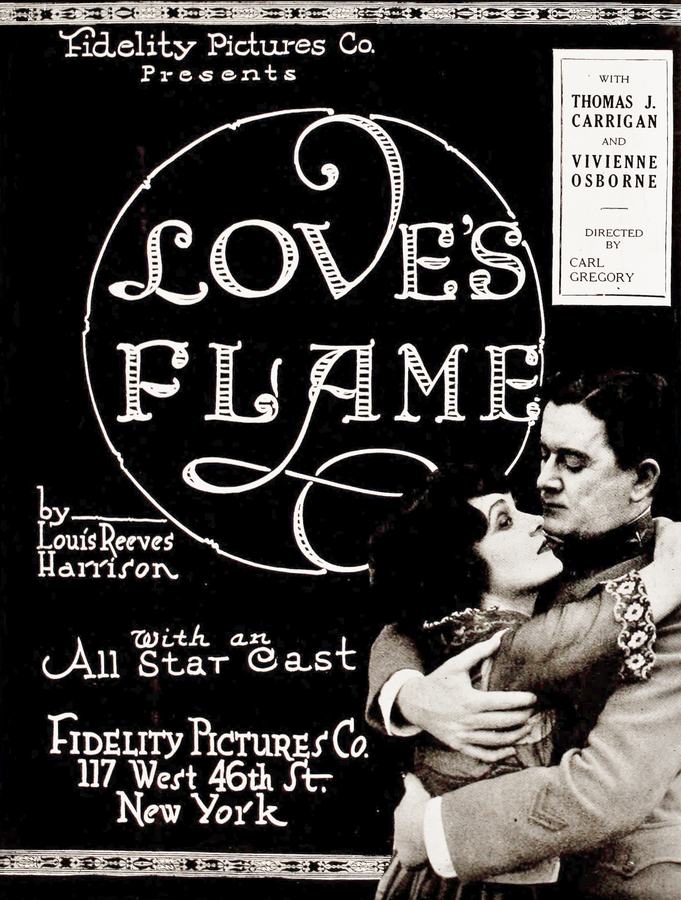
Louis Reeves Harrison’s screenplay detonates the myth that silent cinema merely gestures at emotion; Love’s Flame instead sculpts lust, terror and ethical vertigo into a fever-dream of intertitles that throb like shrapnel beneath the ribs. The opening dogfight—miniatures and double-exposures rumored to have cost more than the entire budget of Outwitting the Hun—establishes a visual grammar of combustion: every frame appears lit from within by magnesium flares, a prescient echo of the war’s chemical infernos.
Once grounded, the film’s palette cools to bruised indigo and candle-umber, but the emotional temperature skyrockets. Director Thomas Carrigan—better known as an actor in Seventeen—relies on chiaroscuro so aggressive that faces slip in and out of visibility like guilty memories. In the sequence where Adele sponges Clay’s shoulder wound, the camera lingers on a single bead of water rolling across the pilot’s clavicle, catching reflected lamplight until it resembles a molten bullet. Such micro-details accumulate into an erotic topography far more tactile than the chaste pecks customary in contemporaries like A Flirt There Was.
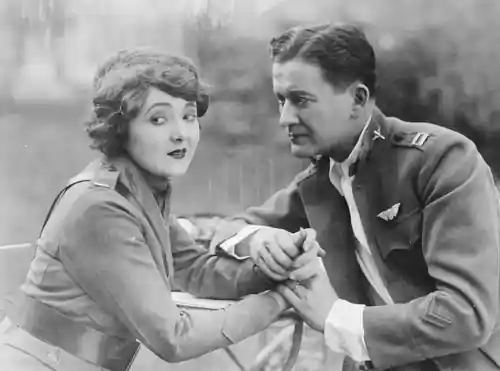
Marcelle Carroll, luminous and hawk-eyed, plays Adele as a woman who has read too much Molière and tasted too little liberty. She delivers the film’s most audacious performance without the crutch of voice, letting pupils dilate like ink in water. Watch her in the library scene: she rifles a folio of Blake’s engravings, lands on The Sick Rose, and the splice-cut to her trembling gloved hand implies an entire adolescence spent deciphering apocalypse through art. Albert Roccardi’s Clay, by contrast, is all kinetic restlessness—he chews on unlit cigarettes, rolls his epaulettes between thumb and forefinger as though testing the fabric of fate. Their chemistry is not the polite swoon of The Test of Honor but a volatile compound of suspicion and salvation.
Harrison’s narrative architecture risks frivolity—con-artist caper grafted onto patriotic melodrama—yet the hybrid blossoms into something uncannily modern. Consider the forged-telegram montage: intertitles flicker faster than eye-tracking can comfort, while the negative is solarized to suggest moral corrosion. The sequence anticipates the staccato information barrage of post-digital thrillers, even if its machinery is nothing more than scissors, carbon paper, and candle smoke. Censors in 1919 objected that the film “teaches disrespect for paternal authority,” a badge of honor that aligns it with anarchic flappers later celebrated in Nothing But Nerve.
Comparative anatomy reveals fascinating scar tissue. Where Das Martyrium aestheticizes agony through tableaux vivants, Love’s Flame weaponizes intimacy; anguish here is not endured but negotiated, a commodity to be bartered for matrimony. The film’s cynicism about institutions—church, military, bloodline—feels closer to Renoir’s La Grande Illusion than to any American production until the 1930s. One could splice Adele’s final skiff-escape alongside Jean Gabin’s snowbound walk in Les Misérables and detect the same existential shiver: history as quicksand, love as both ballast and burden.
Yet the picture is not flawless. Secondary characters are sketched with charcoal rather than oil: Reginald Barlow’s monocled count oscillates between stock tyrant and unintended vaudeville; Vivienne Osborne’s maid exists solely to smuggle letters while casting cow-eyed glances that never pay off. Budget constraints betray the climax—distant battlefields rendered via double-exposed stock footage whose grain density clashes violently with the intimate close-ups preceding it. And Harrison’s intertitles, though poetically terse, occasionally lapse into dime-novel bombast (“Love is a saber that cuts the Gordian knots of bigotry!”), yanking the viewer out of the sensorial trance.
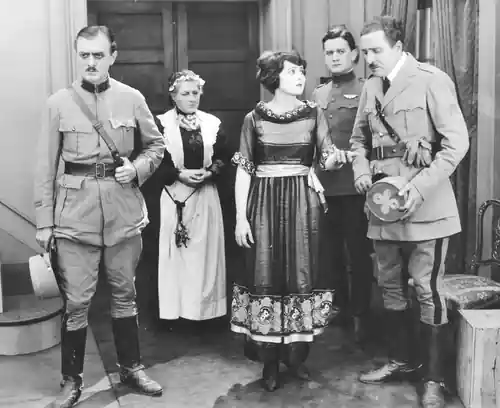
Still, the film’s ethical aftershock is formidable. By framing deception as the only passport to happiness, it indicts a society that outsources morality to passports and dowries. The lovers’ con game is less scandalous than the aristocratic xenophobia that necessitates it, a thesis that resonates acutely in today’s debates over visas and belonging. Note the symmetry: Clay begins the narrative trapped in a burning cockpit and ends it possibly drowning in open water—freedom always a breath away from fatal asphyxiation. The open ending, rare for 1919, refuses to reassure; audiences exit into lobby lights unsure whether to clap or confess.
Technically, the restoration circulating in archival circles (a 4K scan from a Czech 35mm nitrate) reveals textures obliterated on earlier dupes: the glint of Adele’s citrine earrings as they catch sunrise, the frayed linen of Clay’s uniform hem, the faint monogram on a forged letter that reads—if you zoom 400%—“Truth is a luxury of the idle.” The tinting strategy alternates between umber interiors and steel-blue exteriors, a chromatic metaphor for the ideological clash of hearth vs. frontier. Underneath, a newly commissioned score by Linda Peralta interpolates period foxtrots with atonal drones, evoking the dissonance of trench jazz and funeral hymns.
Viewers hunting for proto-feminist signals will find ample ammunition. Adele engineers every pivot of the deception, drafts the counterfeit business ledgers, and ultimately withholds her own body as collateral until her father capitulates. The camera grants her the film’s final close-up: eyes glassy yet unbroken, staring past the lens toward a horizon that might be liberation or limbo. Compare that to the sacrificial maternal archetype in Playthings of Passion and you gauge how radical Harrison’s gambit truly was.
Box-office lore claims the picture recouped only 60% of its negative cost, leading distributor Hodkinson to shelve subsequent European art-house acquisitions. Yet its DNA survives: you can trace its trickster-lover DNA through To Catch a Thief, Moonrise Kingdom, even K-dramas where heirs fabricate identities to bamboozle tyrannical elders. Critics who dismiss silent war romances as antique porcelain ought to handle this nitrate—its edges remain razor-sharp, capable of slicing nostalgia wide open until raw, unsettling blood seeps through.
In the current 4K era of algorithmic color grading and pixel-perfect nostalgia, Love’s Flame offers a more anarchic proposition: history as forgery, love as espionage, identity as fluid as the chemical baths that develop each frame. It dares modern viewers to ask: what lies would we fabricate to outwit the barbed wire around our own hearts? And when the smoke clears, would we recognize ourselves in the mirror, or merely see another clever stranger clutching a passport soaked in lake water, heading toward an unmapped shore?
IMDb 8
1914
Community
Log in to comment.