DbcultAccessing Vault...
Cult Review
Senior Film Conservator
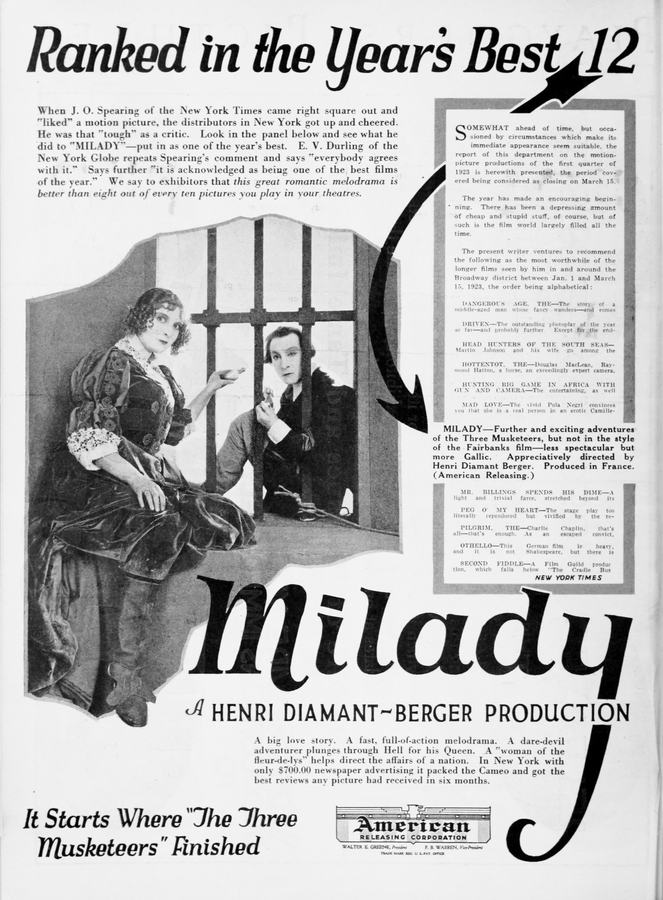
When we pivot our gaze toward the early horizons of European cinema, specifically the silent epics that dared to translate the sprawling prose of Alexandre Dumas into a visual lexicon, Milady (1923) emerges not merely as a sequel or a companion piece, but as a towering monument to atmospheric dread and political volatility. Directed by Henri Diamant-Berger, this production represents the zenith of French silent film ambition, capturing a world where lace and steel are equally sharp. While many contemporary viewers might be more familiar with the swashbuckling levity of later adaptations, this particular iteration dives headlong into the chiaroscuro of the soul, focusing on the titular antagonist with a fervor that borders on the obsessive.
The narrative architecture of the film is built upon the shifting sands of 17th-century courtly maneuvering. Édouard de Max portrays Cardinal Richelieu with a predatory stillness, a performance that rivals the psychological depth seen in The Purple Mask. He is the grand architect of a tragedy that feels both inevitable and shockingly personal. His desire to embarrass the King is not merely a whim of power; it is a calculated surgical strike against the foundations of the French throne. To execute this, he employs Milady de Winter, played with haunting intensity by Claude Mérelle. Mérelle does not play Milady as a caricature of evil; she portrays her as a woman who has transmuted her past traumas into a cold, diamond-hard resolve.
The contrast between the Cardinal’s icy intellectualism and Milady’s burning thirst for retribution creates a friction that drives the film forward. Unlike the more straightforward heroism found in Brigadier Gerard, the protagonists here are often reacting to a web they can barely see. D’Artagnan, played by Aimé Simon-Girard, maintains a sense of Gallic vigor, but he is frequently outmatched by the sheer sophistication of the villains' designs. His loyalty to Constance (Pierrette Madd) serves as the film’s emotional anchor, a fragile thread of purity in a tapestry of filth.
Visually, the film is a feast of historical verisimilitude. The sets are not merely backgrounds; they are oppressive spaces that reflect the claustrophobia of court life. The use of natural light and deep shadows creates a mood that is far more sophisticated than the theatrical staging of many American films from the same era, such as Reaching for the Moon. Diamant-Berger understands that the camera is a witness, not just a recording device. The way the lens lingers on Milady’s expressions—the subtle twitch of a lip, the narrowing of eyes—conveys more narrative weight than a dozen intertitles could ever hope to achieve.
The pacing of the film is deliberate, allowing the tension to simmer like a slow-burning fuse. This isn't the frenetic energy of The Exploits of Elaine; rather, it is a methodical deconstruction of characters. When we see Constance acting as a spy for the Queen, there is a palpable sense of danger. She is not a damsel in distress in the traditional sense, but a participant in a game where the stakes are life and death. Her eventual fate is foreshadowed by the very shadows she inhabits, a tragic necessity in a world where innocence is a liability.
The sequence involving Milady’s escape, facilitated by a traitor within the ranks, is a masterclass in suspense. It highlights the pervasive nature of corruption—the idea that no institution is immune to the lure of silver or the fear of the blade. This thematic depth elevates the film beyond simple adventure. It shares a certain grim realism with Polikushka, focusing on the human cost of systemic failure. Milady’s subsequent revenge—the poisoning of Constance—is filmed with a chilling lack of sentimentality. It is a moment of pure, unadulterated malice that leaves the audience breathless.

The act of poisoning is treated with a ritualistic gravity. It is the culmination of Milady’s descent, the point of no return. When D’Artagnan arrives, it is too late for a heroic rescue. This subversion of expectations is what makes the 1923 version so enduring. It refuses to provide the easy catharsis found in films like Welcome Little Stranger. Instead, it forces the viewer to confront the finality of loss. The subsequent beheading of Milady is not a moment of triumph for the Musketeers; it is a somber execution, a grim cleaning of the slate that leaves everyone involved scarred.
Reflecting on the performances, one cannot overlook the contribution of Henri Rollan and Charles Martinelli, who round out the Musketeers with a sense of camaraderie that feels lived-in. Their presence provides a necessary counterpoint to the solitary machinations of Richelieu and Milady. However, the film belongs to Claude Mérelle. Her portrayal of Milady de Winter set a standard that few have matched. She captures the duality of the character—the victim of a cruel society and the perpetrator of even crueler acts. This complexity is often lost in modern remakes, which tend to favor action over psychological depth.
In terms of its place in cinema history, Milady stands alongside works like Indiscretion or The Woman in its willingness to explore the darker facets of the female experience within a patriarchal framework. It is a film about agency—how it is stolen, how it is reclaimed, and how it is ultimately used as a weapon. The technical prowess of the 1923 production, from its lavish costumes to its innovative editing, ensures that it remains a compelling watch even a century later.
The film’s exploration of betrayal is particularly poignant. The traitor who aids Milady’s escape represents the inherent instability of the political landscape. Much like the narrative tension in Three Sevens or the moral ambiguity of The Millstone, Milady suggests that the greatest threats come not from the enemy across the field, but from the person standing right next to you. This cynicism is a hallmark of the post-WWI European psyche, a reflection of a world that had seen the collapse of empires and the failure of old ideals.
Ultimately, Milady (1923) is a triumph of silent storytelling. It manages to be both a grand spectacle and an intimate character study. It avoids the pitfalls of melodrama by grounding its performances in a tangible reality. The tragedy of Constance and the fall of Milady are played out with a sense of operatic scale, yet the emotions remain piercingly human. For those seeking to understand the roots of cinematic storytelling, or for those who simply want to lose themselves in a world of intrigue and vengeance, this film is an essential experience.
It is a reminder that before the advent of sound, cinema had already mastered the art of the soul. The silence of the film only amplifies the screams of the characters, the clashing of swords, and the quiet drip of poison into a cup. It is a haunting, beautiful, and devastating piece of work that deserves its place in the pantheon of great adaptations. Whether compared to the historical drama of Princess Romanoff or the gritty realism of Crashing Through to Berlin, Milady remains a unique and formidable achievement in the history of the moving image. It is, quite simply, a masterpiece of shadow and steel.

IMDb —
1924
Community
Log in to comment.