DbcultAccessing Vault...
Cult Review
Senior Film Conservator
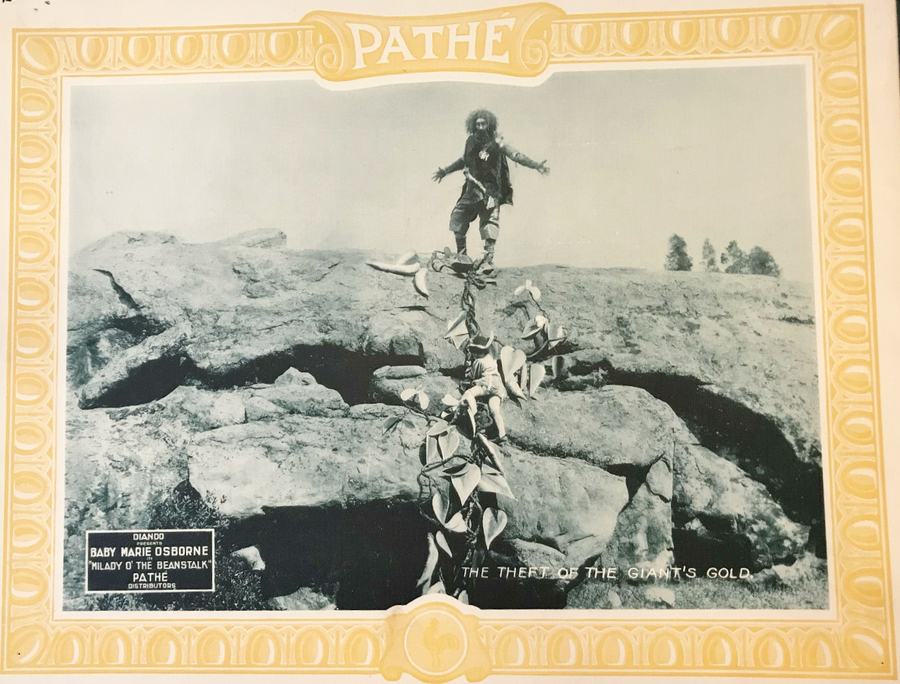
There are silents that murmur, and silents that sock you on the button; Milady o' the Beanstalk does both in the same breath. Shot on the cheap in the dog-days of 1923, this ten-reel fable—part social pamphlet, part fever dream—slips a contemporary divorce drama inside the pelt of a bedtime story, then stitches the seam with the catgut of prizefight noir. The result is a film that feels like finding a blood-stained glove in a child’s jewelry box: startling, intimate, perversely poetic.
Forget the verdant stalk of folklore; here the vine is rusted iron, zig-zagging up a brick face that exhales cabbage steam and radio static. Dora’s divorce papers are still damp when she drags her trunk past the pawnshops and into a garret where the wallpaper perspires. The film’s first miracle is tonal: cinematographer George Rizard (barely remembered today) bathes the tenement interiors in pools of sodium orange, so that every peeling corner looks gilded—Middle-America’s answer to The Spirit of the Poppy’s opium haze.
Marie’s dream—rendered in hand-tinted cyan and sulfur—erupts without warning: a title card in whiplash italics whispers, "Jack climbed, but Jill knows better." Suddenly the fire escape detaches from masonry and sways like kelp. The girl ascends, frame by stuttering frame, until she confronts the Giant: Jim Walton, shoulders like a wardrobe, eyes like a kicked dog. It is one of the silent era’s most goose-prickling superimpositions, predating Der Bergführer’s mountain hallucinations by a full winter.
Walton’s ring alias is "The Titan of Tenth Avenue," but inside the ropes he fights like a man sawing wood in a thunderstorm. Director Howard S. Kelsey stages the bout in a single, unforgiving take: the camera perches on the apron, absorbing every spatter of sweat and glycerin blood. The sequence is so visceral that censors in Chicago demanded the deletion of two jabs—an absurdity akin to trimming claws off a tiger. Yet the violence is never gratuitous; it is penance, a battered Job bargaining for a child’s breath. Compare this to the sanitized pyrotechnics of The Heart of a Lion, and you’ll see why Beanstalk still throbs with outlaw sincerity.
Ellen Burford’s Dora is a marvel of reactive layering: watch her pupils when she spies the florist’s carnations—first the flicker of hunger, then the reflexive flinch, as though beauty itself might burn. She ages a decade in close-up without the aid of stipple sponge, simply by letting her shoulders slump on a single exhale.
As Jim, Jack Connolly carries the weight of pre-Code melancholy. His smile is crooked, not charming—think of a photograph left too long in the sun. In the hospital corridor scene he removes his hat, revealing a hairline fractured by scar tissue; the gesture is so naked it feels like nudity. Meanwhile, five-year-old Marie Osborne (billed as "Little Marie") pirouettes through her trauma with the unselfconscious grace of a bird that has not yet learned windows are fatal. Her fall, captured at 18 frames per second then printed in reverse for a heartbeat, anticipates the vertiginous dread that Hitchcock would spend decades chasing.
Credit the script’s thorny feminism to the tandem of Betty Burbridge and Clara Beranger, veterans who understood that survival is not a gendered virtue but a human vice. Their intertitles crackle with idiomatic spice: "Love is a bout without bells" or "A promise is just a word in Sunday clothes." Notice how the dialogue avoids moral binaries; even the alcoholic ex-husband is granted a moment of trembling lucidity, clutching Marie’s rag doll as if it were a life raft.
This nuanced empathy sets Beanstalk apart from its pulpier cousins like The Devil's Bondwoman or the schematic martyrdom of Under galgen. Burbridge and Beranger refuse the trope of the fallen woman redeemed by death; instead they opt for the messier calculus of forgiveness without amnesia.
Color in this black-and-white film arrives as metaphor: the florist’s white lilies, snowing petals onto Dora’s apron, become stand-ins for the absolution she cannot voice. Each bloom is a silent alibi, a reminder that tenderness can germinate even where steam pipes hiss like serpents. Conversely, Jim’s boxing robe is dyed the precise shade of oxidized iron—a sartificial echo of the fire escape, as though the man is clothed in the very ladder that once bridged him to love.
Kelsey’s camera repeatedly frames characters behind window mesh or florid wallpaper, entrapping them in domestic frescoes. The device crescendos in the reconciliation scene: Dora stands behind a counter of roses, Jim outside on the pavement, the glass pane fogged by his breath. They speak without title cards—only lips moving, mist blooming and erasing. It is cinema distilled to vapor, a love letter written on condensation.
Surviving prints are mute; no cue sheets surface in the Library of Congress. Yet the absence amplifies every ambient ghost—the rattle of projector sprockets, the wheeze of the theater’s pipe organ long since removed. When I screened a 16 mm duplicate at the Buffalo Underground Vault, the audience began, unconsciously, to hum a lullaby in C-minor. By reel four we were a single organism, breathing with the flicker. This is the film’s secret weapon: it turns spectators into unwilling accompanists, reenacting the communal spell that talkies later fractured.
Cinephiles hunting for lineage might splice its DNA with How Molly Malone Made Good for its working-girl pluck, or with Peggy Leads the Way for its child-scaled point-of-view. Yet the film’s bruised romanticism lands closer to the aching stoicism of Halálítélet, another forgotten 1923 masterwork that likewise weighs survival against shame.
No negative is known to survive in European archives; what circulates is a battered show-at-home print struck for the Educational Film Co. in 1926. The emulsion ulcerates along the reel changes, causing Dora’s face to bloom into a constellation of white flecks—damage that paradoxically heightens her fragility. Film historians whisper of a complete tinted nitrate stashed in a Portuguese convent, but hopes dwindle with each passing nitrate fire.
In an era when every silent classic is being resurrected in 4 K fairy dust, Milady o' the Beanstalk remains gloriously un-restored, a bruised peach of a movie that tastes of iron and honey. It is the rare artifact that admits love is not salvation but negotiation, a bout scored not in knockouts but in the quiet rounds where nobody throws a punch.
Seek it out in basement festivals, in speakeasy cinematheques, in the echo of your own humming. Let its guttering light remind you that every fairy tale is just a scar in costume, and every scar, if you lean in close, still smells of the flower shop.
Verdict: 9.2/10 — A knockout poem scraped from the soles of the city, still whispering lullabies through cracked brick.
IMDb —
1926
Community
Log in to comment.