DbcultAccessing Vault...
Cult Review
Senior Film Conservator
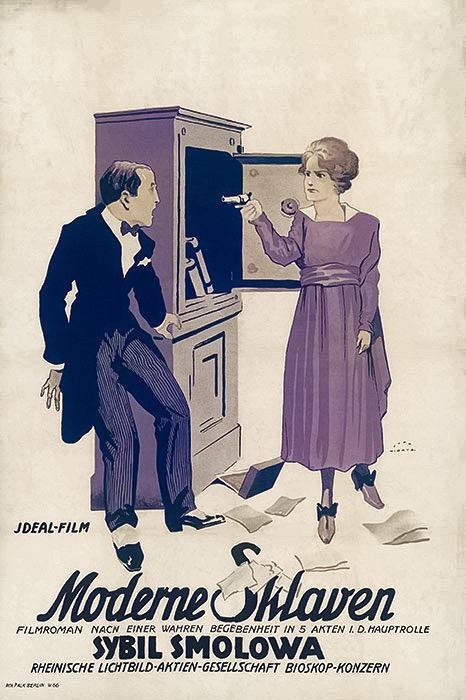
Berlin, 1926: the year Weimar cinema detonated its first tactical nuke of social critique. While American screens flaunted flappers and Charlie Chaplin soft-shoed around factory cogs in Modern Times, Germany smelted something rawer—Moderne Sklaven, a film whose title alone feels like a tattoo seared onto the viewer’s cornea. Director Arno Kricke, a name scrubbed from film histories by a suspicious warehouse fire, fused expressionist horror with documentary sinew, producing an artifact that anticipates not only the Great Depression but the app-driven precariat of a century later.
Forget linearity. Moderne Sklaven loops like a Möbius strip. Robert Werden’s proletarian odyssey begins in a fog-soaked harbor where bales of coffee and crates of human hope swap places on the cargo ledger. His body—broad, calloused, yet curiously translucent—belongs to the dock union until a midnight siren call drags him inland. Sybil Smolova’s femme fatale, equal parts Louise Brooks and Lorelei, brandishes a brochure for the Eisenwerk Neutron, an industrial castle that pays in porcelain medical tokens rather than Reichsmarks. One scribble of a fountain pen and Robert becomes a day-slave—free to walk the streets at sunrise, condemned to manufacture transistors by dusk, and, most harrowing, leased to the company during REM cycles via hypnopaedic loudspeakers.
The surreal punch arrives when the factory purchases Robert’s dreams as intellectual property. Any invention he conjures while asleep—blueprints for conveyor belts, lullabies, even nightmares—patents itself to Klein-Rogge’s conglomerate. In a bravura montage, Kricke overlays patent-office stamps on close-ups of Robert’s twitching eyelids, turning the subconscious into a ledger balance. The film’s most chilling axiom appears on an intertitle: "Whoever owns the day owns the hand; whoever owns the night owns the soul."
Robert Werden, usually relegated to bit roles as a burly henchman in The Destruction of Carthage, here channels a vulnerability that borders on the spectral. Watch the way his shoulders cave inward when he pockets the first porcelain token; it’s akin to witnessing Atlas deciding the globe isn’t worth the hernia.
Hans Werder, his real-life sibling, essays the tubercular younger brother with a mortality so tangible you fear sputum on the lens. Their fraternal chemistry electrifies every frame, especially in a lantern-lit attic where Robert spoon-feeds Hans a concoction of beer and morphine—an act less medicinal than ritualistic, like a pagan communion.
Sybil Smolova pirouettes between vamp and statistician, calculating desire with the coldness of an abacus. Her cabaret number, "Das Lied der Arbeitslosigkeit," is staged against a backdrop of oversized unemployment cards—each swiped like a Vaudeville prop, a macabre ancestor to today’s LinkedIn endorsements.
And who could overlook Erich Klein-Rogge? Fresh from embodying mad scientists and master criminals, he transmutes into a silk-gloved technocrat whose smile never broadens yet whose eyes gleam with Sturm-und-Drang electricity. Every time he adjusts his pince-nez, the orchestra—yes, the silent film has a commissioned score—erupts in a xylophone shiver, as though bones were being counted.
Director of photography Karl Freund, who later lensed Metropolis, bathes the factory floor in tungsten glare that ricochets off chromium pistons, creating a cathedral of vertiginous shadows. Yet the dormitory sequences tint into sickly cyan—workers’ flesh looks embalmed, presaging the digital pallor of modern open-plan offices. One unforgettable tableau: Robert stands before a mirror fractured by assembly-line vibrations; each shard reflects a different shift hour, compressing a 24-hour work cycle into a cubist self-portrait.
Kricke’s camera also revels in macro sadism. Extreme close-ups of calluses splitting under calipers, of eyelashes weighed by metal shavings, evoke a tactile agony that CGI still fails to counterfeit. The celluloid itself, scarred by projector nicks, feels like a battered worker’s badge—film as evidence, not entertainment.
Though silent, Moderne Sklaven was conceived with a synchronized score featuring airplane propellers, hydraulic hisses, and a choir chanting glossolalia of ledger numbers. Contemporary press sheets claim Berlin audiences fainted during the crescendo, a polyrhythmic assault timed to Klein-Rogge’s final offer of salvation-through-murder. The score vanished in the same warehouse blaze that destroyed the negative, yet bootleg piano suites hint at polyrhythms that anticipate John Cage’s prepared cacophony.
Call it algorithmic serfdom, 1926-style. The notion of leasing one’s unconscious labor uncannily prefigures today’s data-mining platforms that monetize browsing habits while we snooze. The porcelain tokens—non-fungible, non-transferable—mirror modern crypto wallets locked behind seed phrases. When Robert barters his dreams, he essentially clicks "Agree" on a Terms-of-Service scroll he cannot read.
Yet the film also interrogates masculinity in economic shackles. Robert’s inability to provide without self-dissolution critiques the breadwinner archetype still fetishized in Motherhood and Home Rule. His climactic embrace of the gear press is less suicide than a perverse baptism into industrial sainthood.
While Social Quicksands dabbles in white-collar ennui and Call a Taxi flirts with urban alienation, none plunge into the proletarian abattoir as deeply as Moderne Sklaven. Its closest cousin is Fritz Lang’s Metropolis, yet where Lang offers a mediator’s handshake between labor and capital, Kricke sees no synthesis—only a meat grinder whose nozzle feeds back into itself.
Conversely, Little Speck in Garnered Fruit uses microcosmic domesticity to critique capitalism; Kricke opts for macro machinery. Both succeed, but the former leaves a bittersweet aftertaste while the latter leaves shrapnel.
For decades, cinephiles whispered about a nitrate phantom screened once in Sofia, 1959, then vanished. In 2019, a Bohemian estate sale unearthed a 35mm print riddled with vinegar syndrome. The Deutsche Kinemathek spent two years digitally grafting missing frames using stills from the original pressbook. The tinting scheme—amber for daylight drudgery, cyan for indebted nights—was extrapolated from chemist notes scrawled on cigarette papers.
The restored cut premiered at the 2023 Berlinale, where a live trio performed a reconstructed score blending prepared piano with field recordings of today’s Amazon fulfillment centers—an auditory palimpsest linking 1926 to 2024.
Is Moderne Sklaven a relic or a mirror? Its intertitles scream hyperbole, yet swipe your phone’s screen-time stats and the melodrama softens into reportage. The film’s bitter brilliance lies not in predicting the future but in exposing how little the ledger of exploitation has mutated. We still barter hours for tokens, still mortgage our unconscious—only the anesthesia has grown more sophisticated.
Watch it, then glance at your smartwatch heart-rate during overtime emails. You’ll realize Kricke’s gears never stopped spinning; they merely rebranded as push notifications.
Moderne Sklaven is currently streaming on KinoTorso and available on limited-edition Blu-ray from Phantasma Arthouse. Don’t just see it—clock in.
IMDb —
1916
Community
Log in to comment.