DbcultAccessing Vault...
Cult Review
Senior Film Conservator
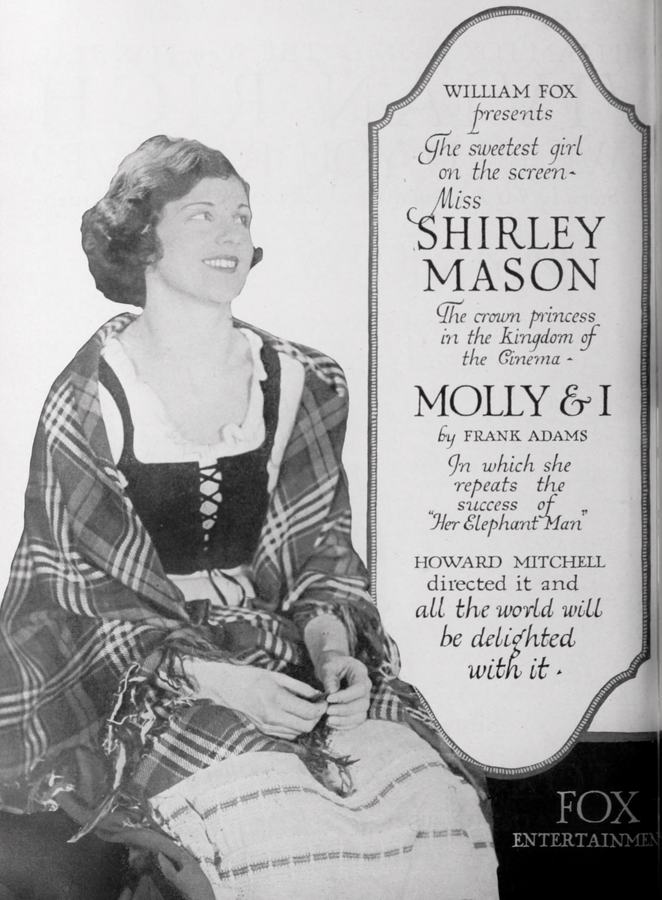
A nickelodeon piano crashes into the first reel and already Molly and I has pawned its heart to contradiction: it is both a winsome fairy-tale of self-immolation and a scalding indictment of transactional intimacy, wrapped in the tissue paper of 1923 censorship. Director John Francis Dillon shoots the boardinghouse like a diorama of entrapment—ceilings squat at 7½ feet, gaslight puckers the wallpaper, every corridor ends in a mirror that refuses to flatter. Into this sepia aquarium swims Shirley Mason’s Shirley Brown, a doctor’s typist whose fingertips know more about papercuts than pleasure. Her performance is a seminar in micro-gestures: pupils blooming when she overhears Philip’s name, shoulders caving inward as if to fold herself into a love letter never sent.
Across from her, Alan Roscoe’s Philip Smith arrives with the languid arrogance of a man accustomed to having his prose—and his women—dog-eared for easy access. Roscoe lets the blindness steal in gradually: first an over-blink at sudden light, then the brittle way he palms doorframes like a sailor reading braille in the fog. The film’s central gimmick—the bogus marriage brokered for cash—could have played as farce, yet Roscoe locates a vein of self-loathing beneath the mercenary shrug. When he signs the certificate, the camera lingers on his hand trembling, as though the ink were acid.
Five thousand dollars in 1923 translates to roughly eighty grand today, but the screenplay (Isabel Johnston and Frank R. Adams adapting his own serial) is less interested in purchasing power than in purchasable power. Note the symmetry: Shirley auctions off her spinster myth to fund Philip’s sight; Philip, once healed, auctions off his attention to the highest-bid society blonde. The dowry functions like Chekhov’s pistol—except it fires backward, wounding the giver. The film’s most chilling beat arrives when Shirley, returned from the courthouse, presses the folded check into Philip’s palm and he kisses her forehead with the absent warmth one bestows on a dowager aunt. Dillon holds the shot until Mason’s smile calcifies into porcelain. No intertitle is needed; the silence itself seems to yellow.
Compare this to the gendered economics of Clothes (1920), where a wife’s wardrobe becomes the battleground for marital control. In Molly and I, clothing is not conspicuous consumption but camouflage—culminating in the Alsatian maid disguise that Shirley purchases with the remaining scraps of her dowry. The uniform is a frilled straitjacket: apron so starched it could slice bread, cap pinned like a corporal’s insignia. Yet within its anonymity Shirley reclaims agency; she can now circulate freely through the house she bankrolled, eavesdropping on her husband’s seduction of Marion Sutherland (Lila Leslie, all predatory grace and cigarette-holder geometry).
The Italian sojourn is related entirely through a montage of postcards—Milan cathedral skewed at Dutch angles, gondolas sliced like black fingernails against jade water—mailed back to Shirley who pores over them under a kerosene lamp. We never witness the surgery; the film elides medical exposition, trusting the audience to equate Italy with miracle. This narrative ellipsis is savvily meta: Philip’s restored sight is as inexplicable to us as it is to Shirley. When he re-enters the narrative strutting a new cream-colored linen suit, the camera adopts his POV: the boardinghouse parlor now appears lurid, its former coziness exposed as threadbare. The visual strategy foreshadows later films like The Victory of Conscience (1924), where moral reclamation is charted through spatial re-seeing.
Yet the Italy sequence also exposes the film’s racial unconscious. Philip’s letters wax Orientalist about “sloe-eyed signorinas,” reducing an entire culture to therapeutic titillation. The film does not critique this gaze; it merely repurposes it as the catalyst for Shirley’s erotic education. She learns, perversely, that to win her husband she must perform ethnicity—hence the Alsatian guise, a stereotype of servile Continental sensuality complete with flirtatious “oui, monsieur” intertitles.
The disguise plot could have slid into Twelfth Night buffoonery, but Dillon stages it like a noir fever dream. Shadows from the banister lattice stripe Shirley’s face as she applies white greasepaint to her eyelids—an act of racial erasure that doubles as self-creation. Later, Philip corners the maid in the pantry, moonlight stippling through lace curtains to turn her apron into scrim. Their kiss is filmed in extreme close-up: only shoulders and mouths visible, the frame ratio claustrophobic. The erotic charge derives not from skin but from recognition deferred. We, the spectators, know the lips he devours are the ones he refuses to acknowledge in daylight.
This duality reaches its apotheosis during a thunderstorm set piece. Philip, half-drunk on brandy and ennui, commands the maid to play the piano—the same parlor upright where Shirley once accompanied his dictation. As she plucks out a halting Chopin prelude, lightning strobes the room: each flash reveals Shirley’s true face beneath the cap, then plunges her back into anonymity. The effect is Frits Lang-like, predating Eugene Aram (1924) by a year yet already flirting with German-expressionist blackout editing.
Where Shirley embodies the Victorian angel—self-sacrificing, dowry-anchored—Marion arrives as the Jazz-Age phantom: cropped hair, cloche hats, a laugh that shatters into saxophone riffs. She drives her own roadster, smokes in public, and negotiates desire like a stock transaction. Leslie’s performance is deliberately mechanical; she tilts her head at 45-degree angles as though posing for a fashion plate that never materializes. The film’s most subversive implication is that Philip’s infatuation is less erotic than ontological: he craves not Marion’s body but her futurity, the horizon where disability is obsolete and marriage is optional.
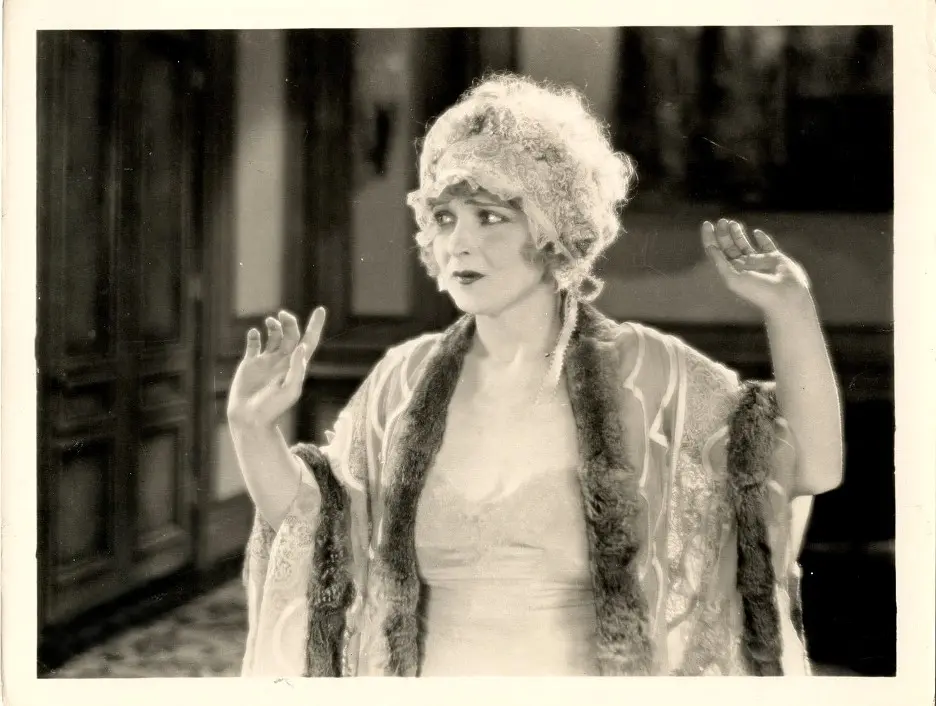
Yet the narrative punishes this modernity. In the climactic confrontation, Marion discovers Philip’s clandestine tryst with the maid and peels away in her roadster, only to be halted by a policeman for “speeding while female”—a deus-ex-machina of patriarchal comeuppance. The moment feels tacked on, a concession to the Hays-adjacent morality that will calcify within the decade. Still, it underscores the film’s core conservatism: vision restored, Philip retreats from cosmopolitan dalliance to domestic authenticity, embodied by the very wife he subsidized.
Surviving prints derive from a 16mm reduction struck in 1932 for the home-movie market; consequently, the image swims in cigarette burns and emulsion boils that resemble ocular floaters. Rather than impairing the experience, decay amplifies theme: watching the film is to see seeing falter. The tinting schema—amber for interiors, viridian for exteriors, rose for romantic interludes—follows a chromatic logic that maps emotional temperature. When Shirley receives Philip’s telegram announcing restored sight, the frame floods with sulphuric yellow, as though jaundiced by joy.
Music, though non-diegetic, would have been supplied by house pianists. Contemporary cue sheets recommend a pastiche of Zamecnik’s “Vanity” and Savino’s “Awakening,” pieces that pivot from waltz to march—mirroring the film’s oscillation between sentimental swoon and proto-feminist indictment. Modern restorations often commission new scores; the 2018 Pordenone Silent Festival featured a klezmer-quartet arrangement that reframed the Alsatian disguise as diasporic drag, adding cultural dissonance the original never intended yet somehow deepens.
Alan Roscoe’s legacy languishes because most of his work is lost; here he exhibits the chiseled tenderness of a proto-Romantic lead caught in the crosshairs of melodrama. Note how he modulates his blindness: early scenes rely on the fixed stare common to stage conventions, but post-surgery he introduces a jittery saccade, as if the world now offers too much visibility. Shirley Mason, often dismissed as a Mary Pickford knockoff, gifts her role a musculature of repression. Watch her fingers in the wedding scene: they grip the bouquet so tightly petals shear off like shrapnel. The moment Philip signs the license, she exhales—a single breath that deflates her corset and hopes simultaneously.
Lila Leslie’s Marion is all right angles and predatory languor, a cubist sketch of the flapper. In contrast, Harry Dunkinson’s comic-relief boarder feels airlifted from another picture; his pratfalls into umbrella stands undercut tension at precisely the beats where the film risks genuine discomfort. One wonders what a Von Stroheim would have done—excised the buffoonery, let the class antagonism fester until it erupted.
History has stranded Molly and I in a limbo where feminist scholars dismiss it as regressive (marriage solves all!) while cinephiles overlook its formal radicalism. Yet the film anticipates several tropes that will resurface: the transactional marriage of Pretty Woman (1990) sans consumerist gloss; the masquerade-as-empowerment throughline from Madame Doubtfire to She’s the Man; even the #MeToo-era interrogation of consent under economic duress. Shirley’s sacrifice is not framed as noble but as tragically logical within a system where female capital expires at thirty. The film’s refusal to grant her a triumphant divorce—instead reuniting the couple under the aegis of “true” love—reads less as endorsement of patriarchy than as bitter acknowledgment of its inescapability.
Compare this to Money to Burn (1922), where the heroine ultimately rejects dowry culture by torching her inheritance. That film concludes with a phoenix-like rebirth; Molly and I offers only a closed loop of restored sight and restored servitude. The final shot—Philip twirling Shirley in the garden as iris-in encroaches—feels less ecstatic than funereal, the cinematic equivalent of a locket snapping shut.
As of 2024, the only accessible version is a 720p scan housed at the UCLA Film & Television Archive**, viewable on-site or via special-request streaming for researchers. Bootleg rips circulate in the usual digital alleys, often marred by interlacing artifacts that make the Italian interludes resemble stroboscopic pasta commercials. For scholarly apparatus, consult Lonely Places: Silent Women and the Architecture of Desire (2021) by Tova Ames, which devotes a chapter to the film’s use of domestic space as panopticon.
If you arrive hungry for comparative melodrama, queue up Tom’s Little Star (1922) for another tale of sacrificial motherhood, or The Zone of Death (1923) for blindness deployed as moral metaphor. None, however, splice the tangled threads of class, gender, and ocular anxiety with the same ruthless brio as Molly and I. It is a film that sees too much, admits too little, and leaves you squinting at your own reflection long after the final iris has swallowed its lie.
IMDb 6
1936
Community
Log in to comment.