DbcultAccessing Vault...
Cult Review
Senior Film Conservator
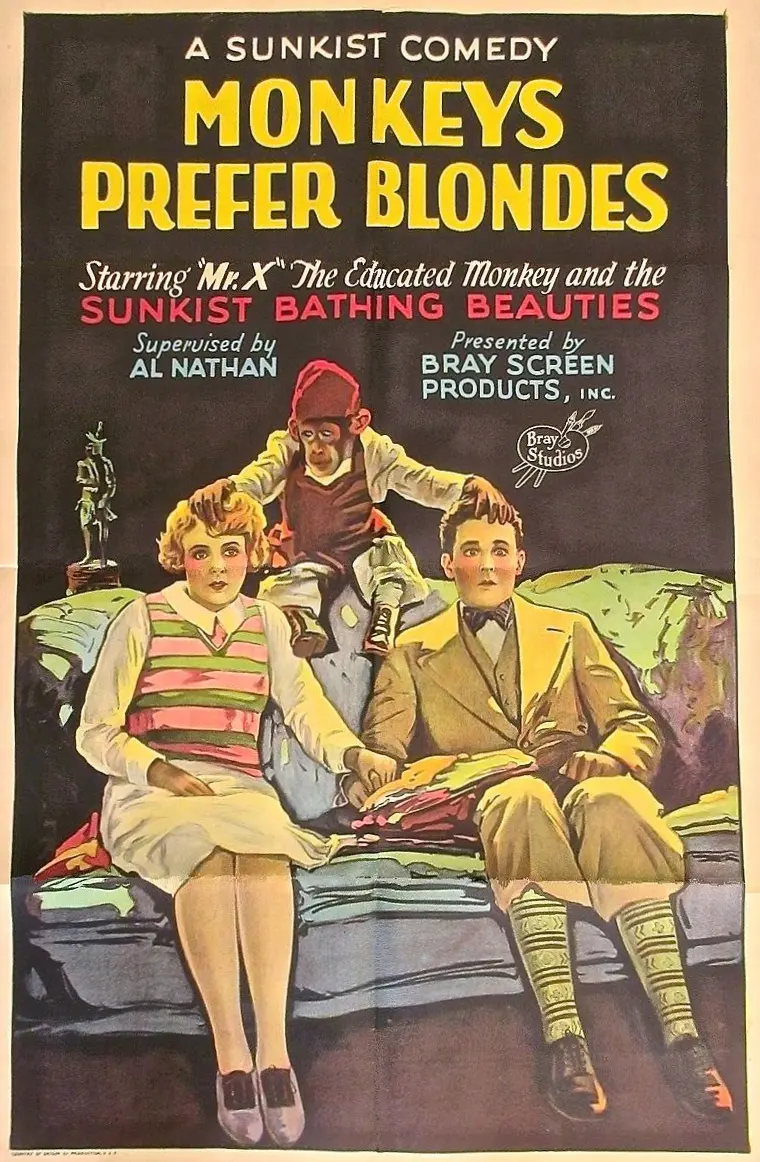
Short answer: No, unless you are a dedicated historian of the silent era. While the film offers a fascinating window into 1920s marketing and beach culture, its comedic value has evaporated over the last century. This film is for cinematic completionists and those obsessed with the 'Sunkist Bathing Beauties' subgenre; it is absolutely not for the casual viewer seeking modern pacing or coherent storytelling.
Direct Answer: This film works because of its frantic, uninhibited energy and the sheer novelty of its period setting. It fails because it prioritizes visual spectacle—specifically the display of the 'Beauties'—over actual comedic timing or narrative structure. You should watch it if you want to understand the precursors to the modern 'beach movie' or if you are tracking the early career of Edward Ludwig.
To understand Monkeys Prefer Blondes, one must first understand the Sunkist Bathing Beauties. Long before Instagram influencers dominated the digital landscape, these troupes of women were used as cross-promotional tools to sell everything from citrus to cinema tickets. In this short, their presence is the primary draw, and Edward Ludwig treats them more like scenery than characters. This isn't a criticism of the actresses, but rather a reflection of the cynical marketing at play in 1926.
The film functions as a proto-music video. There is a specific scene where the troupe parades along the shoreline, and the camera lingers with a gaze that feels remarkably modern in its voyeurism. Unlike A Girl at Bay, which attempts to wrap its female leads in a layer of mystery, Monkeys Prefer Blondes is brutally direct. It wants you to look. It wants you to laugh. It rarely succeeds at the latter.
Buddy Messinger is the most interesting element of the production. Having transitioned from a successful child star career, Messinger here is attempting to find his footing as a leading man in slapstick. He possesses a rubbery physicality that occasionally reminds one of a cut-rate Buster Keaton, but he lacks the deadpan soul that made Keaton a legend. In the sequence involving the monkey stealing the picnic basket, Messinger’s reactions are oversized and desperate.
There is a moment where Messinger trips over a sandcastle that feels genuinely painful. It’s one of the few times the film feels grounded in reality. In many ways, his performance here is more frantic than his work in Home Brew, suggesting a performer trying too hard to compensate for a thin script. He is doing the heavy lifting while the 'monkeys' and 'beauties' simply exist around him.
Edward Ludwig would eventually go on to direct more substantial fare, but here he is clearly a director-for-hire. The framing is static, and the pacing is erratic. He relies heavily on the 'chase' mechanic, a staple of the era that feels exhausted by the ten-minute mark. However, his use of the natural light on the beach is surprisingly effective. The high-contrast sunlight creates a bleached, dreamlike quality that makes the film look better than it actually is.
Compared to the more ambitious framing found in The Isle of Lost Ships, Ludwig’s work here is pedestrian. He stays in wide shots for too long, losing the nuance of the physical gags. When the monkey finally interacts with the 'blondes,' the editing is so choppy that the punchline is lost in a blur of hand-cranked frames. It’s thin. It’s loud. It’s 1926.
If you are looking for a laugh, the answer is a resounding no. The humor is built on tropes that have aged poorly—specifically the 'mischievous animal' trope which feels more like animal cruelty today than comedy. However, if you are looking for a time capsule, the answer changes. The film captures the boardwalk architecture, the swimwear of the era, and the social dynamics of the roaring twenties with accidental precision.
It serves as a fascinating counterpoint to Hypocrites, which tackled social morality with a heavy hand. Monkeys Prefer Blondes has no morality. It has no message. It is pure, unadulterated commercialism masquerading as entertainment. It is a hollow shell of a movie, but the shell is beautifully polished by a century of nostalgia.
Pros:
- Authentic 1920s beach atmosphere.
- Interesting look at Buddy Messinger’s post-child star career.
- Short runtime makes it a painless historical curiosity.
Cons:
- The primate-based humor is repetitive and dull.
- The 'Bathing Beauties' are used as props rather than actors.
- The editing is jarring even by silent-era standards.
When placed alongside Kino Pravda No. 16, the artistic vacuum of Monkeys Prefer Blondes becomes even more apparent. While Vertov was experimenting with the very soul of the camera, Ludwig was just trying to get a shot of a girl in a swimsuit before the tide came in. This isn't to say that all cinema must be high art, but the lack of craft in the gag construction makes it difficult to defend.
Even a film like The Carter Case, which had its own issues, understood the need for a hook. Here, the hook is the title, which is a play on the popular 'Gentlemen Prefer Blondes' novel of the time. It’s a clickbait title for a 1920s audience. It’s an early example of the 'mockbuster' or the 'cash-in' film, a tradition that continues to plague cinema today.
There is a strange, perhaps unintentional, subtext in the way the monkeys are used. They act as surrogates for the audience. They pull at the women's clothing, they disrupt the social order, and they act on impulses that the 'gentlemen' on the beach must suppress. It’s a crude metaphor, but it’s there. The monkey isn't just a prop; it’s the personification of the male gaze in its most literal, primal form. This adds a layer of discomfort to the viewing experience that Ludwig likely never intended.
"It is a film that exists in the space between a postcard and a commercial, offering a glimpse of a world that was already disappearing as the cameras rolled."
The pacing is the film's greatest enemy. Slapstick requires a build-up, a climax, and a release. Monkeys Prefer Blondes operates at a constant, high-pitched whine. There are no quiet moments to allow the humor to breathe. This results in a viewing experience that feels longer than its actual duration. It lacks the sophisticated narrative layers of Hush Money or the suspense of Danger Within.
The tone is also remarkably inconsistent. It pivots from lighthearted beach play to mean-spirited animal antics without warning. This jarring shift is common in early shorts, but it’s particularly noticeable here because the beach setting suggests a relaxed atmosphere that the film’s editing refuses to provide.
Monkeys Prefer Blondes is a fascinating failure. It is a movie that shouldn't be watched for pleasure, but should be studied for its place in the evolution of the American leisure industry. It’s a cynical, beautiful, frantic mess. It works as a document. It fails as a comedy. It is a relic of a time when the mere sight of a beach and a monkey was enough to sell a ticket. We have moved past it, but looking back provides a necessary perspective on how far the medium has come. It’s a shallow dive into a very deep historical ocean.

IMDb 5.8
1935
Community
Log in to comment.