Summary
In the gaslit haze of Montmartre, where absinthe and accordion riffs drip from every balcony, William Carter—a Virginian with a fob watch instead of a past—loses his pulse to Fanchon La Fare, a dancer whose kicks sketch calligraphy of defiance across the cabaret’s tarnished mirror. Their pas de deux of glances ends when Atlantic gales haul him back to the manicured hypocrisy of Richmond; yet Fanchon, passport crumpled like a discarded libretto, sails in pursuit. A single bureaucratic smudge—ink bled beyond the margin—condemns her to exile, so William pronounces the three syllables that will ricochet through his bloodline: “I do.” The Carters, Presbyterians carved from plantation marble, recoil as though a moth had landed on the family Bible. At a church bazaar meant to fund stained-glass saints, Fanchon whips her crinolines into a cyclone, re-enacting the can-can that once made Parisians howl; mid-pirouette she locks eyes with a gaunt stranger—her childhood bridegroom, a ghost tethered by a long-ago signature in a village ledger—and collapses like a marionette with severed strings. That night the wraith trespasses the Carter manse demanding his “property,” prompting Leigh, the hot-blooded younger brother, to fire a pistol whose report echoes all the way to the courthouse. Under gasping ceiling fans and antebellum portraits, Fanchon unspools her truth: she was bartered at thirteen, the marriage never annulled, the stranger both jailer and juror. The bullet is thereby acquitted of malice; Leigh walks free; Fanchon, once banished to the rain-soaked streets, is ushered back into the drawing room where candlelight now flickers with something akin to forgiveness.
Synopsis
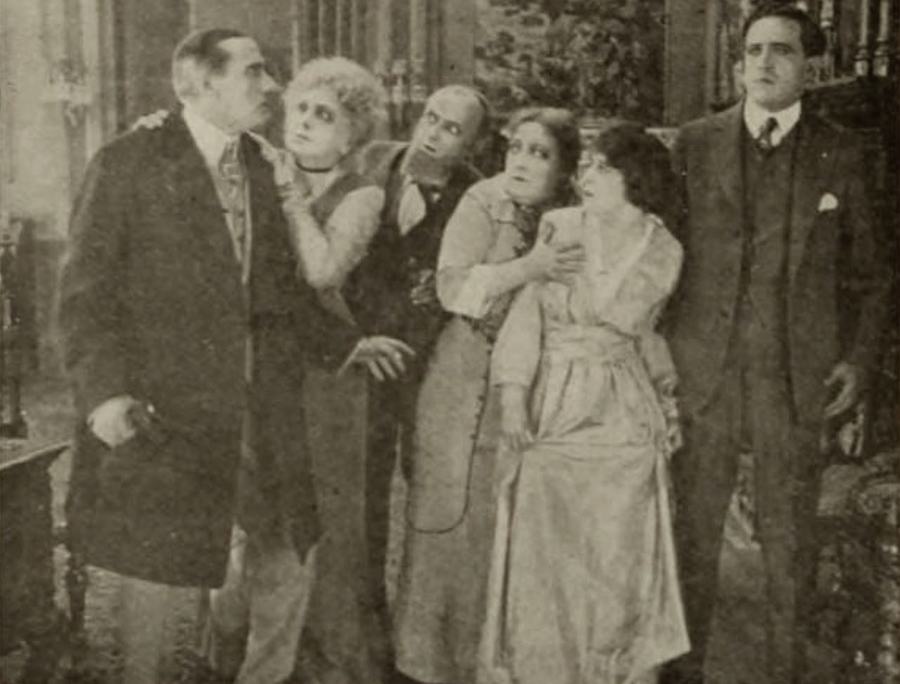
William Carter, a young Virginian in Paris, becomes enchanted with music-hall dancer Fanchon La Fare. After William reluctantly returns to America, Fanchon follows him, and when she is threatened with deportation because of an irregularity in her passport, William marries her. The marriage causes consternation in the upright Carter family, which is compounded when Fanchon performs one of her dances at a church benefit. At the conclusion of her dance, Fanchon sees a stranger in the audience and faints. Later, the same man appears at the Carter residence and demands to see her. Leigh Carter, William's younger brother, becomes angered and shoots the man. At the trial, Fanchon confesses that the stranger was her estranged husband whom she had been forced to marry as a child. The crime thus clarified, Leigh is freed, and Fanchon, who had been expelled earlier from the Carter house, is welcomed back by her husband and his family.
Review Excerpt
"
Paris, 1920: a city rebuilding its vertebrae after the war, cobblestones still echoing with the hiss of pneumatic brakes and the rustle of ostrich-plume boas. Into this half-lit carnival stumbles William Carter—think Gatsby without the fortune, just a Southern drawl and a hunger for the kind of kinetic sin the Old Dominion has outlawed. Fanchon La Fare, meanwhile, is no naïve ingénue; she is kinetic incarnate, a whirl of jet curls and black-stockinged calves that can turn a bar’s smoky air int..."