DbcultAccessing Vault...
Cult Review
Senior Film Conservator
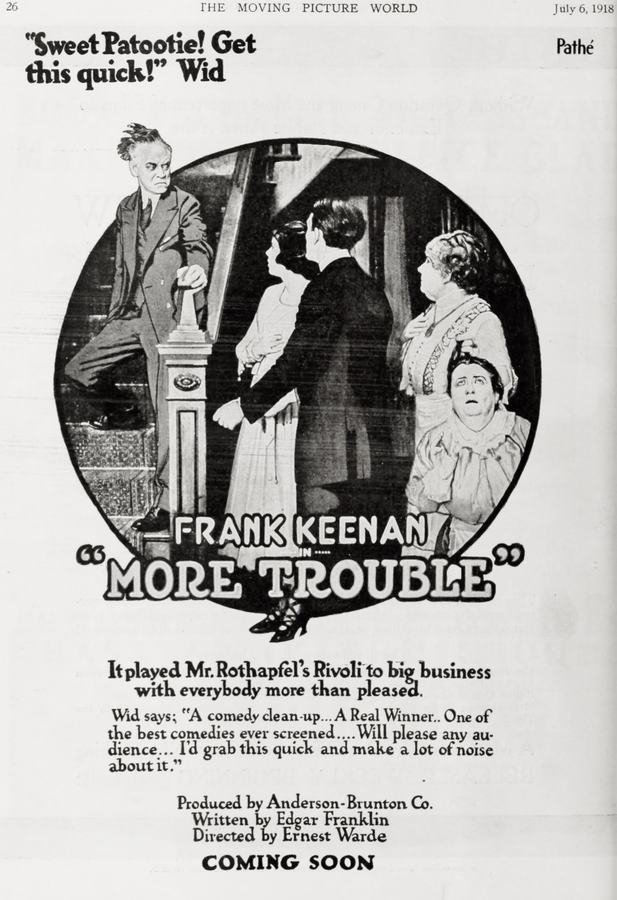
Stepping back into the annals of early cinema, one occasionally unearths a gem that, despite its age and the silent medium, speaks volumes about the human condition. Such is the case with 1918's "More Trouble," a film that, at first glance, appears to be a straightforward morality tale but quickly unfurls into a nuanced exploration of loyalty, deception, and the often-fraught relationship between a father's expectations and a son's hidden life. Released amidst the tumultuous backdrop of the Great War, this cinematic offering from the creative partnership of Ouida Bergère and Edgar Franklin, and featuring the nascent yet compelling talents of John Gilbert, provides a fascinating window into the social anxieties and moral compass of its time. It’s a narrative steeped in the kind of familial drama that transcends eras, presenting a microcosm of societal pressures and personal failings that feel remarkably contemporary.
At the heart of "More Trouble" lies the patriarch, Lemuel Deering, portrayed with a robust blend of pride and vulnerability by Frank Keenan. Lemuel is the archetype of the self-made industrialist, a man who has forged a steel empire through sheer will and unwavering principles. His greatest pride, however, isn't just his booming business; it’s his son, Harvey, played by the charismatic John Gilbert. Harvey embodies everything a father could wish for: a brilliant academic record, graduating at the very top of his class, and an impeccable reputation – a young man who, by all accounts, eschews the vices of drink and tobacco. His return home to join the family business as a partner isn't merely a career move; it's the seamless continuation of a legacy, a testament to Lemuel's success not just as a businessman, but as a father. The initial scenes, one can imagine, paint a picture of domestic bliss and professional triumph, a vision of the American dream perfectly realized within the Deering household and their bustling steel mill.
This initial portrayal of Harvey as an exemplary figure is crucial, setting up the profound shock that follows. It highlights the societal value placed on outward appearances and the crushing weight of expectation, themes that resonate throughout the film. Lemuel’s unwavering belief in his son's integrity, born from years of observing what he perceived as Harvey's virtuous character, makes the subsequent revelations all the more devastating. It’s a classic dramatic setup, where the seemingly unshakeable foundations of trust are slowly, methodically, eroded by an unseen force.
The narrative tension truly begins to coil when a series of perplexing bills starts arriving at the Deering residence. These aren't minor discrepancies; they are invoices from liquor dealers, tobacconists, and, most damningly, billiard parlors – establishments entirely antithetical to the virtuous image Harvey has cultivated. For Lemuel, these documents are not just financial liabilities; they are direct assaults on his perception of his son, and by extension, on his own judgment and paternal success. The mystification turns to outright disbelief, then to a stubborn denial of reality. How could his Harvey, the model of rectitude, be entangled in such profligacy? The sums involved are not trivial either, culminating in one staggering bill for $25,000, an astronomical figure for the era, signaling not just casual indulgence but a pattern of reckless extravagance. This financial hemorrhaging, initially a private family matter, quickly threatens to spill over, jeopardizing the very stability of the Deering enterprise.
Harvey, for his part, vehemently denies any involvement. His denials, initially convincing to a father desperate to believe in his son, add another layer of psychological complexity. Is he truly innocent, or is he a master of deception, upholding his carefully crafted façade? This ambiguity keeps the audience, much like Lemuel, in a state of agonizing suspense. The film cleverly leverages this doubt, forcing us to question the nature of trust and the reliability of appearances. It’s a poignant exploration of how easily a parent's love can be manipulated or, conversely, how deeply it can blind them to uncomfortable truths. This period of the film could be compared to the moral ambiguities found in The Dupe, where characters are often victims of circumstances or manipulations beyond their immediate grasp, struggling to discern truth from fabrication.
What begins as a personal financial imbroglio soon escalates into a full-blown corporate crisis, threatening to dismantle Lemuel's life's work. The mounting debts, combined with the general instability they imply, trigger a cascade of disastrous events. First, the workers, sensing vulnerability or perhaps directly impacted by the company's financial strain, threaten to strike. This isn't just a labor dispute; it's a direct assault on the operational heart of the steel mill, a symbol of Lemuel's power and legacy. The specter of a strike, in an era of burgeoning labor movements, would have resonated deeply with contemporary audiences, highlighting the precarious balance of industrial power. Following this, the bank, no longer willing to overlook the mounting liabilities, places an attachment on the mill. This is the ultimate betrayal, not just of financial trust, but of the very foundation of the Deering name. The mill, once a testament to prosperity, now stands as a monument to potential ruin.
For Lemuel, this is the breaking point. His son's alleged transgressions have moved beyond personal disappointment to an existential threat to his entire livelihood and reputation. The proud father, initially mystified and then stubbornly loyal, is now on the verge of disowning Harvey. The emotional weight of this decision, the tearing apart of a family unit over financial impropriety, is immense. It’s a dramatic zenith, where the audience is left wondering how such a seemingly perfect life could unravel so completely, and what depths of despair Lemuel must be facing. This escalating crisis echoes the societal pressures and class anxieties explored in films like The Fringe of Society, where external pressures often expose the fragility of individual and familial standing.
Just as Lemuel stands poised to cast his son out, a dramatic intervention occurs. Harold Morrowton, Harvey's college roommate and fraternity brother, steps forward with a startling confession. It was he, Harold, who orchestrated the elaborate deception, systematically forging Harvey's name on all the incriminating bills. His motive? A familiar tale of youthful entitlement and parental parsimony: his own father had refused to provide him with sufficient spending money, leading Harold down a path of financial deceit. This revelation shifts the narrative dramatically, exonerating Harvey of direct culpability for the debts, yet simultaneously implicating him in a different, perhaps equally troubling, form of transgression – a silent complicity born of misplaced loyalty.
Harvey, now free to speak, explains his silence. The bond of fraternity, he argues, was paramount. To betray Harold's trust, even in the face of mounting evidence against himself, was unthinkable. This defense, while perhaps understandable within the rigid codes of collegiate brotherhood, is utterly baffling to Lemuel. For the pragmatic industrialist, such a code of honor pales in comparison to the integrity of one's name and the financial stability of an entire enterprise. The film here delves into the complex ethics of loyalty: when does unwavering faithfulness become a destructive force? When does protecting a friend cross the line into self-immolation and familial betrayal? This particular dynamic, the hidden life and the consequences of deception, finds a strong parallel in films such as Hypocrites, which often explored the chasm between outward piety and inner moral corruption.
The resolution of "More Trouble" is both pragmatic and profoundly symbolic. An exasperated Lemuel, having weathered the storm of confusion, despair, and near-ruin, issues a decree that is as much about character building as it is about debt repayment. Both Harold and Harvey are ordered to work off their substantial debts through hard labor in the very steel mill they almost brought to ruin. This isn't merely a punishment; it's a transformative experience, a return to the foundational principles of hard work and earned recompense that Lemuel himself embodies. The steel mill, initially a symbol of family legacy and then a site of impending disaster, becomes a crucible for redemption and character formation. It's a powerful statement about the value of manual labor, the dignity of work, and the idea that true worth is forged through effort, not inherited status.
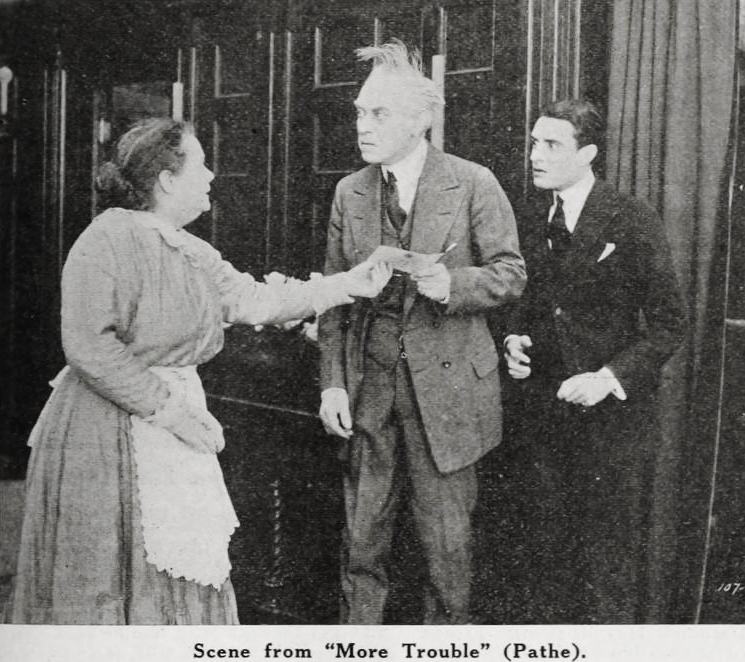
This ending, while perhaps simplistic by modern standards, perfectly encapsulates the moral sensibilities of the era. It suggests that transgressions, even those born of misguided loyalty or youthful folly, must be met with tangible consequences and a period of atonement. The image of the two young men, stripped of their collegiate finery and immersed in the grit and grime of industrial labor, is a potent visual metaphor for the lessons they are meant to learn. It’s a narrative arc that speaks to the power of repentance and the possibility of earning back one's good standing, much like the thematic journey often seen in films such as As Ye Repent, where moral rectitude is achieved through a process of acknowledging and atoning for past wrongs.
The success of a silent film hinges almost entirely on the expressive power of its actors, and "More Trouble" is no exception. Frank Keenan, as Lemuel Deering, delivers a performance that anchors the film with gravitas and emotional depth. His transformation from proud patriarch to bewildered father, then to a man on the brink of disowning his son, and finally to a stern but just arbiter, is compelling. Keenan masterfully conveys the internal turmoil through subtle gestures and facial expressions, a testament to his skill in the silent medium. He embodies the rigid moral code of the industrialist, yet allows glimpses of the loving father beneath the stern exterior.
John Gilbert, in one of his earlier roles, showcases the raw talent that would soon propel him to superstardom. As Harvey, he navigates the tricky terrain of appearing innocent while harboring a secret complicity. Gilbert's boyish charm, combined with moments of genuine distress and the eventual quiet dignity of his confession, makes Harvey a sympathetic figure despite his initial lack of transparency. His performance here hints at the romantic intensity and dramatic range he would later perfect. The interplay between Keenan's seasoned gravitas and Gilbert's youthful intensity creates a fascinating dynamic, effectively conveying the generational clash and the emotional stakes of the narrative. Even in these early days, Gilbert's presence was undeniable, a precursor to the magnetic screen persona that captivated millions.
The supporting cast, including Clyde Benson, Joseph J. Dowling, and Ida Lewis, though perhaps less prominent, contribute significantly to the film's texture, creating a believable world around the central drama. Their reactions and interactions serve to underscore the gravity of the situation, from the concerned faces of the workers to the stern visages of the bankers. While details about Harold Morrowton's actor are not readily available, his character's pivotal confession would have required a performance capable of conveying both desperation and a certain moral cowardice, before ultimately finding a measure of courage.
Directed by the uncredited hand (as was often the case in early cinema, where the director's role was less emphasized than the producer or writers), "More Trouble" nonetheless exhibits a clear narrative drive and effective visual storytelling. The choice of setting the climax within the gritty confines of the steel mill itself is particularly astute. The visual contrast between the clean, ordered world of the Deering home and the smoky, laborious environment of the factory floor is a powerful symbolic device. It highlights the stark realities of industrial life and serves as a visual representation of the journey Harvey and Harold must undertake – from privilege to hard-earned humility.
The cinematography, while likely adhering to the conventions of 1918, would have relied heavily on clear blocking, expressive close-ups to convey emotion (especially for Gilbert and Keenan), and perhaps some rudimentary editing techniques to build suspense. The pacing would have been crucial for maintaining audience engagement without the aid of spoken dialogue, relying instead on intertitles and the actors' pantomime. The film's writers, Ouida Bergère and Edgar Franklin, crafted a story that, despite its relatively simple premise, delves into surprisingly complex moral territory. They explore not just the obvious wrong of forgery and debt, but the more subtle ethical dilemmas of loyalty, parental expectation, and the responsibility that comes with privilege. It’s a narrative that, for its time, was quite sophisticated in its psychological underpinnings, moving beyond mere good-versus-evil to explore shades of grey in human behavior.
The film touches on themes that were highly relevant to its contemporary audience: the moral decay sometimes associated with wealthy youth, the sanctity of a family's financial standing, and the enduring value of hard work. In an era grappling with the aftermath of rapid industrialization and shifting social norms, "More Trouble" offered a reassuring message about accountability and the possibility of redemption through labor. It also subtly critiques the blind spots of parental pride, suggesting that even the most exemplary children can harbor secrets or become entangled in unforeseen complications, a narrative thread also explored in a different light in The Millionaire Baby, where the complexities of wealth and family dynamics often lead to unforeseen troubles.
While "More Trouble" may not be as widely remembered as some of the groundbreaking epics of the silent era, its significance lies in its well-crafted narrative and its early showcase of John Gilbert's talents. It represents a particular strain of early American cinema that focused on moral dramas, often with clear lessons about right and wrong, but delivered with enough character depth to engage audiences beyond simple didacticism. The film's examination of loyalty, particularly the conflict between loyalty to a friend and loyalty to family integrity, remains a timeless ethical quandary. It’s a question that continues to resonate in modern storytelling, proving that certain human dilemmas are universal, regardless of the technological or social context.
Watching "More Trouble" today offers more than just a historical curiosity; it provides insight into the values and anxieties of a bygone era, filtered through the lens of early cinematic art. It’s a reminder that even in its nascent stages, film was capable of tackling complex human emotions and societal critiques, albeit through the exaggerated expressions and dramatic intertitles characteristic of the silent screen. The film's resolution, while perhaps a touch idealistic in its belief in the redemptive power of manual labor, carries a potent message about the consequences of actions and the path to genuine atonement. It underscores the idea that true character is often forged not in the halls of academia or the comforts of wealth, but in the crucible of adversity and hard-won experience.
In conclusion, "More Trouble" stands as a commendable example of early silent drama. It might not redefine cinematic language, but it certainly exemplifies effective storytelling within the constraints and conventions of its time. It’s a film that, through its compelling performances and well-structured plot, invites us to reflect on the nature of trust, the weight of responsibility, and the enduring power of a father's love, even when tested to its absolute limits. For enthusiasts of silent cinema and those interested in the foundational works of Hollywood stars like John Gilbert, "More Trouble" is more than just a historical artifact; it's a narrative that continues to provoke thought and emotion, proving that some stories, and the troubles they explore, are truly timeless.
IMDb —
1928
Community
Log in to comment.