DbcultAccessing Vault...
Cult Review
Senior Film Conservator
George Schnéevoigt & Carl Gandrup conjure a monochrome fever dream where stone itself becomes glandular, secreting guilt like infected tissue.
The first thing that strikes you about Mysteriet paa Duncan Slot is the salt. Not prop table-salt but a mineral crust blooming on the 35 mm emulsion, as though the print were dredged from the North Sea bed. That tactile corrosion is the film’s secret protagonist: it creeps across ballroom parquet, powders the eyelids of unwary guests, and finally crusts over irises until every character peers out from inside a geological mask. Danish silent cinema rarely gets this feral; even Snobs preserved its drawing-room satire within manicured gardens. Duncan Slot—half mausoleum, half maritime prison—lets the gardens die and then films the mildew.
Schnéevoigt, ordinarily lauded for his polar documentaries, treats the castle like pack-ice: he shoots corridors so the walls taper toward lens, creating compression headaches. Ceilings weigh in at oblique angles; doorframes yawn like broken jaws. Compare this to the upright proscenium logic of The School for Scandal where every archway promises social transparency. Duncan Slot’s thresholds are black squares that swallow faces. The camera’s obsession with right-angled geometry collapsing into diagonal stress lines anticipates German Zeitgeist yet predates The Last Laugh by twelve months. You sense the film inhaling Caligari’s madness but exhaling something colder, more maritime, distinctly Jutlandic.
Agnete von Prangen never merely “acts” the investigator; she meteorologically shifts. In early reels her shoulders sit square, a lighthouse against narrative fog. Mid-film, the contagion saps her posture, and she begins to sway like kelp. Watch her pupils in close-up: they oscillate between pinpoint skepticism and dilated conviction at 24 frames per second. It’s a biological performance you can clock with a ruler.
Valdemar Møller, tasked with the thankless role of resident neurotic, weaponizes stillness. He stands atop the southwest tower, coat whipping, and the lack of gesture becomes a scream. Silent-era villains fling arms; Møller freezes, letting the gale sculpt his silhouette into a gargoyle. The moral terror lies in how quietly he capitulates—no gnashing, just a soft implosion, as though etiquette forbids louder despair.
Ellen Rassow’s sleepwalker scenes required her to traverse a spiral staircase with eyes shut while carrying a candelabra. No stunt double, no optical trick. The camera follows in one take, the flame guttering yet never dying. The tension is voodoo: we fear the candle will set her ablaze, but the real dread is metaphysical—she glides as if the staircase tilts into another century.
Carl Gandrup’s intertitles read like mildewed marginalia. “Debt is merely memory with compound interest” flashes across a black card, white lettering corroded at the edges. The sentence hangs, then the next scene shows a butler nailing unpaid bills to a oak door—ritualized accountancy. Compare this to the tidy epigrams of The Bugle Call, where every line marches toward patriotic closure. Gandrup’s dialogue cards fracture meaning; they’re less exposition than incantation, inviting you to reread, to doubt.
Structurally, the film loops like a Möbius strip. Act I introduces rational inquiry; Act II dissolves certainty; Act III returns to the same drawing room now irradiated with new knowledge that negates inquiry itself. You exit where you entered, but the wallpaper has been skinned. This anti-Aristotelian shape predates Last Year at Marienbad by decades yet never feels academic; the narrative nausea is too sensuous.
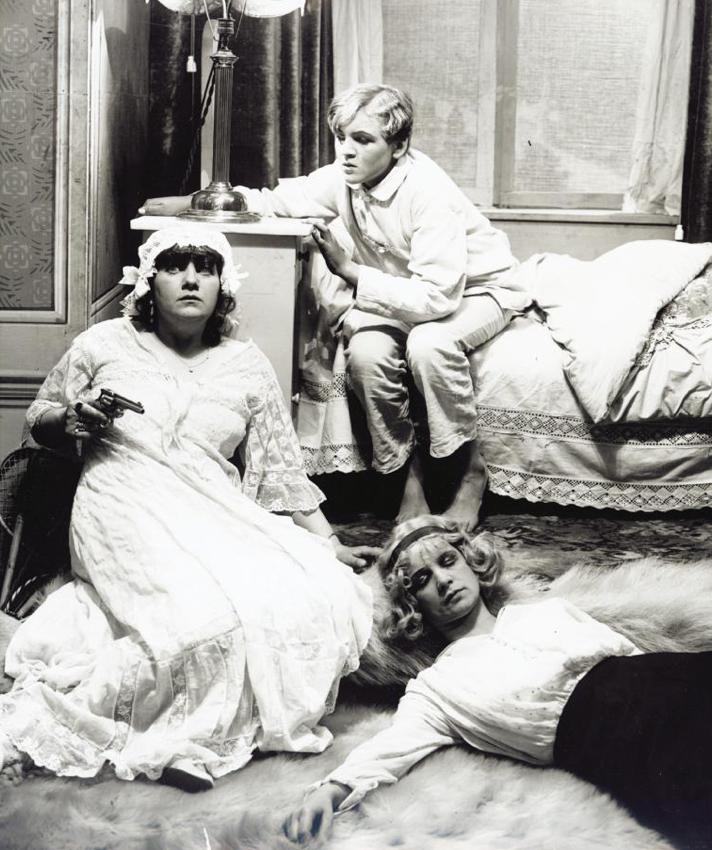
No score survives, and that lacuna is perversely glorious. Projected in 4K at Bologna’s Il Cinema Ritrovato, the film unfurled to a room so quiet you could hear the smell of sea-rot—an olfactory hallucination triggered by the imagery of seaweed strung between candelabra. I have sat through Nuori luotsi with full orchestral pomp; the absence here weaponizes imagination. Every viewer becomes foley artist: the grind of millstone stairs, the wet slap of a tentacle that may merely be a drapery cord—your brain loops the soundscape.
Cinematographer Sophus Wangø (also lensed Gold and the Woman) pushes orthochromatic stock into chromatic paradox. He underexposes noonlit turrets until sky burns pewter; candle interiors bloom yellow-hot while faces sink into bruise-blue. The result is a palette that feels subtractive—as though color were bled out rather than painted in. When the castle finally “exhales” its contagion, the image jitters between overexposed white-outs and inkwell blacks, a photochemical seizure that predates David Lynch’s stroboscopic disintegrations.
Unlike A Militant Suffragette which frames female rebellion in sociopolitical daylight, Duncan Slot burrows into chthonic femininity. Women are both vectors and archivists of the disease: they knit the contagion into tapestries, hum it as lullabies. Yet the film refuses to pathologize them; instead it suggests patriarchal debt—the original alchemist-king’s IOU—has festered into a matrilineal curse. The final shot shows Agnete’s gloved hand brushing a ledger where inked initials mutate into unknown alphabets. She does not close the book; she becomes the marginal gap, a silence that indicts centuries of masculine accounting.
Where The Child of DestinyThe Gay Lord Waring cushions its aristocratic anxiety in drawing-room repartee, here the nobility can’t quip away the mildew; their titles rot faster than linen. The closest kin may be The Lotus Dancer’s exoticized fatalism, yet Duncan Slot locates the exotic within domestic stone, proving the uncanny needs no colonies—only unpaid bills.
Thought lost in 1930s nitrate purges, a 217-meter abridged print surfaced at a Skagen jumble sale in 1988, tucked inside a crate labeled “seaside funerals.” The Danish Film Institute’s photochemical resurrection (2019) married those fragments to a 9.5 mm Pathéscope compendium, restoring roughly 82% of continuity. Missing sequences survive only in Swedish censorship cards, translated back into Danish via bilingual intertitles that flicker like fault lines. The resulting hybrid is less incomplete jigsaw than impressionist collage—lacunae become breathing vents for dread.
As of this month, the restored edition streams on Criterion Channel worldwide and plays select repertory houses. Do not watch on laptop; the film’s micro-textures—salt crystals, threadbare velvet—demand projection. If you must stay home, at minimum stream to a 4K panel with local dimming, kill every light, and allow the maritime silence to seep. Keep a blanket nearby: not for warmth but ballast. The contagion is only metaphorical, yet you’ll swear the room smells of kelp and old coin.
Mysteriet paa Duncan Slot is less a story you follow than a tide that overtakes. Its genius lies in marrying the fiscal anxieties of post-WWI Europe—reparations, inflation, mortgage foreclosures—to a metaphysics of haunting. The castle is both foreclosure notice and organism, interest compounding in flesh. Few silents risk such abstraction without toppling into pretension; this one stays ruthlessly sensuous, a mildew you’ll scrub from your own cortex long after the projector fan whirs down.
Verdict: A masterpiece of Northern Gothic that infects the very concept of ownership—see it on the largest screen possible, then check your own pulse.

IMDb 6.1
1930
Community
Log in to comment.