DbcultAccessing Vault...
Cult Review
Senior Film Conservator
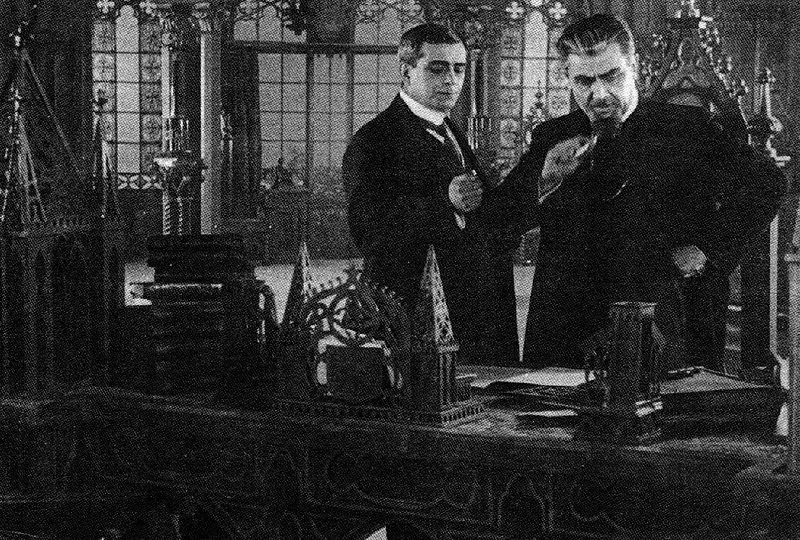
Yevgeny Bauer's cinema, even a century after its creation, possesses an uncanny ability to resonate with the contemporary viewer, transcending the temporal distance with its profound psychological insights and visually arresting aesthetics. His films are not merely period pieces; they are timeless explorations of the human condition, often set against the backdrop of a Russia teetering on the brink of seismic social transformation. In the pantheon of his remarkable oeuvre, Nabat stands as a particularly potent example, a film whose very title – 'Alarm Bell' or 'Tocsin' – signals its thematic urgency and dramatic intensity. To delve into Nabat is to embark on a journey into a meticulously crafted world where personal awakening mirrors national upheaval, where the individual's conscience becomes a microcosm of a society grappling with its own moral compass.
The film introduces us to Elena, portrayed with exquisite grace and simmering internal conflict by the incomparable Vera Karalli. Karalli, renowned for her balletic artistry, brings a unique physical eloquence to her character, allowing her inner turmoil to manifest in subtle gestures and expressive glances. Elena exists within a gilded cage, a life of aristocratic comfort and artistic acclaim as a celebrated dancer, funded and meticulously controlled by a powerful, avaricious industrialist, a role brought to chilling life by Vladimir Strizhevsky. Strizhevsky's portrayal eschews overt villainy for something far more insidious: a suave, paternalistic possessiveness that slowly suffocates Elena's spirit. His wealth, a symbol of the era's rampant industrial expansion and burgeoning inequality, casts a long, oppressive shadow over her existence, rendering her an object of possession rather than an autonomous being. The initial scenes establish this opulent yet hollow world with Bauer's characteristic visual flair, employing deep focus and intricate mise-en-scène to create a sense of luxurious entrapment. One cannot help but draw parallels to the thematic undercurrents of films like The Gilded Cage, where the superficial allure of wealth often conceals a deeper, more insidious form of captivity.
The narrative's true catalyst arrives not in a sudden explosion, but in the insidious, persistent ringing of the metaphorical 'Nabat' – the alarm bell of social consciousness. This awakening is personified by the enigmatic dissident intellectual, a role imbued with quiet intensity by Konstantin Khokhlov. Khokhlov's portrayal is a masterclass in understated charisma, his character's words, though unheard in a silent film, are conveyed through his piercing gaze and earnest demeanor, igniting a nascent awareness within Elena. This intellectual represents the burgeoning revolutionary fervor, a counterpoint to the decadent inertia of the aristocracy. His presence introduces a moral complexity that forces Elena to confront the stark realities beyond her insulated world. The film skillfully juxtaposes the frivolous pursuits of the elite – lavish balls, theatrical performances, superficial romances – with the growing unrest simmering beneath the surface of Russian society. Zoya Barantsevich, in a supporting role, adds another layer to this social tapestry, perhaps as a confidante or a representative of the more conventional aristocratic mindset, further highlighting Elena's growing isolation as her perspective shifts.
Bauer's directorial genius is particularly evident in how he externalizes Elena's internal struggle. Her balletic movements, initially graceful and expressive of artistic freedom, gradually become tinged with a newfound urgency, a desperate yearning for authentic expression. The camera, ever a participant in her emotional journey, often frames her in compositions that emphasize her isolation or her burgeoning sense of purpose. The use of light and shadow, a hallmark of Bauer's style, is deployed with striking effect; the harsh, artificial glow of the salons gives way to the more natural, often somber light of the clandestine meetings, mirroring Elena's moral migration. One scene, in particular, stands out: Elena, alone in her opulent chamber, catches a reflection of herself in a mirror, a moment of profound introspection where the superficiality of her existence is starkly revealed. It's a visual motif that echoes similar moments of self-realization in other silent dramas focusing on female protagonists, such as Marga, Lebensbild aus Künstlerkreisen, where the inner life of a woman becomes the central dramatic axis.
The narrative builds with an inexorable momentum towards its climax, not through sensationalism, but through the escalating tension of Elena's moral dilemma. The 'Nabat' transitions from a metaphorical awakening to a more literal, pressing call to action. As the revolutionary undercurrents grow stronger, Elena finds herself increasingly entangled, her initial intellectual curiosity transforming into a profound commitment. This commitment necessitates a radical break from her past, a rejection of the comfort and security offered by Strizhevsky's industrialist. The film does not shy away from depicting the inherent dangers of such a choice, the personal sacrifices demanded by political conviction. Vjacheslav Svoboda and Nikolai Tsereteli, though in perhaps smaller roles, contribute to the atmosphere of simmering tension, their characters likely representing different facets of the societal conflict – perhaps a loyal servant caught in the crossfire, or another figure from the revolutionary underground. Nikolai Radin, too, likely provides a nuanced performance that enriches the ensemble, contributing to the authenticity of the world Bauer creates.
What distinguishes Nabat is its refusal to simplify complex ideological struggles into mere good versus evil. Instead, Bauer explores the nuances of human motivation, the allure of comfort versus the imperative of conscience, and the profound personal cost of political engagement. Elena's journey is not one of easy conversion but of arduous transformation, fraught with doubt and danger. This psychological depth is a hallmark of Bauer's writing, often credited to Yevgeny Bauer himself, who frequently penned his own scenarios. His unique ability to craft narratives that are both emotionally resonant and intellectually stimulating sets him apart. The film’s exploration of social injustice and the burgeoning desire for change resonates with the powerful, often heartbreaking themes found in works like Les Misérables, Part 2: Fantine, where the plight of the downtrodden serves as a stark indictment of societal failings.
The climax of Nabat is both emotionally devastating and symbolically resonant. It culminates in Elena's decisive act, a moment that transcends her individual fate to become a powerful emblem of the 'Nabat' ringing out across a nation on the precipice. Whether this act is one of sacrifice, defiance, or a desperate cry for justice, it leaves an indelible mark, forcing the audience to grapple with the profound implications of her choice. Bauer's mastery of visual storytelling ensures that this moment, devoid of spoken dialogue, communicates volumes. The composition, the lighting, Karalli's raw performance – all coalesce to create a scene of unforgettable power. It's a testament to the enduring impact of silent cinema, where the absence of sound often amplifies the visual and emotional force.
Comparing Nabat to other films of its era, one finds both common threads and unique distinctions. While many contemporary melodramas, such as The Love Trail or Selskabsdamen, focused primarily on romantic entanglements and personal betrayals, Bauer often infused his narratives with a deeper social consciousness, reflecting the turbulent times. His films, including Nabat, frequently explored the psychological toll of societal pressures, the clash between individual desire and collective destiny. The film's portrayal of espionage and underground movements, if present, might draw comparisons to the thrilling narratives of A Spy for a Day or The Mysterious Mr. Wu Chung Foo, though Bauer's approach would undoubtedly prioritize psychological realism over mere adventure. However, Nabat distinguishes itself through its specific focus on internal awakening as a mirror to external revolution, a theme handled with a sensitivity and complexity that few of his contemporaries could match.
The enduring legacy of Yevgeny Bauer, and by extension, Nabat, lies in his pioneering approach to cinematic language. He was a master of the moving camera, innovative lighting, and intricate set design, elements that transformed the static theatricality of early cinema into a dynamic, immersive experience. His influence can be seen in the works of later Russian masters, and his psychological realism prefigures the character-driven dramas of subsequent decades. Nabat, in particular, stands as a testament to the power of art to reflect and comment upon its historical moment, offering a window into the anxieties, aspirations, and ultimately, the revolutionary spirit that defined early 20th-century Russia. It is a film that demands to be seen, studied, and cherished, not just as a historical artifact, but as a vibrant, living work of art that continues to sound its 'alarm bell' for justice and consciousness.
In an era where the moving image was still finding its voice, Bauer had already mastered a sophisticated visual grammar, one that allowed him to explore the deepest recesses of the human psyche and the broadest sweep of social change. The performances, particularly Karalli's, are imbued with a raw intensity that transcends the limitations of silent acting, communicating a spectrum of emotions with remarkable clarity. The script, even without dialogue, constructs a compelling and tightly woven narrative, a credit to Bauer's singular vision as both writer and director. It's a film that reminds us of the profound impact cinema can have, not just as entertainment, but as a powerful medium for social commentary and artistic expression. Nabat is more than just a film; it is a historical document, a psychological study, and a timeless work of art, all rolled into one arresting experience. It serves as a potent reminder that the 'alarm bell' of conscience, once rung, cannot be unheard.
IMDb 5.6
1933
Community
Log in to comment.