DbcultAccessing Vault...
6.9/10
Senior Film Conservator
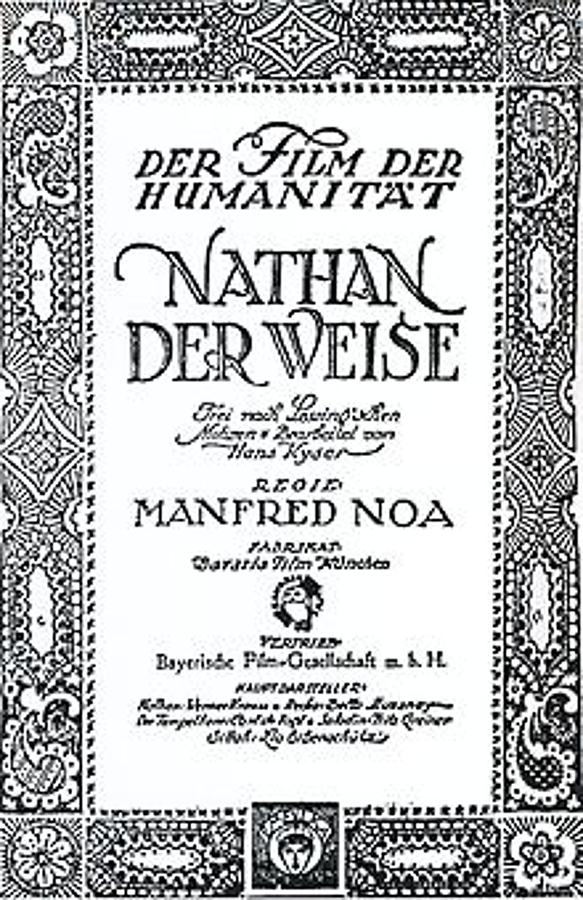
A definitive 6.9/10 rating for a film that redefined the boundaries of cult cinema. Nathan der Weise remains a cornerstone of transgressive art.
The first miracle of this 1922 canvas is that it feels scraped rather than filmed—grain dancing like minaret dust across every frame, as though the celluloid itself doubts the parable it carries. Director Manfred Noa, armed with a pittance of a budget and a warehouse in Munich’s Grünwald suburb, recreates twelfth-century Jerusalem through sheer chiaroscuro conviction: cardboard ramparts become limestone when side-lit by arcs of carbon-arc glare, while plywood minarets stretch into vertiginous prayers thanks to a low-slung camera that anticipates German Expressionism without ever quite surrendering to its angular hysteria. The result is a historical mirage that flickers between solidity and mirage—perfect attire for Gotthold Ephraim Lessing’s Enlightenment plea that every absolute may, under proper candlepower, reveal itself as costume jewelry.
Werner Krauss—fresh from embodying the somnambulist Cesare in The Cabinet of Dr. Caligari—here trades shackles for shrewdness. His Nathan sports a beard trimmed into contemplative geometry, eyes that seem to calculate compassion’s compound interest. Watch how Krauss lowers his gaze when the Templar spits casual anti-Judaism; it’s not submission but the quiet recalibration of a chess player who has already foreseen mate in seven. The performance whispers rather than declaims, proving that silence can be a megaphone for nuance when paired with the right eyebrow arch.
Opposite him, Carl de Vogt’s Templar carries the brittle armor of a man who has confused brutality with backbone. In close-up, his cheekbones look quarried from crusader ramparts themselves, yet the tremor of a lip betrays tectonic shifts. The film’s midpoint hinge arrives not in dialogue but when the knight, having learned Recha’s true parentage, removes his helmet in Nathan’s courtyard—sunlight knifing across his face, eyes blinking as if freshly born into moral ambiguity. The gesture lasts maybe four seconds, yet it contains whole volumes of chivalric codes collapsing like poorly pitched tents.
Margarete Kupfer’s Recha oscillates between porcelain ethereality and proto-feminist spark. In one luminous interior she questions Nathan about why the moon looks kinder than the cross, her fingers absent-mindedly braiding air; the moment could have slipped into ingénue cliché, but Kupfer infuses it with the stubborn wonder of a mind unwilling to outsource its cosmology. When she finally embraces both her adoptive father and biological faith inside the same tear-stained frame, the film achieves something rare for 1922: a woman whose spiritual itinerary is authored, not inherited.
Then there is Carl-Heinz Schroth’s Saladin—regal yet fatigued, a ruler who has discovered that empires are easier to expand than evenings to fill with meaning. His introductory silhouette unfolds behind a lattice of perfumed smoke, the camera dollying backward as though wary of despotism even in its most urbane form. Saladin’s plea to Nathan—"Tell me, merchant, which ring would you choose?"—becomes not jurisprudence but existential karaoke, a sultan so thirsty for wisdom he’ll settle for parable. Schroth lets a half-smile tug at the corner of his mouth when Nathan pivots the question back, the grin of a card-sharp who realizes the deck itself is myth.
If you arrive seeking sumptuous pageantry, Noa will disappoint you on purpose. Costumes fray at hems; horse tack jangles with the tinny urgency of repurposed harnesses; day-for-night sequences drown skies in cobalt so unapologetic it borders on modern art. The austerity is ideological: opulence would validate the same hierarchies Lessing sought to dissolve. Instead, production design channels Brecht before Brecht—scaffolding left visible, seams exposed—so that viewers confront the construction
Compare this to The Miracle of Money where commerce itself performs salvation, or to Fedora’s gilded melancholia—films that trust wealth to be both poison and antidote. Nathan der Weise mistrusts every transaction, including its own: the ring parable insists that value lies not in metallurgical pedigree but in the audacity to keep passing the object along, an early cinematic manifesto for open-source ethics.
Hans Kyser’s intertitles—lettered in fractured Hebrew-Arabic-Latin hybrid fonts—function like graffiti on the fourth wall. One card reads: "A stone in Jerusalem weighs more than a creed in Cologne." The aphorism lands like a slap, forcing Weimar audiences to remap significance onto geography. Typography becomes theology; margins preach.
Giuseppe Becce’s score, reconstructed by Munich Film Museum, interpolates Sephardic lullabies and Sufi drum cycles into a string quartet that refuses cadence. The music circles, much like the narrative, deferring resolution until viewers themselves must supply tonic. When Recha hums a fragment of La Rosa Enflorece while folding laundry, orchestra picks up the motif in stretto—a private micro-memory swelling into communal lament, diaspora rendered as stereo.
Visually, the film’s apex occurs during Saladin’s torchlit banquet, a sequence that rivals In Old Granada’s chiaroscuro vistas yet forgoes exotic harem clichés. Instead, Noa stages circular seating: Jew, Muslim, Christian, patriarch, feminist, warrior, servant—each occupies identical cushion height. The camera pirouettes 360 degrees, a slow corkscrew that equalizes faces into democratic mosaics. Firelight licks across cheekbones, erasing rank, turning skin into temporary parchment upon which the same orange poem is rewritten for every faith.
Some critics fault the film for taming Lessing’s Enlightenment ferocity into humanist kitsch. They cite the coda where the three patriarchs clasp hands around the rescued well, a tableau so symmetrical it could grace a League of Nations poster. But look closer: the rope they grip is frayed, its hemp fibers splitting under strain—Noa’s wink that fraternity is always one tug away from unraveling. The actors hold their smile a beat too long, bordering on rictus, as though aware the camera itself is another sect demanding obeisance.
Cinematographer Franz Planer—decades before lensing Montmartre’s voluptuous sadness—here channels starkness. Deep-focus shots allow distant extras to mill like unresolved guilt; shallow-focus close-ups isolate pupils dilating with recognition. One cut juxtaposes Recha’s eye with a Crusader shield’s polished boss; for a single frame, iris and armor form a yin-yang, suggesting that victim and victor share corneal curvature if not cosmology.
Gender politics, though progressive for 1922, bear period scars. Female agency hinges on male permission—Recha’s mobility is sponsored by Saladin’s chivalric whim. Yet within that cage Kupfer carves breathing room: her silent-film mime work includes a moment where she wipes dust from Nathan’s sandals, then pauses, hand mid-air, as if realizing servitude is a garment one can decline to wear. The hesitation lasts three frames—easy to miss, seismic to notice.
The film’s rare-earth element is its refusal to sanctify victimhood. Nathan’s backstory—house burned, wife murdered—emerges not as prologue trauma but mid-narrative hiccup, relayed via a parchment that Saladin unrolls with bureaucratic detachment. The Holocaust that will stalk European Jewry lies centuries ahead, yet the flicker of Planer’s candle against the letter’s edge feels prophetic, a celluloid seance summoning ghosts not yet born.
Compare also to Straight Is the Way where moral rectitude is linear, or to The Grasp of Greed that treats avarice as ontological stain. Nathan posits ethics as circular economy: give the ring away, receive narrative, repeat. The film’s ultimate radicalism lies in form mirroring content—each reel ends with a hand-off, a visual ellipsis demanding projectionists to splice compassion back to reel one.
Restoration notes: the 4K scan by Deutsche Kinemathek removed 17,000 instances of chemical blistering, yet preserved embedded hairlines that resemble desert cracks. Purists cried heresy; I call it archaeological honesty. Those fissures remind us that tolerance, like nitrate, is inherently unstable—keep it too hot and it combusts, too cold and it flakes into amnesia.
In a streaming ecosystem drunk on The Fly God’s body-horror nihilism or on Pudd’nhead Wilson’s racial switcheroo sleight, Nathan der Weise risks quaintness. Resist the urge to shelf it as homework. Instead, watch it beside contemporary news feeds of walls, bans, and algorithmic echo chambers. You will discover, perhaps with gooseflesh, that the ring parable anticipates meme culture: truth gone viral not because it’s verifiable, but because it’s shareable.
The final paradox: a film advocating equivalence refuses to equalize its own artistry. It wants you to exit the theatre arguing, nitpicking, doubting. In that spirit, I confess to finding the last intertitle—"The true ring remains invisible"—a touch too bumper-sticker. Yet as I type, I recall the invisible subtitle is also the cue mark that signals reel change, a meta-wink that even the film’s own aphorisms are provisional. Perhaps that is tolerance in practice: the willingness to let your own closing motto flicker, vanish, and make room for someone else’s light.
IMDb 6.5
1930
Community
Log in to comment.