DbcultAccessing Vault...
Cult Review
Senior Film Conservator
The year 1921 stood as a pivotal meridian in the evolution of the moving image, a time when the crude antics of the nickelodeon were being refined into the sophisticated visual grammar of the silent feature. Within this transformative milieu, Nip o' Scotch emerges not merely as a relic of forgotten laughter but as a testament to the directorial genesis of Roy Del Ruth. While many of his contemporaries were preoccupied with the burgeoning sentimentality seen in works like The Old Nest, Del Ruth leaned into the visceral, the kinetic, and the unapologetically absurd.
To understand the structural integrity of Nip o' Scotch, one must acknowledge the environment of its creation. The Mack Sennett studio was a laboratory of timing, a place where gravity was a suggestion and logic was subservient to the laugh. Del Ruth, often overshadowed by the later giants of the sound era, displays here a burgeoning mastery of the frame. Unlike the sprawling historical pageantry of The Queen of Sheba, which sought to overwhelm the viewer with scale, Del Ruth finds depth in the miniature. Every movement in this short is calibrated. The way a character reacts to a bottle of scotch isn't just a gag; it’s a study in human frailty and the explosive potential of prohibition-era anxieties.
The film’s pacing is relentless. It avoids the languid developmental cycles found in Mr. Opp, instead opting for a percussive delivery of narrative beats. Each scene is a brick in a wall of escalating tension, where the payoff is always a release of physical energy. This is not the comedy of manners found in The Stimulating Mrs. Barton; it is the comedy of the body, the comedy of the collision.
Critics often dismiss early 20th-century shorts for their reliance on ethnic tropes, but Nip o' Scotch utilizes the Scottish archetype as a surrealist mask. The kilt, the sporran, and the titular scotch are not just props; they are symbols of a misplaced identity in a rapidly modernizing world. This thematic undercurrent provides a fascinating contrast to the more somber, identity-focused narratives of European imports like De røvede Kanontegninger. While the latter deals in espionage and national secrets, Del Ruth deals in the secret of the perfect pratfall.
The performance of the lead, deeply embedded in the Sennett tradition, mirrors the frantic energy of a man caught in a storm. There is a specific desperation in the silent comedian’s eyes—a realization that the world is inherently hostile to their dignity. This same sense of impending doom, though played for laughs here, echoes the more serious stakes of Under Suspicion. Both films navigate the precariousness of social standing, though Del Ruth ensures that the fall from grace is literally a fall down a flight of stairs.
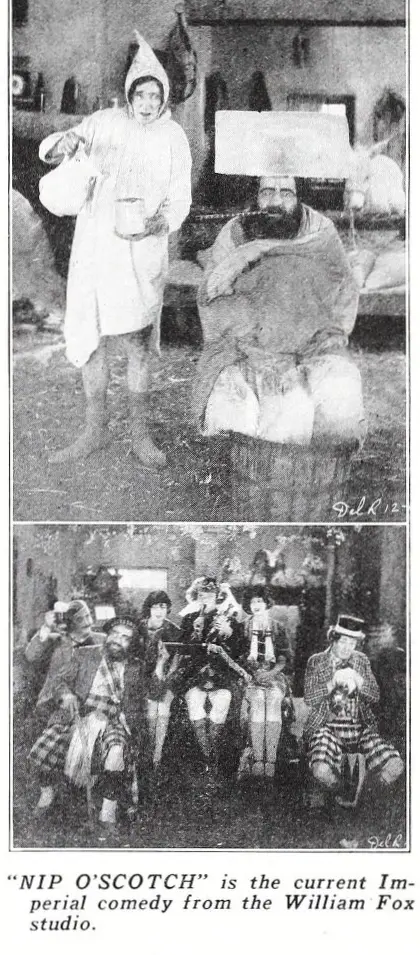
When we place Nip o' Scotch alongside The Skipper's Narrow Escape, we see a divergence in how comedy was being packaged for the masses. The 'Skipper' series relied on a certain domestic familiarity, whereas Del Ruth’s work feels more experimental, more willing to push the boundaries of visual distortion. The scotch becomes a hallucinogenic lens through which the world is warped, a technique that predates the more overtly stylistic flourishes of later avant-garde cinema.
Furthermore, the ruggedness of the outdoor sequences—brief as they may be—invokes a strange kinship with the maritime brutality of The Sea Wolf. Of course, where Jack London’s adaptation seeks to find the animal in man through violence, Del Ruth finds the animal in man through the loss of motor skills. It is a cynical, yet hilariously honest, appraisal of the human condition. The film doesn't ask us to sympathize with the protagonist's plight; it asks us to witness the mechanical failure of his intentions.
The cinematography in Nip o' Scotch is deceptively simple. The camera remains mostly static, allowing the performers to inhabit the space with their histrionics. However, the depth of field is utilized with surprising efficacy. Background gags occur simultaneously with foreground action, creating a layered comedic experience that demands multiple viewings. This density of information is something one might expect from a Dickensian adaptation like Barnaby Rudge, but to find it in a two-reel comedy is a testament to the ambition of the Del Ruth/Sennett collaboration.
Consider the lighting—stark, high-contrast, and functional. It lacks the moody, atmospheric shadows of Centocelle, yet it serves the clarity of the action perfectly. In slapstick, shadow is the enemy of the punchline. Everything must be visible; every twitch of the lip, every spill of the drink. The clarity of the image mirrors the clarity of the comedic intent. There is no ambiguity in a Roy Del Ruth short; there is only the setup, the anticipation, and the glorious, messy execution.
One cannot ignore the year 1921 without mentioning Prohibition. Nip o' Scotch is, in many ways, a subversive commentary on the illegality of leisure. The obsession with the 'nip' reflects a society that was forbidden from its vices, making the pursuit of alcohol a comedic quest of epic proportions. This search for a forbidden prize mirrors the desperate hunt in $5,000 Reward, though the currency here is liquid rather than paper. The protagonist’s struggle is the struggle of the common man against an overreaching legislative body, played out through the medium of spilled booze and wobbly legs.
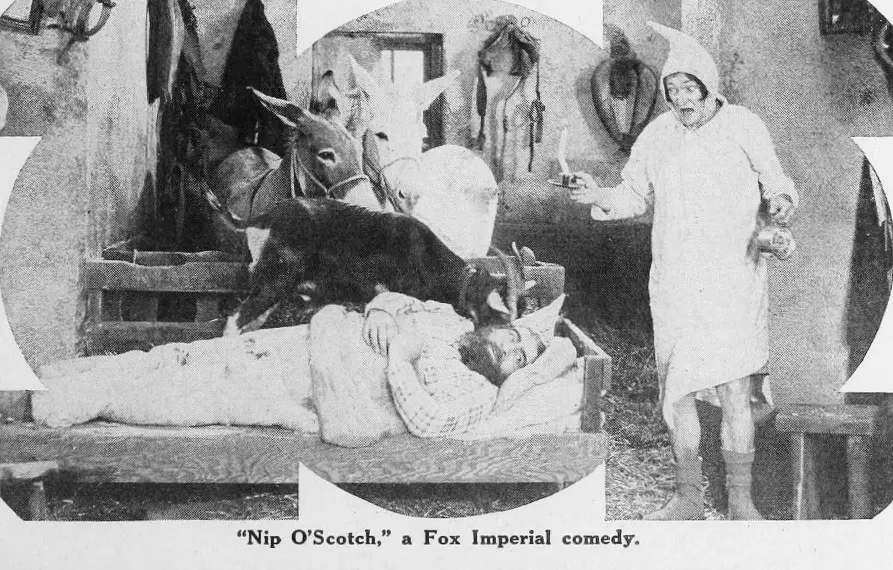
This rebellious spirit is a common thread in the era's output. Whether it’s the urban displacement of This Way Out or the historical yearning of The Dawn of Freedom, the films of this period were grappling with what it meant to be free in a changing America. Nip o' Scotch suggests that freedom is found in the ability to make a fool of oneself, a sentiment that feels remarkably human and timeless.
While Roy Del Ruth holds the directorial reins, the presence of the Sennett regulars—most notably Billy Bevan (though the prompt focuses on Del Ruth as the primary entity)—cannot be understated. The performance style is a lexicon of gestures that have largely vanished from modern cinema. It is a language of the eyes and the limbs. The way the protagonist navigates the screen reminds one of the bustling streets in When Broadway Was a Trail, where the environment itself is an obstacle to be overcome. In Nip o' Scotch, the obstacle is often the character’s own lack of coordination, exacerbated by the titular beverage.
The film’s conclusion, a whirlwind of resolution that leaves the audience breathless, avoids the moralizing endings of films like Dodging a Million. There is no lesson learned here, no fortune gained, and no character growth. There is only the survival of the ordeal. This lack of artifice is what makes the film so enduringly watchable. It doesn't pretend to be more than it is: a masterclass in the rhythmic application of physical humor.
In the vast ocean of silent cinema, Nip o' Scotch is a bright, flickering lighthouse. It represents a moment in time when the medium was discovering its power to manipulate time and space for the sake of a chuckle. Roy Del Ruth would go on to direct major features, but the DNA of his later success is visible in the frantic frames of this short. He understood early on that cinema is movement, and movement is life.
To watch Nip o' Scotch today is to peel back the layers of film history and find a core of pure, unadulterated joy. It is a reminder that while technology changes and social norms shift, the sight of a man struggling against the simple physics of the world will always be fundamentally hilarious. It stands as a vibrant, whiskey-soaked monument to the era of the pratfall, demanding our attention not just as a historical curiosity, but as a living piece of art that still manages to land its punches with the precision of a heavyweight champion.
Reviewer's Note: For those seeking a deeper dive into the technical evolution of the 1920s, I highly recommend contrasting the editing techniques here with those in The Sea Wolf or the narrative density of Barnaby Rudge. The contrast reveals the true versatility of the silent era's pioneers.
IMDb 7.4
1921
Community
Log in to comment.