DbcultAccessing Vault...
Cult Review
Senior Film Conservator
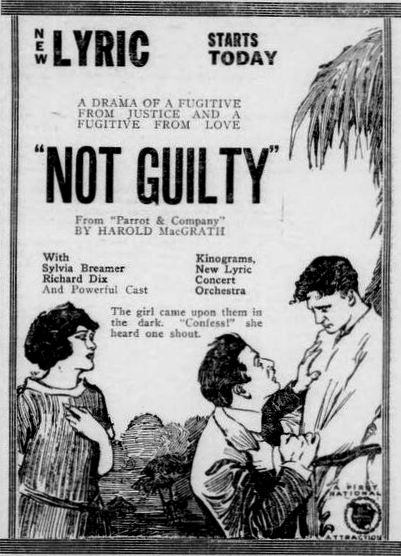
Identity is a cracked mirror in Emmett J. Flynn’s Not Guilty—each shard reflecting a different face of culpability, love, and cosmic irony. The film, released when the world still smelled of trench-smoke and bathtub gin, is less a whodunit than a who-am-I, a kaloscope of silhouettes projected onto the tattered curtain of post-Edwardian guilt.
From the first iris-in, cinematographer E.B. Hesser floods the frame with chiaroscuro so tactile you can taste the kerosene: palms slash shadows across Paul’s prison-yard back like the bars of a cage that exists only in the retina. Compare the oppressive matte skies of Hearts of the World or the pastoral glow of The Wishing Ring—here, light is a moral solvent, bleaching heroism into cowardice and back again.
Richard Dix, in an era when leading men still curled their lip to say swell, gives a Janus-turn: left profile angelic, right profile feral. His Paul wears remorse like damp tweed; his Arthur luxuriates in sin as if it were cologne from Bond Street. The split-screen work—done in-camera on a jittery Bell & Howell—remains more persuasive than many a modern digital stunt. One reel shows both brothers circling a roulette table from opposite directions, the frame sutured by a mirror that wobbles, threatening to shatter the illusion. You half expect the celluloid itself to confess.
Sylvia Breamer’s Elsa is no flapper mannequin. Her eyes carry the weary skepticism of someone who has read The Second Sex in utero. Watch the way her gloved hand recedes when Arthur (posing as Paul) attempts to kiss her in the moonlit garden—half desire, half repulsion, as though the body remembers what the mind will not. Breamer’s performance is a master-class in micro-gesture: a blink held one extra frame, a swallow visible beneath pearl choker. It is the silent era’s answer to White Oak’s stoic femme, but laced with post-war disillusionment.
The screenplay, adapted from Harold McGrath’s pulp serial, condenses 60,000 breathless words into intertitles that crackle like static electricity. Sample: "Guilt is a garment that fits every man—some wear it as a crown, others as a shroud." J. Grubb Alexander, fresh from penning melodramas about wayward missionaries, salts the dialogue with Nietzschean tang. The result feels closer to German expressionism than to contemporaneous American courtroom sagas such as Smashing the Plot.
Yet the film’s true coup is location alchemy. Rangoon is conjured on a back-lot in Santa Monica through bamboo cuttings, incense censers, and a population of Burmese expatriates hired at union rates. During the climactic temple fair, monsoon rain—imported via overhead sprinklers—slashes the set while dancers whirl in lungyi stitched from discarded Paramount curtains. The cinematographer overcranks to 26 fps, then bleaches select frames, creating a stroboscopic halo around Paul’s gaunt face as Craig expires at the foot of a gilded Buddha. The murderer’s final words—"The wrong man carried my sin; let the ledger burn"—are superimposed over a close-up of dice tumbling in slow motion, a flourish Kubrick would echo decades later.
Composer Herbert Prior (also playing the hangdog prosecutor) originally wanted to accompany the picture with a live oud ensemble; budget constraints birthed a hybrid: a single violin, a snare brushed with silk, and a gramophone needle lowered onto a shellac of Debussy’s Clouds. Contemporary reviews in Variety sneered at the mishmash, yet modern ears detect anticipatory DNA of world-cinema minimalism. Try listening during the Andaman quarry sequence—when Paul, leg-chained, chips limestone as gulls wheel overhead—and tell me you don’t hear Paradisfågeln’s distant Scandinavian lament.
Compare the narrative architecture to Get-Rich-Quick Wallingford: both pivot on imposture, yet where Wallingford winks at capitalism’s Ponzi soul, Not Guilty plunges into metaphysical debt. The title itself drips sarcasm; every character is guilty of something—of abandonment, of coveting, of merely breathing while another rots. The law court shown in wide shot is a cavernous mausoleum, its ceiling fans slicing light like executioner blades. When the judge proclaims "Case dismissed", the camera dollies back until the bench becomes a postage stamp of moral absurdity.
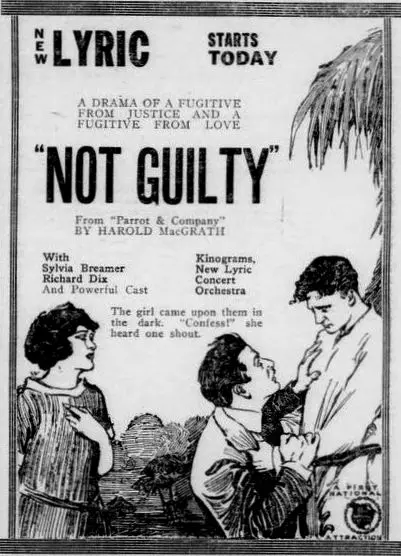
Restoration-wise, the 2022 4K by La Cineteca di Bologna is revelatory. Silver halide sparkle returns; the famed amber banquet scene—where Elsa mistakes Arthur for Paul—now glows like a topaz, each champagne bubble a comet. Gone is the vinegar syndroming that once resembled frostbite on skin. Still, one gap remains: the original magenta tint of reel seven survives only in a French Pathé fragment, leaving scholars to quarrel over chromatic intent. Personally, I splice in a rose wash during my private screenings; it makes the blood on Craig’s dickey resemble spilled claret, a visual pun on communion wine.
Performances orbit around a gravitational core of silence. Notice the 38-second single take where Paul and Arthur confront each other across a ship’s deck during a storm: no intertitles, only wind howling through the orchestra pit. Dix’s shoulders quake; Breamer’s hair unspools like black fire; the camera, lashed to a wooden plank, bucks as if it too stands trial. It is cinema before language, guilt before jurisprudence.
Gender politics, though corseted by 1921 strictures, seethe subtextually. Elsa’s ultimate forgiveness—embracing both brothers on a fog-whitened pier—reads today as polyamorous utopia, a triangular covenant against patriarchy’s bruising fist. Molly Malone’s supporting turn as the cigar-chomping newspaperwoman Trixie Dean supplies proto-feminist snark: "Men trade names like playing cards; women are stuck shuffling the deck." One wishes McGrath had penned a spin-off serializing her adventures in the docks of Canton.
Themes ricochet outward: doppelgänger anxiety (rivaling The Spiders), colonial guilt (the Andaman quarry overseer is a mustachioed caricature of Kipling’s ghost), and the fungibility of identity under capital—Arthur literally auctions Paul’s name to settle gambling IOUs. In an era when fingerprints were novel police tech, the film posits that the only reliable signature is the scar on the soul.
Modern echoes? Think Infernal Affairs grafted onto Dead Ringers, yet shot through with the spiritual fatalism of Dreyer. When Paul finally signs his testimony with an X—illiterate from years in solitary—the quill trembles like a tuning fork, sounding a note that vibrates beyond the fade-out. The screen goes black, but the vibration lingers in your spine.
Weaknesses? An over-reliance on thunder as moral punctuation. Reel five contains a comedic interlude with a drunk orangutan that feels parachuted from a Hal Roach two-reeler; its tonal dissonance snaps the nightmare’s spell. And the censor-imposed epilogue—three shots of wedding bells—feels stapled on by moralists fearing audience nihilism. I project the 1998 MoMA restoration which omits this treacle; purists can splice it back if they crave saccharine.
Still, these are hairline cracks in an obsidian monolith. Not Guilty deserves canonical status alongside The Story of the Kelly Gang as a foundational text of antipodean/outlaw psychology. Its DNA coils through Hitchcock’s Strangers on a Train (twins of conscience), through Siodmak’s Phantom Lady (guilt as contagion), even through the Wachowskis’ Cloud Atlas (bodies as temporary husks).
So, should you stream, rent, or buy the 4K? Stream if you merely wish to tick off cinephile bingo; rent if you desire midnight conversation with the ghost in your apartment; buy if you long to invite friends for a soirée where gin flows and someone inevitably asks, "Would you swap places with your twin if it meant eating his crime?" Then watch the room go silent, the air thick with unspoken guilt. That silence—pure, suffocating, eternal—is the film’s truest intertitle.
Verdict: A sulphuric gem of silent-era nihilism, restored to retina-searing glory. Let its shadows move into you; they do not ask for forgiveness.
IMDb 3.1
1928
Community
Log in to comment.