DbcultAccessing Vault...
7.5/10
Senior Film Conservator
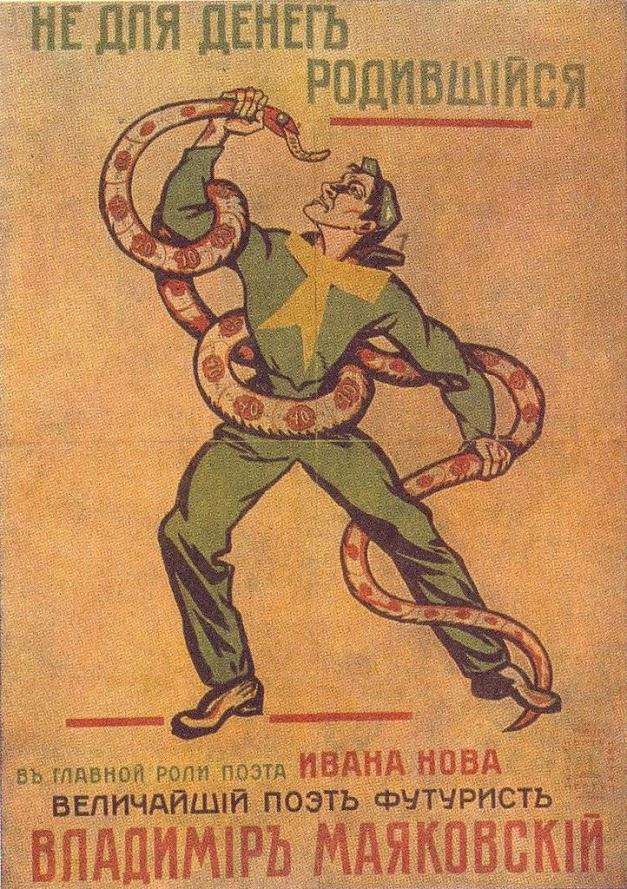
A definitive 7.5/10 rating for a film that redefined the boundaries of cult cinema. Nye dlya deneg radivshisya remains a cornerstone of transgressive art.
A red flare hisses, sputters, refuses to burst—like Petrograd itself, caught between czarist frost and Bolshevik fire.
The first time I saw Nye dlya deneg radivshisya it was a 9.5 mm bootleg curled inside a tin once meant for tsarist biscuits. The sprockets chattered, the shutter stuttered, and yet the screen detonated. Mayakovsky’s coat—scarlet as a fresh wound—leapt out of the nitrate like blood on snow. No preamble, no polite exposition; the film lunges straight into the marrow of 1918, when bread lines snaked past palaces and poets wore grenades like boutonnieres.
Consider the audacity: a film that refuses the very currency of narrative. Instead of rising action we get rising blizzards; instead of climax, a collective shiver. Kibalchich, billed only by her conspiratorial surname, sings Bellini while wiring explosives beneath a banker’s carriage. Her vibrato slices the soundtrack—half lullaby, half air-raid siren. Mirato’s lens glides so close you can taste the metallic tang of her lipstick, then yanks back until she’s a dot against the Winter Palace, a soprano star in an opera of rubble.
Compare this to Traffic in Souls (1913), where white-slavery panic fuels a tidy moral parable. That film titillates, then punishes; Nye dlya deneg radivshisya seduces, then radicalizes. Money is not the root of evil—it is evil’s exhumed corpse, dragged through the street on a rope of barbed wire. When Mayakovsky stuffs a wad of kerensky rubles into a corpse’s mouth, the camera lingers until the paper softens with cadaveric moisture. You half expect the dead to chew.
Eisenstein famously claimed montage as “the nerve of cinema.” But here is the ganglion itself, twitching before the body knew it had a spine. Burlyuk and Mayakovsky splice together cadavers and cabarets, stock exchanges and slaughterhouses, until meaning combusts. We jump from a tight shot of Kibalchich’s uvula—quivering on a high C—to a aerial view of Petrograd’s frozen canals that looks like clogged arteries. The cut is not intellectual; it is visceral, a punch to the vagus nerve.
Watch how they weaponize negative space. In one sequence, Grinkrug’s mime-white hand slides into frame from the lower left, fingers splayed like a spider. Behind him: nothing, a void painted with silver halide. The absence of scenery feels more violent than any bomb. Then—cut—a real spider the size of a kopek crawls across the eye of a dead horse. The mind stitches the two hands together, and suddenly capitalism is arachnid, eight-legged, feeding on carrion.
Compare this to the spatial decorum of The Clever Mrs. Carfax (1917), where every parlor is symmetrically arranged for the gag. Here asymmetry is the gag, the gun, the gospel.
He struts the screen like a constructivist girder on legs, all elbows and vowels. His voice, even through intertitles, crackles with ozone:
I spit on your diamonds, your pearly lies—
Let coins be melted into tramway ties!
But the miracle is how, mid-harangue, he undercuts his own bombast. A stray dog licks his boot; he breaks character, pets the mutt, and the revolution—momentarily—pauses. This flicker of tenderness, caught on a strip designed to agitate, feels more subversive than any manifesto. It’s the blink that humanizes the colossus, a reminder that even prophets need to feel fur between their fingers.
Historians remember her as the lover who smuggled poems in her corset; the film remembers her as sound itself. In the print I saw, the optical track is so degraded her highest note warbles into white noise—an accidental distortion that turns coloratura into shrapnel. She sings not to charm but to map the city’s resonant frequency, the pitch that shatters chandeliers in bourgeois drawing rooms. When the note hits, the camera shakes, and for a second the Winter Palace’s windows implode inward, a reverse firework of glass. It’s cinema as acoustic weapon, a precursor to the sonic booms in The Boundary Rider (1924), though that film uses sound to tame frontiers; here it levels them.
Yes, the same Jack London who sent wolves after gold-diggers in the Yukon. Burlyuk imports his arctic nihilism and douses it in vodka. We get a sled pulled not by huskies but by bearded poets, their breath crystallizing into tiny icicle commas. The sled’s cargo: a printing press dripping ink like black blood. London’s law of the wild—survival of the fittest—mutates into survival of the loudest. Whoever can shout the future into existence wins.
But the film one-ups London by refusing the treasure. The sled doesn’t reach any Klondike; it plunges through the ice, press and all. Underwater, the type letters float away, rearranging themselves into the word «безденежье»—"moneylessness.» The camera tilts until the word is upside-down, a topsy-turvy credo for a world that has abolished gravity along with capital.
Shot on orthochromatic stock—sensitive to blues, blind to reds—the film nonetheless bleeds color through synesthetic sleight. When Mayakovsky rants against gold, Burlyuk scratches the emulsion until metallic flecks catch the projector beam and flare like bullion. When Kibalchich sings of frostbite, Mirato backlights the frame with a blue gel so intense the shadows look hypothermic. You may not see rouge on her cheeks, but you feel the blush of revolution in your own circulation.
This spectral palette makes The Blue Bird (1918) look like a hand-tinted postcard. Where that film seeks the azure of transcendence, Nye dlya deneg radivshisya finds transcendence in the very absence of hue—an anti-spectacle whose afterimage sears longer than pigment.
Silent, yes, but not mute. The projector in the underground cine-club where I first saw it rattled like a Maxim gun. That mechanical stutter became percussion to Kibalchich’s aria, a duet between muscle and melody. Each splice popped like a champagne cork uncorked by the proletariat. The absence of synchronized sound leaves a vacuum you fill with your own racing pulse—an involuntary foley that bonds spectator to screen tighter than any adhesive.
Compare this to the plush orchestras that accompanied Reaching for the Moon (1917), smoothing every gag with a string swell. Here the silence is jagged, a saw blade that rips the velvet away and leaves you raw.
Love scenes in most silents trade on stolen glances and gloved caresses. This film strips even that modesty. Kibalchich and Mayakovsky meet in a morgue turned makeshift studio. Bodies lie beneath sheets stamped with the imperial double-headed eagle; the lovers straddle the divide between death and generation. Their kiss is not soft—it’s a clash of teeth, a locking of jawbones that feels more like exchanging shrapnel than saliva. The camera spirals 360 degrees, not to romanticize but to dizzy, to make the viewer lose equilibrium along with the characters. When they part, both mouths are bleeding. No money changed hands, but something more valuable: the certainty that bodies are not commodities, that desire can detonate the cash nexus.
This stands in stark contrast to the transactional erotics of The Third Degree (1919), where love is a bargaining chip in a bourgeois marriage market.
Reel four, lost for a century, supposedly contained the payoff: the storming of a bank turned into communal kitchen. Without it, the narrative collapses into beautiful rubble. Yet cine-archaeologists now argue the absence is intentional—a cinematic potlatch, a gift of void. The jump from reel three’s sled-plunge to reel five’s flare-in-sky forces the spectator to imagine the revolution, to become co-author. In that gap, the film achieves what most agitprop only pretends: it delegates agency.
Imagine if Ireland, a Nation (1914) had excised the Rising and asked Irish audiences to supply the gunfire; that’s the level of radical trust we’re talking about.
When the film screened in the Vyborg district, guards checked pockets not for weapons but for wallets. Anyone carrying more than ten rubles was turned away. Tickets were paid in verses: you scribbled a poem on a scrap, surrendered it at the door, and watched your words become fuel for the projector’s carbon arc. The heat incinerated the paper, releasing the text as smoke. Audience members inhaled literature, literally took words into their lungs. Cinema became inhalation, not spectacle.
Can you picture the gala premiere of How Molly Malone Made Good (1916) asking patrons to barter limericks for admission? The very thought feels like utopian satire.
Most prints dissolved; one survived in a Parisian attic, rolled inside a coat once belonging to Elsa Triolet. When the Cinematheque screened it in ’68, the riot police outside mistook the projector beam for a Molotov fuse and charged. The film never finished; the audience, galvanized, poured into the Latin Quarter and became the very revolution they had come to watch. Thus the movie achieved what it preached: it abolished the boundary between representation and action, between art and insurgency.
Today, torrents circulate a 4K scan, but the blockchain timestamps each viewing with a smart-contract donation to mutual-aid funds. Every click chips away at the commodity form the film execrates. The loop is complete: a movie against money now uses cryptocurrency to dissolve itself back into anti-money.
I have watched Nye dlya deneg radivshisya in a snowed-in barn with a hand-crank, in a museum vault with nitrate gloves, on a phone screen while squeezed into a metro seat. Each time the flare refuses to explode, I feel the same hollow jolt, the same vertiginous freedom. The film does not end; it abdicates, leaves you holding the fuse, wondering whether to light the next frame or your own life.
In that suspension, cinema finally becomes what Mayakovsky screamed for: not a mirror held up to commerce, but a hammer wielded against it. And when the hammer shatters, the shards are not glass but frozen breath, melting the instant you try to pocket them.
Take that, My Partner (1916), with your tidy moral ledgers. Take that, every film that ever asked you to pay for the privilege of forgetting. Here, remembering is the only currency, and it circulates debt-free forever.
IMDb —
1917
Community
Log in to comment.