DbcultAccessing Vault...
Cult Review
Senior Film Conservator
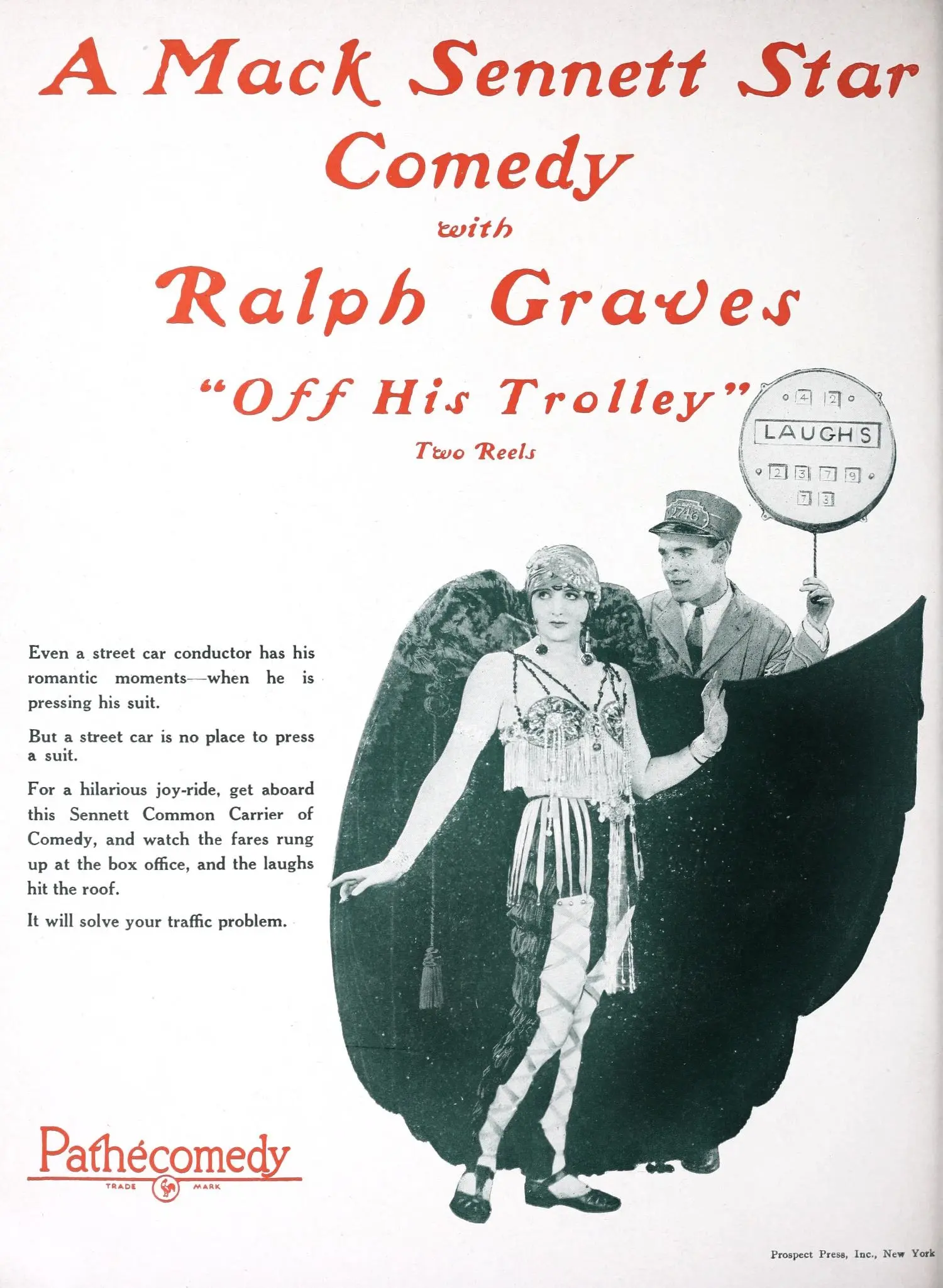
In the pantheon of 1924’s silent offerings, few films capture the manic desperation of the urban working class with as much kinetic energy as Off His Trolley. While the title suggests a whimsical departure from reality, the film is rooted in a surprisingly gritty pecuniary anxiety. Our protagonist, a streetcar conductor portrayed with frantic athleticism by Barney Hellum, is not merely a vessel for slapstick; he is a manifestation of the era’s burgeoning consumerist trap. Much like the characters in The Twinkler, he is a man whose aspirations are consistently strangled by the reality of his ledger. The film opens not with a joke, but with the weight of debt—a heavy, suffocating presence that defines his every interaction.
The 1920s were a period of radical transition, and this film serves as a fascinating cultural artifact of that shift. The trolley itself is a symbol of the old guard, a fixed track of labor and predictable movement. Contrast this with the allure of the automobile—a machine of perceived freedom that ultimately leads our hero to ruin. This thematic tension between the fixed track and the open road mirrors the psychological struggle of a man torn between the stability of his "fair damsel" and the chaotic attraction of the cabaret. It is a narrative framework that shares a spiritual lineage with The Devil's Garden, where the environment itself seems to conspire against the protagonist's moral fortitude.
Enter the vamp—a character archetype that by 1924 had become a staple of cinematic morality plays, yet here she is rendered with a particularly predatory sharpness. She is the catalyst for the conductor's descent, a figure who exists in the flickering shadows of the cabaret, away from the honest sunlight of the streetcar tracks. Her "wiles" are not merely romantic; they are transactional. She represents the seductive nature of the high life that the conductor cannot afford but desperately craves. In many ways, her character serves as a more comedic, though no less destructive, version of the figures found in Lulù (1923).
The sequence where she wins the diamond ring—a piece of jewelry only partially paid for—is a masterclass in the comedy of erosion. We watch as the conductor’s meager possessions are stripped away in a series of social maneuvers he is ill-equipped to handle. The ring is a symbol of his commitment to his fiancée, yet he surrenders it to a woman who views it only as a trophy of her influence. This scene highlights the film's obsession with the fragility of ownership. In the world of Off His Trolley, nothing is truly owned; everything is on credit, everything is precarious, and everything can be lost in a moment of weakness.
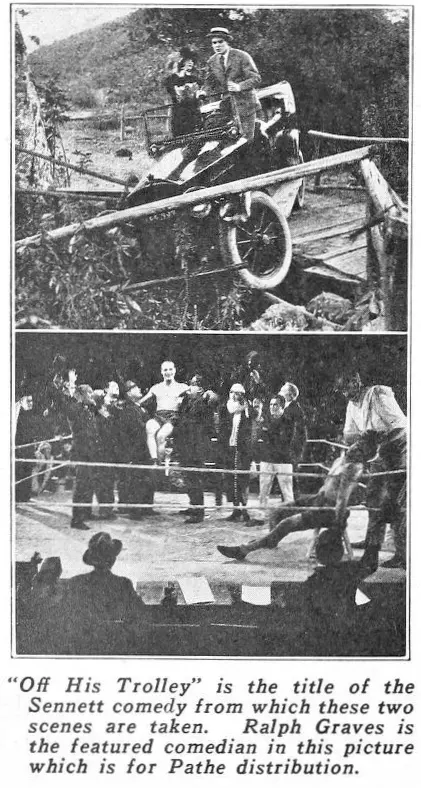
The acquisition of the car marks the peak of the conductor's hubris. In the mid-twenties, the automobile was the ultimate signifier of social mobility. For a man who spends his days on the fixed rails of a trolley, the car represents an escape from the tracks of his social class. However, the film treats this vehicle not as a chariot of liberation, but as a ticking time bomb of mechanical and financial failure. The car, like the ring, is only "owned to some extent," a phrase that perfectly encapsulates the debt-fueled expansion of the American economy during this period. It is a theme echoed in the social critiques of Egyenlöség, though here it is filtered through the lens of Mack Sennett-style chaos.
The climax of the film—the wreck in the rain—is where the slapstick transcends mere comedy and enters the realm of the existential. The rain is the great leveler. It washes away the cabaret’s glitter and the car’s prestige, leaving only the cold reality of the mud. The wreck is not just a collision of metal; it is the collision of the conductor’s fantasies with the unyielding laws of physics and finance. As the car dissolves into a useless heap of iron, the conductor and the vamp are forced into the most egalitarian of acts: walking. This sequence is shot with a surprising amount of atmosphere, the rain creating a claustrophobic, shimmering world that mirrors the protagonist's internal state. It lacks the mystery of Lucille Love: The Girl of Mystery, but replaces it with a raw, tactile sense of failure.
The success of Off His Trolley rests heavily on its ensemble. Barney Hellum possesses a face that is a map of anxiety, his wide eyes and frantic gestures making him the perfect victim for the film’s escalating misfortunes. He doesn't just fall; he disintegrates with grace. The inclusion of Alice Day and Natalie Kingston adds a layer of professionalism and charm that elevates the material above standard two-reelers. Alice Day, in particular, provides the necessary emotional anchor as the "fair damsel," her presence a constant reminder of what the conductor is risking for his fleeting moment of cabaret glory.
Behind the scenes, the writing team—including the legendary Tay Garnett and Rob Wagner—infuses the script with a cynical wit. Garnett, who would go on to direct noir masterpieces, shows early signs here of his fascination with the darker side of human desire. The pacing is relentless, a hallmark of the John A. Waldron production style. Every gag is meticulously timed to reinforce the theme of inevitable collapse. There is a precision to the destruction that reminds one of the calculated morality in The Man Who Played God, albeit with more pies and fewer sermons.
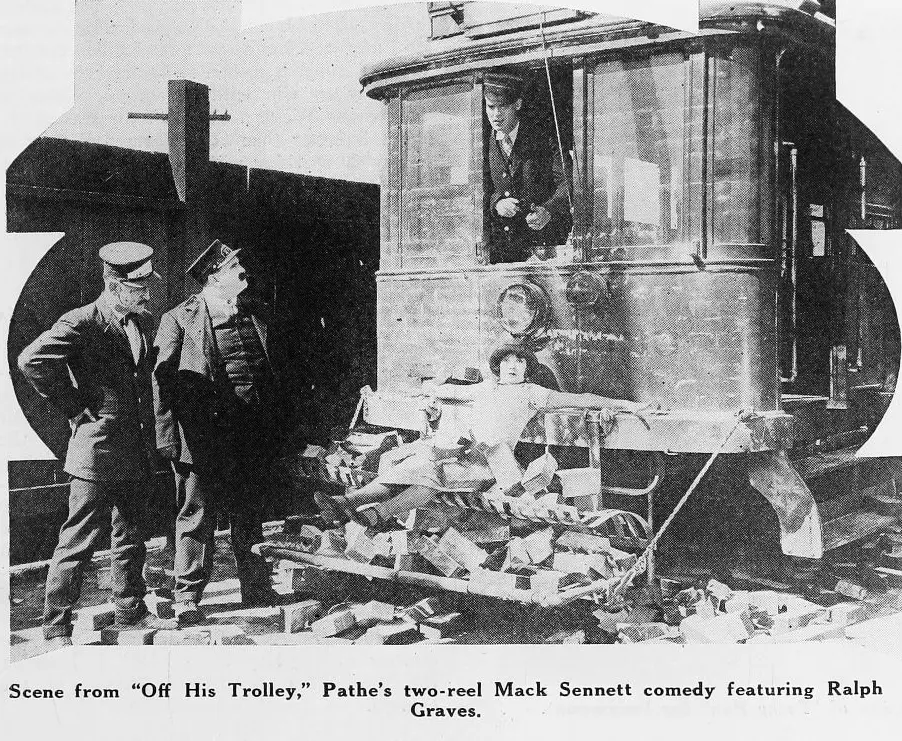
Why does Off His Trolley resonate a century later? Perhaps because the "merry chase" it depicts is one we still recognize. The chase for status, for the shiny object, for the approval of those who do not care for us—these are universal follies. The film’s conclusion, with the pair splashing through ankle-deep mud, is one of the most honest endings in silent comedy. There is no magical restoration of fortune, no sudden inheritance. There is only the long walk home in the dark. It is a sobering reflection that contrasts sharply with the more idealistic resolutions of films like The Bashful Lover.
The film also serves as a technical showcase for the era's cinematography. The outdoor sequences, particularly the streetcar footage and the rain-drenched finale, exhibit a depth of field and a mastery of natural light that was often missing from indoor-bound dramas. The way the mud clings to the performers’ costumes is not just a gag; it is a visual representation of their social descent. They are literally being reclaimed by the earth, their pretensions washed away by the storm. This visual storytelling is as potent as the mountain vistas in La montagne infidèle, focusing on the micro-catastrophes of the human condition rather than the macro-events of nature.
When comparing this to Paradise Lost, one sees a similar preoccupation with the loss of innocence, though Off His Trolley trades epic poetry for physical pratfalls. Where Sands of the Desert finds humor in the exotic, this film finds it in the mundane—the bills, the rain, the broken-down car. It is a more relatable, and thus more cutting, form of comedy. It lacks the pastoral sentimentality of Lena Rivers, opting instead for a gritty, urban cynicism that feels remarkably modern.
Even compared to other slapstick shorts like Toonerville's Fire Brigade, this film feels more grounded in a specific social reality. It isn't just about things going wrong; it's about *why* they go wrong. The conductor's failure is a choice—a series of choices, actually—driven by a desire to be something he is not. In this sense, the film shares a thematic DNA with The Sin of Martha Queed, exploring the consequences of deviating from one's prescribed path, though it does so with a much higher frame rate of jokes per minute.
Ultimately, Off His Trolley is a testament to the power of silent film to communicate complex social anxieties through the simplest of means. It uses the language of the body—the frantic run, the slumped shoulder, the desperate scramble—to tell a story of economic and moral exhaustion. It is a film that demands to be seen not just as a relic of a bygone era, but as a vibrant, breathing piece of social commentary. Whether you are watching for the historical value of seeing Barney Hellum at his peak, or for the sheer visceral thrill of a 1920s car wreck, the film delivers on every front.
As our protagonist splashes through the mud at the end, we are left with a sense of catharsis. He has lost his ring, his car, and his dignity, but he has gained a hard-won clarity. The tracks of the trolley may be restrictive, but they are reliable. The open road, for all its promise, is often just a shortcut to a ditch. It is a lesson as relevant today as it was in 1924, and one that is delivered with more heart and humor than almost any of its contemporaries, including the likes of Back from the Front or Play Ball with Babe Ruth. This is a essential viewing for any serious student of the silent era, a muddy, messy, and magnificent slice of life.
IMDb 5.7
1936
Community
Log in to comment.