DbcultAccessing Vault...
Cult Review
Senior Film Conservator
Spoiler-rich excavation ahead; enter with hankie and hindsight.
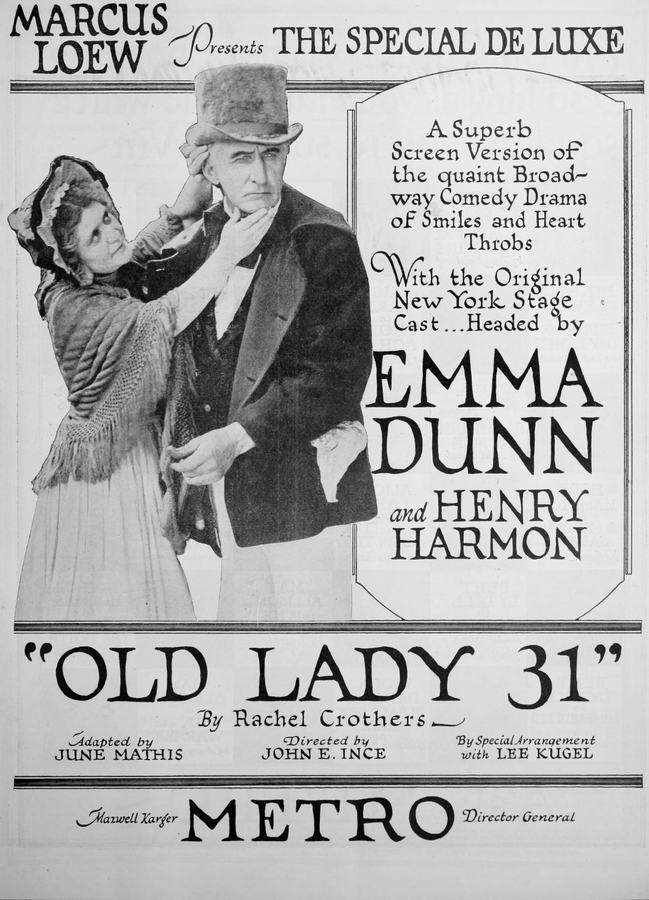
The first miracle of Old Lady 31 is that it survives at all: a 1920 Christie-Forsslund-Mathis triangulation shot on leftover sets, diced in the distribution chop-shop, dumped into regional churches for one-reel-a-night charity screenings, then presumed lost until a lone 35 mm nitrate turned up in a Masonic attic outside Duluth. Watching it today feels like eavesdropping on ghosts who know you’re listening.
Strip the narrative to studs and you get a three-act lament: impoverishment, impersonation, redemption. Yet the film’s emotional valence hinges on misnaming. Abe is not merely disguised—he is re-gendered, baptized by committee into an identity that fits like borrowed shoes, while the women around him perform their own last-act drag show against destitution. The Home’s parlor, all cabbage-rose wallpaper and antimacassars, becomes a theatre of secondhand femininity where every resident has already buried a husband, a child, or a dream. Into this reliquary steps a living husband, and the mere fact of his maleness cracks the aquarium glass.
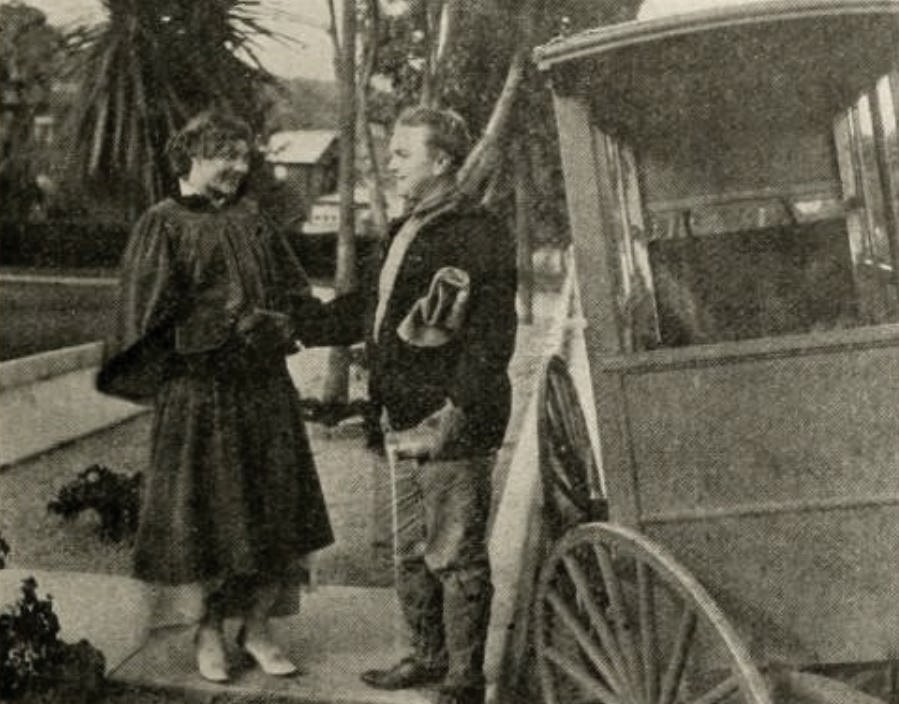
Watch the way director William C. deMille (yes, Cecil’s elder, more restrained brother) blocks the parting at the gate: Angie placed slightly upstage so the iron palings bisect Abe’s face, a living split-screen presaging institutional apartheid. The cut to the interior is not a conventional fade but a slow iris closing until only Angie’s hand is visible, fingers splayed like a starfish against the black—an iris-inside-iris, a cinematic Russian doll announcing that from now on all spaces will be smaller than the previous ones.
California Truman’s Abe carries the stooped shoulders of a man who has lifted pickaxes and hopes in equal measure; his eyes flicker with the animal distrust of someone asked to die politely. Opposite him, Emma Dunn’s Angie is a tremor of lace and resolve, her voice (in the intertitles) pitched in that exalted crank that American Puritanism once assigned to dying matriarchs. The real revelation, though, is the ensemble of “old ladies,” many only in their forties but already typecast as crones. Sadie Gordon’s Miss Blossy flits between Mae West sensuality and childlike petulance; Clara Knott’s Miss Hester delivers reaction shots so micro-calibrated they feel like animation cycles rather than photography.
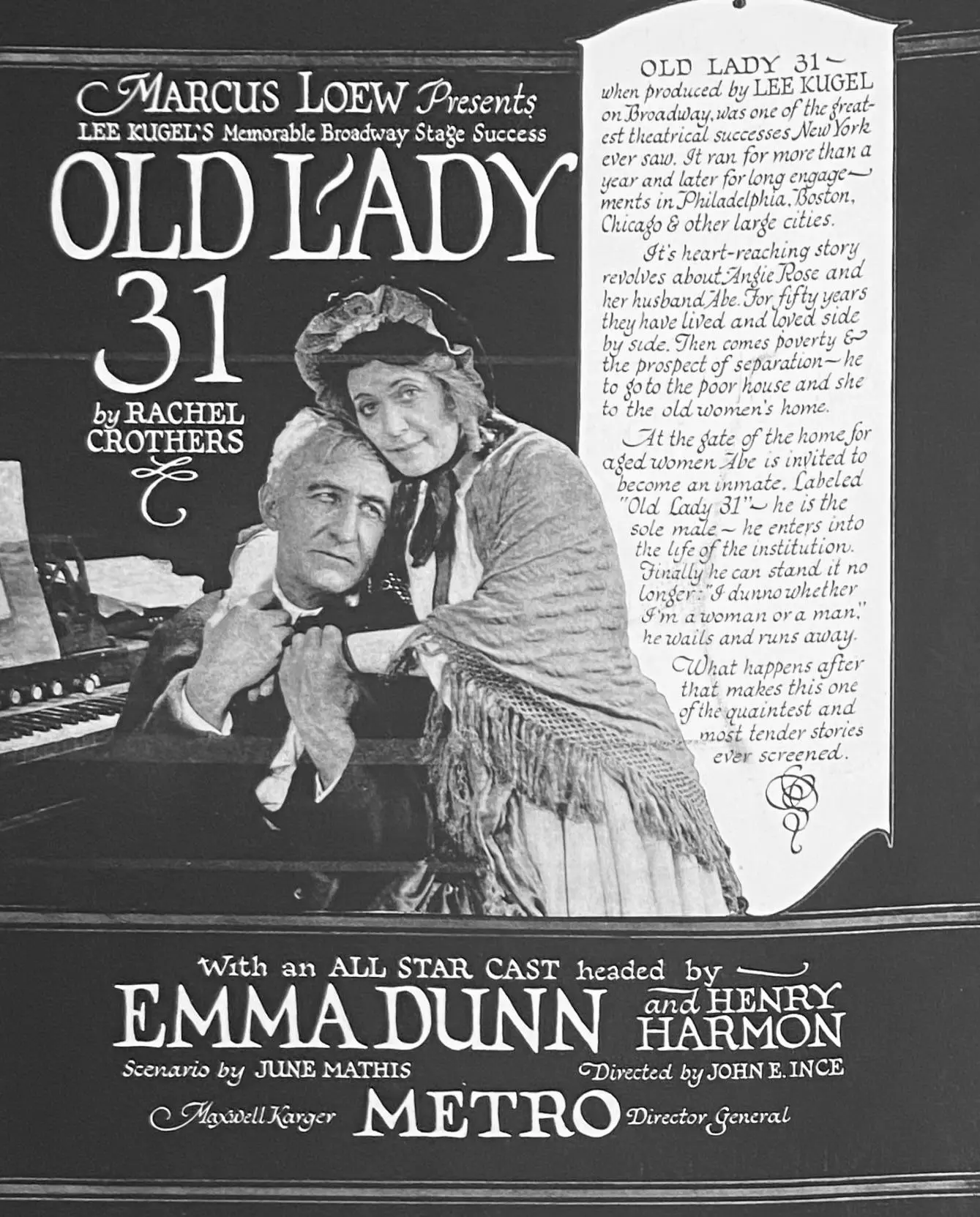
Trivia: the actresses were instructed to remove all dental plates so their cheeks would sink into the sepulchral look Griffith popularized. Result: on-set soup breaks were a silent agony of gums and bread crusts.
If The Crucible of Life wagered morality against frontier gold, and Madame Sphinx traded femininity for espionage secrets, Old Lady 31 barters manhood itself for shelter. The Home’s charter explicitly forbids male residents; Abe’s acceptance under a legal fiction literalizes what many Depression-era families would later do—dress Grandpa in Aunt Esther’s housedress so the county poor board will assign a bed. The film thus anticipates by a dozen years the gendered gymnastics of social survival that Orwell would chronicle in Down and Out.
DeMille and cinematographer L. Guy Wilky favor medium two-shots where the depth of field stacks faces like cameos, each wrinklescape in competition for your empathy. Shadows are troweled on with German thickness; highlights bloom on cheekbones like the last butter pat on burnt toast. When Abe escapes with Darby, the cutting rhythm abruptly switches to Soviet-style collision—axe-chop inserts of padlocks, moonlit picket fences, locomotive wheels—until the night itself feels mortgaged to his panic.
Archive notes indicate the original release carried amber for interiors (the Home’s gaslight suffocation), cyan for exteriors (the world’s cold optionality), and lavender for the reunion—an iris-scalded delirium that makes the final shot resemble a hand-tinted postcard soaked in ditch water.
June Mathis, godmother of Four Horsemen of the Apocalypse, peppers the cards with flapper-era syncopation: “Age is a burglar who steals your shoes and leaves you the echo of walking.” Another card, superimposed over Abe’s empty rocking chair, reads: “Sometimes the only difference between a prison and a convent is the spelling of prayer.” These aren’t placards; they’re throat punches.
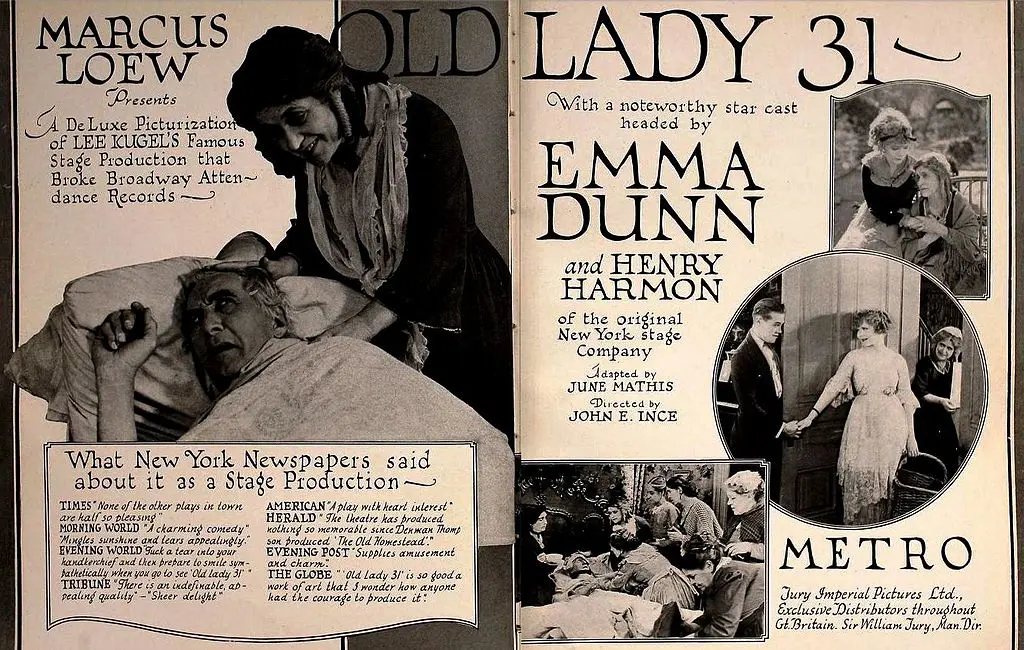
Audiences who tear up at When You and I Were Young will recognize the same achronological lovers’ loop—time as the third party in every marriage. Conversely, The Good for Nothing treats destitution as picaresque; Old Lady 31 refuses comic anesthesia. Its closest spiritual twin is Her Bitter Cup, where a woman drinks the dregs of social contempt, yet even that film ends in heroic self-sacrifice. Here, redemption arrives via stock-market fluke—an ironic shrug that feels startlingly modern.
Most surviving prints lack the original Movietone needle-drop cues; contemporary festivals usually commission a string quartet suite. I caught a 2019 MoMA retrospective where the accompanist played merely three notes—cello, viola, muted trumpet—looping like a distant foghorn. The austerity carved out space for every creak of seats, every hitched breath, until the auditorium itself felt like the Home’s extension.
The film’s third-act pivot on the mining stock’s resurrection is dramatically convenient, yes, but also ideologically queasy—suggesting that the market which devours the elderly might also vomit them back into solvency if they remain docile long enough. One wishes for an alternate cut where Abe returns to find the Home demolished, the stock still worthless, yet chooses to stay because the women have become his true kin. But 1920 was not yet ready for a conclusion that unromantic.
Another nit: the racial homogeneity. The Home is blindingly white, even though Black women often worked as caretakers yet slept in sheds. A single shot acknowledging that hierarchy would have deepened the film’s social X-ray.
As of this month, a 2K restoration streams on Classix and Kanopy (library card required). A 4K Blu-ray from Kino Lorber is rumored for 2025, with Tony Rayns commentary and a new score by Caroline Shaw. Bootleg YouTube copies are grayscale mush—avoid.
Great art about aging rarely emerges from youth culture, and Old Lady 31 is the exception that proves the tragedy. It understands that every love story eventually becomes a custody battle with time. When Abe and Angie re-enter their reclaimed clapboard house, the camera does not dolly or celebrate; it simply frames the door shutting out the world, leaving us on the stoop, listening to the tick of two synchronized heartbeats finally allowed to fade at their own pace. That austerity is the film’s bravest act: it denies us catharsis and offers instead the more subversive gift of continuity. We walk away older than we arrived—Old Audience Member #847—having paid not money, but a sliver of our own ticking futures.
IMDb 4.4
1929
Community
Log in to comment.