DbcultAccessing Vault...
Cult Review
Senior Film Conservator
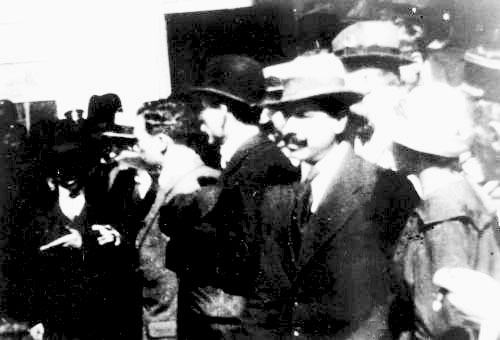
To watch the grainy, oscillating frames of Pristiganeto na bulgarskata delegatziya ot konferentziuata v Parizh is to engage in a form of secular séance. This is not merely a film; it is a laceration in time, a window into the precise moment when the 19th-century dreams of a Greater Bulgaria were formally interred. Filmed on November 27, 1919, the newsreel captures the return of Prime Minister Alexander Stamboliyski and his entourage from the harrowing negotiations in France. While contemporary audiences might be accustomed to the high-octane escapism of something like Hobbs in a Hurry, this archival fragment demands a different kind of attention—a meditative, almost mournful gaze.
The cinematography of 1919 was often characterized by a static, theatrical perspective, yet there is an accidental expressionism in this footage. The way the black smoke of the locomotive billows across the platform creates a natural chiaroscuro, shrouding the delegates in a haze that feels symbolic of their clouded political futures. Unlike the meticulously staged melodrama found in The Marionettes, where every gesture is calculated for maximum emotional impact, the movements in this newsreel are heavy with the awkwardness of reality. Stamboliyski moves with a rugged, peasant-born defiance, yet his eyes—even through the low-resolution flicker—betray the exhaustion of a man who has carried the burden of a nation's surrender.
The crowd at the station is perhaps the most haunting element. There is no cheering, no fanfare. Instead, we see a collection of overcoats and hats, a sea of muted humanity waiting for a sign of what comes next. In the world of fiction, we might see a narrative arc similar to The Lost Bridegroom or its variations like Lost: A Bridegroom, where the protagonist returns to a world that no longer recognizes him. Here, the metaphor is inverted: the delegation returns to a world they no longer recognize, a Bulgaria shorn of its Dobruja, its Thracian coastline, and its pride.
Alexander Stamboliyski remains one of the most polarizing and fascinating figures in Balkan history. In this footage, we see him not as the firebrand orator of the Agrarian Union, but as a diplomat navigating the wreckage of the Great War. The camera captures him stepping into a car—a symbol of the burgeoning modernity that would soon be eclipsed by the turbulent 1920s. There is a sense of The Stronger Vow in his posture, a commitment to a state that was currently being dismantled by the victors of Versailles. The contrast between his physical presence and the fragility of the political situation is staggering.
When we compare this to the narrative structures of the era, such as False Evidence, we see a stark divergence. Cinema of the late 1910s was obsessed with moral clarity and the triumph of truth. However, the Treaty of Neuilly was, for the Bulgarian psyche, a piece of 'false evidence' regarding the justice of the new world order. The film records the physical manifestation of this geopolitical betrayal. It is a 'found object' of history that requires no script to convey its tragedy.
One cannot help but think of the films that have been lost to time, much like the territories lost in 1919. The title The Lost Princess evokes a sense of vanished nobility that resonates with the end of the old Bulgarian dream. This newsreel acts as a bridge between the romanticized past and the brutal realism of the 20th century. The technical limitations of the film—the scratches, the erratic frame rate, the chemical decay—only add to its poignancy. It feels like a memory that is actively fading even as we attempt to grasp it.
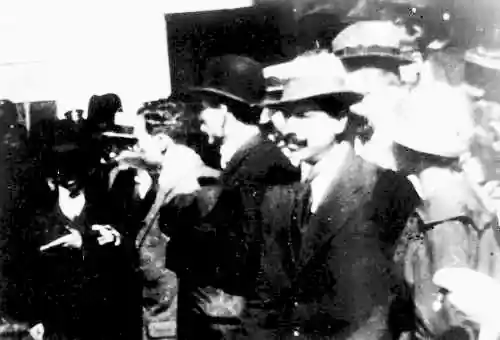
In the context of early cinema, this footage is a precursor to the 'Kino-Pravda' movement. It eschews the artifice of A Pair of Sixes or the exoticism of The Soul of Kura San. There is no attempt to entertain. The cinematographer’s lens is a cold, objective observer of a funeral for an era. We see the 'Children Pay' for the sins of their fathers, a theme explored in the social dramas of the time like The Children Pay, though here the payment is in land and sovereign dignity.
If we look at the cinematic landscape of 1919, we see a world in flux. While audiences in the West were enjoying the rugged landscapes of Way Outback or the domestic tensions of Her Second Husband, Bulgarian cinema was in its infancy, primarily serving as a tool for national self-reflection. This newsreel is one of the few surviving fragments of that period’s visual consciousness. It lacks the polish of a Coral, yet it possesses a raw power that no studio production could replicate.
"The camera does not lie, but it does select what to remember. In this footage, we remember the silence of a nation at a crossroads."
The film also brings to mind the 'Fallen Idol' trope. Stamboliyski, who would eventually meet a brutal end in the 1923 coup, is here at the height of his power, yet he is already a figure of tragedy. Like the protagonist in A Fallen Idol, his fate is tied to forces beyond his control—the 'First Law' of international realpolitik as seen in The First Law. This newsreel is the prologue to that eventual fall, capturing the moment the seeds of future conflict were sown.
The survival of this footage is a miracle of archival preservation. In an era where so much of our visual heritage has turned to vinegar or ash, the ability to watch the Bulgarian delegation return from Paris is a privilege. The restoration highlights the textures of the time—the heavy wool of the suits, the polished metal of the car, the steam from the engine. These details ground the historical event in a sensory reality that history books often lack. It reminds us that history is not just a series of dates and treaties, but a sequence of moments experienced by flesh-and-blood people.
As a critic, one must evaluate this film not on its narrative complexity, but on its archival resonance. It is a masterpiece of the 'accidental.' Every frame is pregnant with meaning, from the way a bystander adjusts his cap to the purposeful stride of the Prime Minister. It is a haunting reminder that cinema is our most potent tool for time travel. When we watch Pristiganeto na bulgarskata delegatziya, we are not just looking at the past; we are standing on that platform in 1919, feeling the cold Sofia wind and the heavy weight of a signed piece of paper that changed everything.
Ultimately, this film serves as a somber companion piece to the more exuberant cinema of the early 20th century. It provides the necessary context for understanding the psychological state of Europe between the wars. It is a work of profound historical importance, a visual testament to a nation's resilience in the face of insurmountable loss. It is, quite simply, essential viewing for anyone seeking to understand the soul of the Balkans.
Community
Log in to comment.