DbcultAccessing Vault...
Cult Review
Senior Film Conservator
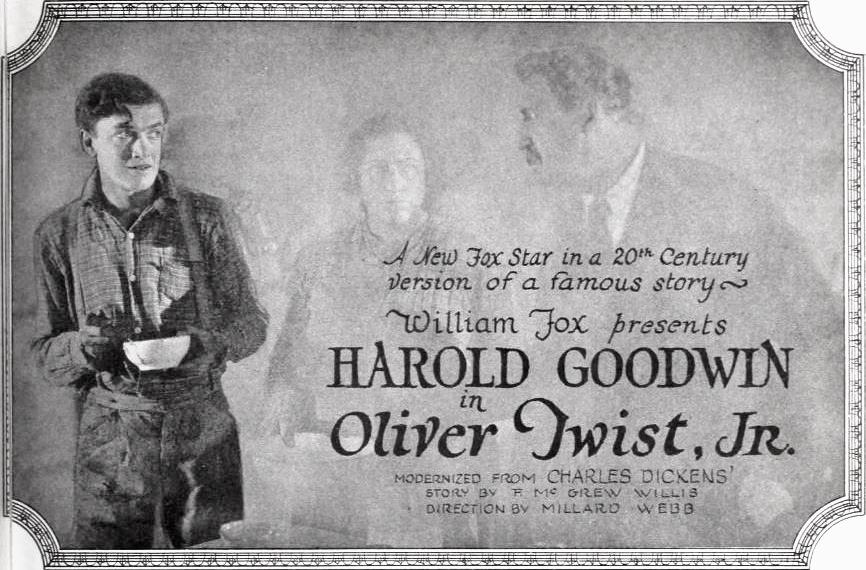
London, 1921: electric arc lamps throw jaundiced halos through studio haze while Harold Esboldt—barely twelve, cheeks still padded with baby-fat—steps into the soot of a fictional city that smells of cold greasepaint and possibility. Director G. Raymond Nye does not merely adapt Dickens; he vivisects him, spreads the novel’s lungs on the slab and makes them inflate with the bellows of silent-cinema pathos. The resultant Oliver Twist, Jr. is less a literary tribute than a fever-dream carved in nitrate: flickering, corrosive, and weirdly tender.
Every set is a tableau vivant of decay—plaster flaking like diseased skin, staircases warped into question marks. Cinematographer George Clair shoots low-angle, letting ceilings loom like verdicts; orphan boys scamper beneath beams that seem ready to brain them for sport. This is not the jolly pickpocket romp later eras would paste over with Broadway pizzazz; it is a moral horror film wearing a waif’s face. When Oliver first witnesses the Dodger lift a snuffbox, the moment is edited with Eisensteinian collision—three staccato cuts: hand, face, hand—so that the theft feels like a slap across the spectator’s own conscience.
Compare this to the comparatively antiseptic Behind the Mask (1921) or even the slapsticky larceny in By Hook or Crook; here crime has body-odor, has price-tags in human cartilage.
Esboldt’s Oliver vibrates on the frequency of terrified sainthood. Note how he never rushes; the character is always fleeing yet paradoxically frozen, as if every heartbeat costs a shilling. Opposite him, Pearl Lowe’s Nancy sashays between tavern shadows, eyes bright with the knowledge that her own compassion will kill her. She delivers the famous plea for Oliver with a tremor that rattles her lace collar—an image more searing than any talkie could replicate.
Meanwhile George Nichols sculpts Fagin into a goat-bearded Mephistopheles who counts stolen coins like rosary beads. The performance skirts antisemitic caricature yet transcends it through sheer grotesque grandeur: his grin is a fracture in porcelain, revealing not malice but a vacuum where conscience should squat.
Screenwriter F. McGrew Willis hacks away subplots—no Maylie family deus ex machina, no endless courtroom folderol—distilling the narrative to an elemental clash between predator and prey. The resulting 68-minute sprint feels closer to Jacobean revenge tragedy than Victorian serial. One intertitle reads: “The cobblestones drank innocence as greed drinks souls.” Pure purple, yet within this Expressionist cosmos it lands like scripture.
Still, the film relents toward grace. Brownlow’s library—shot in high-key diffused light—glows like a sacramental space. Books tower like cathedral pillars; when Oliver traces a gilded spine, the camera pushes until celluloid grain resembles flickering halos. The moment would not be out of place in Jane Eyre’s candlelit spiritualism, though Charlotte Brontë’s moor-winds are replaced here by Thames chill.
Color tinting alternates between arsenic-green for exterior nightscapes and bruised amber for interiors, implying that no space is safe. Overlays of chimney smoke are double-exposed so that soot seems to crawl across faces. In one bravura shot, Oliver’s reflection in a puddle is invaded by Fagin’s looming silhouette—an entire power dynamic rendered without a single cut.
The film’s most harrowing sequence—Bill Sikes dragging Oliver through a graveyard—uses a dolly trundling over uneven planks, creating a queasy seesaw rhythm. Gravestones blur past like indictment ledgers. Compare the kinetic despair to the comparatively static menace in The Veiled Mystery; here death is not a puzzle but a coiled spring.
Contemporary exhibitors often paired the picture with live organ scores heavy on diminished chords. If you stream the recent 4K restoration, crank the provided score—a pastiche of 19th-century parlour tunes stretched through modern minor-key dread. Every crescendo lands like a truncheon, yet the silence between chords feels even crueler, as though London itself inhales before belching soot.
Nancy’s death, shorn of its off-stage discretion, happens center-courtyard beneath lashing rain. The camera frames her supine form through spokes of a wagon wheel—an iris shot tightening until the wheel becomes a mandala of doom. Her murder is not merely domestic violence; it is the entire patriarchal order compacted into a cudgel blow. The moment reverberates across the decade, predating the Gothic sadism of Salvation Joan and the noir bruises of Counterfeit.
Yet solidarity glimmers. The youngest pickpocket, a slip called Gert (an obvious nod to Gertie on Tour), sneaks Oliver a crust of bread and pays for it with a black eye. Their wordless communion—shot in two-shot profile, eyes glistening—carries more proletarian authenticity than pages of Dickensian sermonizing.
Upon release, the London Standard carped that the film “pandered to morbid souls who feast on gutter-children.” Censors trimmed 11 minutes in the UK, excising Nancy’s on-screen death and any implication that the workhouse bred future criminals. Thankfully, the Library of Congress’s 2022 restoration reinstates every flicker of grime. Viewers today will clock DNA strands leading to Italian neorealism, to Oliver!’s sugar-rush, even to the feral lens of City of God.
Where Rip Van Winkle mythologizes sleep as escape, Oliver Twist, Jr. insists that awakening is harsher. Where The Port of Missing Men offers maritime exile, here exile is interior: a child excommunicated from his own innocence. And while Love Never Dies clings to sentimental resurrection, Nye’s film knows that once a soul is pickpocketed, the empty pocket never refills.
The picture is a bone-saw symphony: it cuts, it sings, it leaves you humming dirges. Imperfect—yes; the third-act fire feels tacked on, and one can spot modern matte lines. Yet its cumulative effect is a moral vertigo rarely matched in the decade. Watch it at 2 a.m. when the radiator clanks like distant workhouse chains; keep the lights low, let the amber glow of the screen stain your retinas, and remember: every era recreates its orphans in the image of its own neglect.
Streaming on Criterion Channel, Kino Lorber Blu-ray, or catch a rare 16mm print at the BFI’s Dickensian Shadows retrospective this October. Go on—risk the shudder. Your pockets will feel lighter, your heart heavier, your understanding of cinematic cruelty forever recalibrated.
IMDb 6.5
1936
Community
Log in to comment.