DbcultAccessing Vault...
6.9/10
Senior Film Conservator
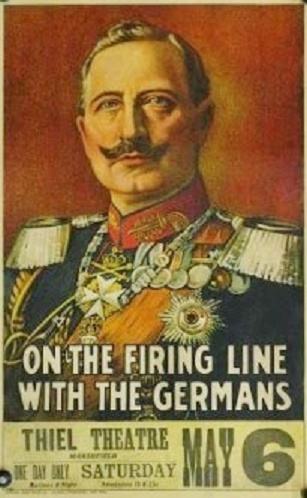
A definitive 6.9/10 rating for a film that redefined the boundaries of cult cinema. On the Firing Line with the Germans remains a cornerstone of transgressive art.
The year 1915, a mere twelve months into the cataclysmic conflict that would reshape the world, saw American cameraman Wilbur H. Durborough embark on an audacious, almost unfathomable journey. Armed with his camera, he ventured into the heart of the maelstrom, embedding himself with the Imperial German Army as it pressed relentlessly eastward through the ravaged landscapes of Poland. The resultant film, 'On the Firing Line with the Germans,' is not merely a historical artifact; it is a raw, often disquieting window into an era of unprecedented global upheaval. This isn't polished propaganda nor a dramatized narrative; it is, at its core, an attempt at unvarnished observation, a pioneering work of documentary filmmaking that captures the brutal mechanics of total war with an immediacy that still resonates over a century later. Its significance lies not just in its content, but in its very existence, a testament to the nascent power of cinema to document unfolding history.
Durborough's achievement in gaining access to the German war machine in 1915 cannot be overstated. At a time when America maintained a precarious neutrality, his presence provided a unique, external perspective on a conflict that many Americans only understood through newspaper reports and official communiqués. This wasn't merely a journalist reporting from afar; Durborough was on the ground, sharing the privations and perils of the soldiers. His camera, a bulky, hand-cranked device, became an extension of his unwavering gaze, capturing moments that would otherwise be lost to the fog of war. The physical demands of filming in such an environment — the unpredictable weather, the constant movement, the imminent danger — speak volumes about Durborough's dedication. He wasn't just recording events; he was participating in the unfolding history, albeit from behind a lens. This intimate access allowed for a granular depiction of military life, far removed from the grand strategic maps and political rhetoric that often define historical accounts of war.
The film meticulously chronicles the Imperial German Army's push through Poland, a campaign characterized by its vast scale and brutal efficiency. Unlike the static trench warfare that defined the Western Front, the Eastern Front was often a war of movement, of vast distances and sweeping maneuvers. Durborough’s footage captures this dynamic, showing columns of troops marching through desolate landscapes, artillery pieces being dragged across muddy fields, and the relentless logistical train that supported such an immense undertaking. The visual narrative emphasizes the sheer industrial scale of modern warfare, where men and machines moved in concert across a ravaged continent. We see the methodical advance, the construction of temporary bridges, the establishment of supply lines – all the unglamorous but utterly essential aspects of a military campaign. It’s a stark illustration of how an army operates, stripped of heroic embellishment, focusing instead on the practicalities of conquest and occupation.
While the title suggests constant combat, a significant portion of 'On the Firing Line with the Germans' is dedicated to the less sensational, yet equally vital, aspects of military existence. We are granted access to the daily routines of camp life: soldiers preparing meals, mending uniforms, resting in makeshift shelters. These moments, seemingly mundane, offer profound insights into the human element of the war machine. They remind us that even amidst the grand theater of battle, life continues, albeit under extraordinary duress. The film also provides rare glimpses into the sophisticated logistics required to sustain an army of this magnitude. We see supply convoys, field hospitals, and communication networks in operation, underscoring the organizational prowess of the German forces. This focus on the practicalities distinguishes Durborough's work from more romanticized depictions of soldiery. It’s a pragmatic look at the sheer effort involved in waging war, showcasing the often-unseen laborers and planners whose contributions were as crucial as those of the frontline fighters.
Perhaps the most arresting sequences in the film are those purporting to show actual battle footage. In an era where staged recreations were common, Durborough's capture of genuine combat, however brief or distant, is remarkable. The chaotic, often indistinct nature of these scenes only serves to heighten their authenticity. They convey the confusion, the smoke, and the sheer terror of men facing death, rather than presenting a clear, strategic overview. This raw, unadorned portrayal of conflict stands in stark contrast to the dramatic narratives of contemporary fiction films. Where a drama like The Captive (also from 1915) might explore the personal romantic entanglements amidst war, Durborough’s lens remains fixed on the brutal, impersonal machinery of battle. Following the skirmishes, the film offers sobering views of captured prisoners of war. English, French, and Russian soldiers, stripped of their weapons and their agency, are seen being processed by their German captors. Their faces, often bewildered or resigned, are a powerful testament to the universal suffering inflicted by war, transcending national loyalties. Durborough's camera captures not just their numbers, but the individual humanity behind the labels of 'enemy,' offering a poignant, if unsettling, moment of reflection on the costs of conflict.
The film's concluding segment delivers its most profound and enduring message, shifting focus from the combatants to the civilians caught in the crossfire. After the battles have receded, Durborough's camera lingers on the ravaged Polish countryside, a landscape scarred by bombardment and occupation. We witness the heartbreaking plight of the civilian population: displaced families, their homes destroyed, their lives uprooted. Children wander amidst the rubble, women huddle in desperate groups, and the elderly stare blankly into an uncertain future. This portrayal of widespread human suffering is a powerful counterpoint to any potential glorification of military might. It underscores the devastating, long-term consequences of war that extend far beyond the battlefield. In an era when war reportage often focused on strategic gains or heroic deeds, Durborough's decision to conclude with such an unflinching look at civilian misery was both prescient and courageous. It firmly roots the abstract concept of 'war' in the tangible reality of human suffering, foreshadowing the comprehensive understanding of conflict's impact that would only fully emerge much later in the 20th century. This humanitarian perspective elevates 'On the Firing Line with the Germans' beyond a mere military chronicle, transforming it into a poignant social document.
Wilbur H. Durborough, often credited as the film's primary cameraman and perhaps its uncredited director, emerges as a figure of significant historical importance. His work predates the more organized and often censored war reportage of later conflicts. He operated with a degree of autonomy that would become increasingly rare as governments learned to control media narratives. While the film inevitably reflects the perspective afforded by its German hosts, Durborough’s eye for detail and his willingness to document the less glamorous aspects of war lend it a remarkable authenticity. His approach, combining frontline action with glimpses of daily life and the civilian toll, laid a foundational stone for what would evolve into modern war journalism. He wasn’t just shooting film; he was crafting a historical record, a visual primary source that continues to offer unparalleled insights into the early years of the Great War. His efforts stand apart from contemporary dramatic productions like The Escape or The Melting Pot, which, while culturally significant, operated entirely within the realm of fiction. Durborough, in contrast, grappled directly with the stark realities of his time.
Today, 'On the Firing Line with the Germans' remains an invaluable resource for historians and film scholars alike. It is a rare, firsthand visual account from a pivotal moment in human history, offering a perspective that is both unique and deeply affecting. The film’s raw, often grainy footage, captured with the technological limitations of 1915, paradoxically enhances its authenticity, lending it a timeless, almost ghost-like quality. It serves as a stark reminder of the sacrifices made and the suffering endured during the First World War, an era that continues to fascinate and horrify. Its influence, though perhaps not immediately recognized in popular culture, is undeniable in the lineage of documentary filmmaking and war reportage. It demonstrated the power of the moving image to bear witness, to document truth, and to confront audiences with the unvarnished realities of conflict. While other films of the era, such as För sin kärleks skull or Across the Pacific, explored diverse narrative themes, Durborough's work carved out a distinct niche for uncompromising realism. It is a cinematic time capsule, preserving not just images, but the very texture of a world at war, compelling us to confront the enduring human cost of conflict and to reflect on the nature of history itself. Its importance transcends mere entertainment; it is an essential piece of our collective memory, a stark and honest reflection of a world irrevocably changed.
In conclusion, 'On the Firing Line with the Germans' is far more than a mere historical curiosity. It is a profound and pioneering work that uses the nascent power of cinema to document the grim realities of the First World War. From the frantic chaos of battle to the mundane routines of camp life, and ultimately to the heartbreaking devastation wrought upon civilians, Durborough's film offers an unparalleled, unvarnished look at a conflict that reshaped the modern world. Its raw honesty, coupled with its remarkable access, establishes it as a foundational text in the history of documentary filmmaking and an enduring, vital testament to the human experience of war. It compels us to remember, to understand, and to never forget the immense sacrifices of that era.

IMDb —
1927
Community
Log in to comment.