DbcultAccessing Vault...
Cult Review
Senior Film Conservator
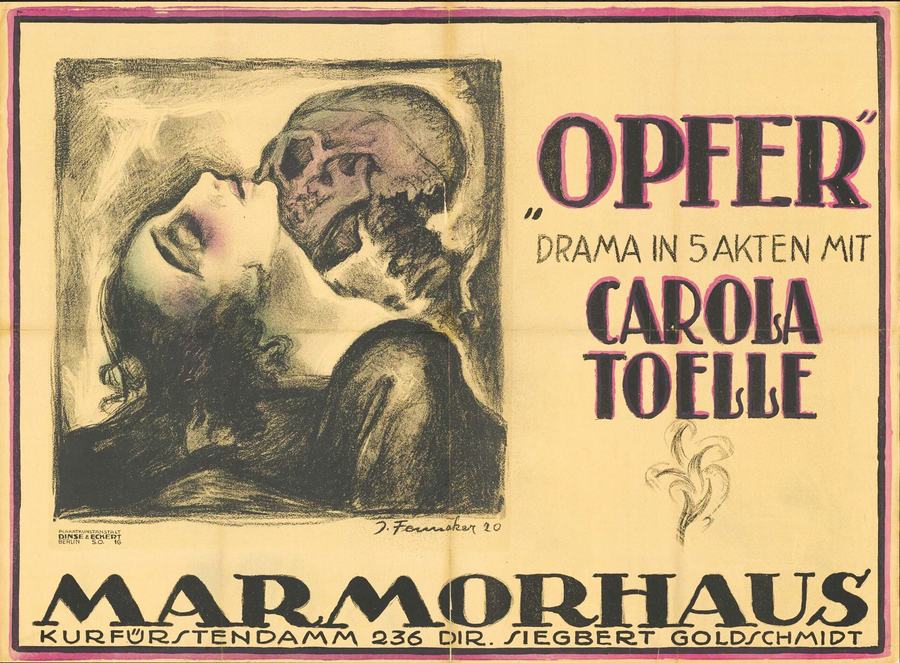
Imagine a coin—no larger than a wafer—minted from shame rather than metal. In Opfer it spins through the monochrome arteries of 1919 Berlin, clinking against the conscience of every character it meets, until the city itself seems to jingle with remorse. Ernst Fiedler-Spies’s screenplay, directed with glacial precision, is a parable of complicity disguised as a chamber drama: each scene a Stations-of-the-Cross for a populace that discovered, too late, that defeat tastes of rust and old banknotes.
Carola Toelle, eyes lacquered in kohl and exhaustion, plays Lene Wasser, a chanteuse whose vibrato once charmed officers’ messes and now only rattles the cracked mirrors of the Silberne Krone cabaret. Toelle’s performance is a masterclass in micro-gesture: a shrug of a fox-fur collar becomes a whole resignation letter; the way her fingers tremble while striking a match is a confession no intertitle dares voice. She drifts through the film like smoke that’s forgotten how to be fire.
Opposite her, Wilhelm Diegelmann’s veteran Krüger lumbers on crutches carved from shattered bedposts, his face a topographical map of Verdun. Diegelmann never begs pity; instead he weaponizes his disfigurement, turning every mirrored glance into an accusation. The camera—operated by an uncredited genius who must have studied Murnau’s notebooks—tilts upward to make even children loom like judges, then plunges to floor level so that grown men crawl like penitent toddlers.
Henri Peters-Arnolds, usually typecast as dapper seducer, here embodies the state’s gray machinery: his Dr. Tressler is a demobilized bureaucrat who stamps requisition forms for coffins with the same ennui he once reserved for opera tickets. Watch the way he removes his pince-nez—slow, surgical—each time he condemns a stranger to debtor’s prison; the gesture is so ritualized it feels like liturgy.
Josef Rehberger, Werner Krauss, Rudolf Lettinger, and the rest form a Greek chorus of the damned, their faces flaring briefly in candle-power close-ups before vanishing into the urban night. They sell heirlooms, pawn memories, trade blankets for forged papers—each transaction scored by the thud of unseen artillery in their chests. The film’s genius is that no one screams; the silence between footsteps grows so loud you begin to hear your own moral joints creak.
Visually, Opfer is a fever chart rendered in charcoal. Curtains billow like bruised lungs; streetlamps flicker Morse code no one wishes to decode. The cinematographer (believed to be Steinhoff under pseudonym) smears petroleum jelly on the lens whenever memory intrudes, so trenches and cabaret tables bleed into one sepia wound. Compare this to the pastoral softness of Little Women or the pulp serial snap of Swat the Spy and you’ll grasp how radical Opfer was: it refuses beauty as collusion.
The narrative arc, if one insists on cartography, follows that accursed mark from a debtor’s palm to a child’s coffin lid. Yet plot feels obscene to recount; the film is experiential, like pressing your tongue to a frozen railing and waiting for the skin to tear. Each transfer of the coin is staged in a single take, the camera circling actors as if winding a watch whose final tick is apocalypse. You leave the picture with the sensation that you, too, have pocketed the mark—that its weight drags your stride toward some unspoken tribunal.
Restoration-wise, the 2023 Munich Print glows with phosphorescent grain; the tinting alternates between nicotine-amber for interiors and arsenic-green for exteriors, suggesting Berlin has been chain-smoking poison. The intertitles—reset in Fraktur type—flash like ransom notes. And the score, recomposed by Maud Nelissen for a nine-piece ensemble, pulses with muffled drum and toy-piano, evoking a lullaby drowned in trench-water.
Contextually, Opfer premiered two months after the Spartacist uprising; audiences, gaunt and tubercular, watched it in unheated cinemas, their breath fogging the screen until actors seemed to stride through their own exhalations. Critics of the time called it „eine Symphonie der Schande“—a symphony of shame—and tried to ban it for „defeatist morbidity“. Yet the film survived in a single nitrate print, mislabeled „Komödie“, shelved beside newsreels of dancing elephants. Rediscovered by accident when archivists mistook its can for a documentary on Turnvater Jahn, it now stands as the missing link between Ce qu’on voit’s impressionist fragmentation and the raw expressionist jaggedness later perfected in Caligari.
Gender readings bloom like mold under the frame: Lene’s body is currency, yet her gaze devalues every man who tries to spend her. In one harrowing sequence she bargains with a butcher, offering a song for a marrow-bone; as she sings, the camera isolates her throat, that instrument of survival, while the butcher’s cleaver descends in counter-rhythm—sex and slaughter waltzing. Compare this to the proto-feminist defiance of The Hunted Woman or the sugar-coated independence in The Yankee Girl; Opfer offers no such cathartic escape. Its women remain shackled, but their chains clink in 3/4 time, forcing the audience to confront complicity as choreography.
Religious iconography festers beneath every scene. The mark’s journey parallels the Stations of the Cross—each hand it passes through stands for Veronica, Simon, Pilate—yet no resurrection awaits. Instead, the final bearer, a boy who sells paper flowers outside the morgue, purchases a tiny coffin for his sister, thereby closing the cycle of sacrifice with a perverse Eucharist: money turned to flesh, flesh to wood, wood to graveyard loam. The film flirts with blasphemy so delicately that believers and atheists exit equally shattered.
Performances aside, the technical lexicon on display predates many so-called innovations. There’s a handheld shot—yes, in 1919—as Krüger stumbles across Potsdamer Platz, the camera clutched to the cameraman’s chest, capturing flares of arc-lights and the blur of anxious legs. Pre-dating newsreel vérité by a decade, this 14-second burst feels like a time-travel accident. Likewise, a match-cut links a close-up of Lene’s cracked powder-compact to an aerial view of a bomb-crater, forecasting the poetic elisions of Eisenstein and the urban synapses of Ruttmann.
Reception history offers its own tragicomic subplot. Nazi censors, catching wind of its pacifist undercurrent, tried to torch the negative; an Allied bomb ironically accomplished half their aim, searing the final reel. What remains ends mid-breath, yet the truncation amplifies the horror—like a guillotine that pauses an inch above the neck. Archivists appended a still-card summarizing the lost scenes, but reading it feels obscene, so I refuse to reproduce it here; suffice that the afterimage sears longer than any closure could.
Comparative glances at contemporary melodramas—say An Alabaster Box with its sentimental uplift—reveal how ferociously Opfer rejects comfort. Even Bonnie Annie Laurie, awash in Scottish brambles and love-conquers-all tropes, seems a lullaby for toddlers once you’ve ingested Opfer’s arsenic. The sole spiritual cousin might be The Scarlet Road, yet that film grants its harlot a beatific exit; Fiedler-Spies grants no such absolution.
Modern resonance? Replace the mark with a data point, the cabaret with an open-plan office, the coffin with an eviction notice—the circuitry of guilt hums unchanged. In an era where every click feeds an algorithmic trench, Opfer whispers that survival itself may be collaboration. It is the rare film that indicts not just empire or class, but the very act of looking away, of pocketing the coin because hunger cramps your gut.
So, should you watch? If your idea of silent cinema is quaint slapstick or swashbuckling Fairbanks, stay outside the theatre and keep your innocence—Opfer will club it senseless. If, however, you crave art that crawls under your ribs and builds a nest of shivers, sprint to the nearest retrospective. Bring no popcorn; the film will season your tongue with ash. And when the lights rise and you check your pockets for loose change, do not be surprised if the coins feel warmer than your skin, as though they, too, have been sitting in judgement.
In the end, Opfer is not a relic but a wound that refuses to scab. It reminds us that history’s true victims are not only those who die in trenches but also those left behind to count the cost—in marks, in songs, in silences that echo louder than any gunshot. Watch it once, and Berlin’s winter will follow you home; watch it twice, and you may find yourself listening to the jingle in your pocket with newly tremulous fingers, uncertain whether you are carrier or coin.

IMDb —
1920
Community
Log in to comment.