DbcultAccessing Vault...
6.3/10
Senior Film Conservator
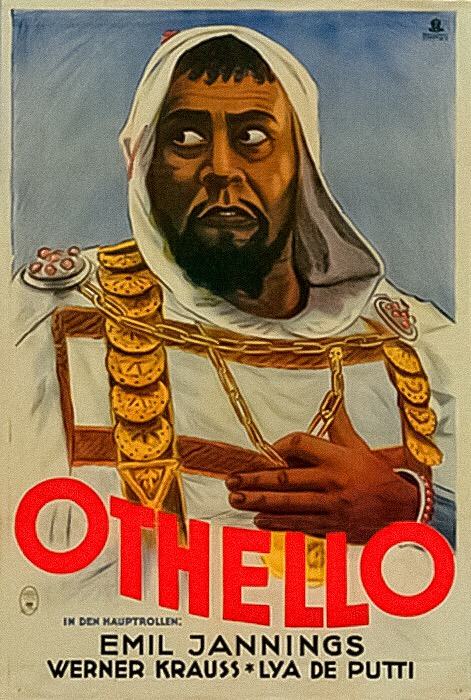
A definitive 6.3/10 rating for a film that redefined the boundaries of cult cinema. Othello remains a cornerstone of transgressive art.
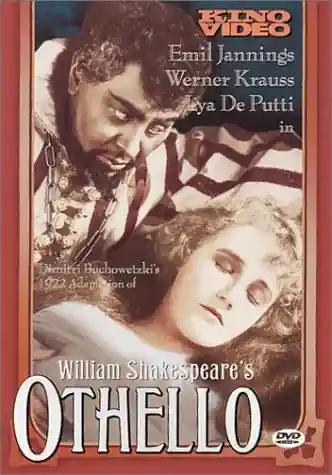
In the sepulchral hush of early Weimar cinema, where every footstep on celluloid sounds like a dirve nail into the coffin of the old order, Dimitriy Bukhovetskiy’s Othello (1922) arrives as both coronation and autopsy. The film is a cracked obsidian mirror held up to Shakespeare’s tragedy, reflecting back not the noble melancholy of Verdi’s opera nor the stately declamations of Irving’s stage, but something feral—something that gnaws.
Emil Jannings, that titan whose corporeal gravity seems to bend space around him, plays the Moor not as velvet-velvet heroism but as a tectonic plate perpetually on the verge of subduction. Watch the way he enters the frame: shoulders eclipsing the candle-flame, cheekbones carved by low-key lighting into basalt ridges. You can almost smell the saddle leather and brine on him, a man who has converted conquered continents into medals, yet remains a refugee in every drawing room.
Forget the postcard canals you know from travelogues; art director Franz Schroedter festoons the city with skewed archways that loom like broken cathedrals. Torches gutter in impossible wind, throwing amber tentacles across the faces of conspirators. The Doge’s palace is rendered as a lattice of negative space—black windows swallowing more light than they emit—so that power itself becomes a void around which characters orbit.
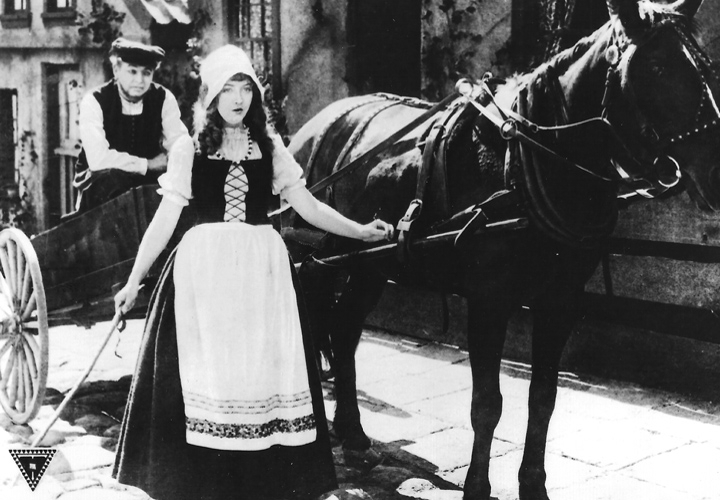
Compare this to the pastoral optimism of Fresh from the Farm (1921) where sunlight spills over haystacks like forgiving memory. Here, illumination is indictment. Every gleam on armor, every moon-slick ripple of the Adriatic, feels culpable—evidence in a trial whose verdict is already sealed.
If Jannings supplies the film’s tectonic rumble, von Alten provides its venereal whisper. His Iago is no blunt sadist; he is a scholar of humiliation, cataloguing every micro-expression that flickers across Othello’s face with the patience of an entomologist pinning wings. Notice how he removes his gloves—one finger at a time—while planting the seed of doubt, as though skin itself were testimony he intends to tamper with.
Silent cinema demands the anatomy of gesture, and von Alten answers with a vocabulary of reptilian subtlety: the way his pupils dilate when he watches the handkerchange pass from Desdemona’s palm to Emilia’s, the fractional tilt of his head that converts camaraderie into conspiracy. It is a performance you could freeze-frame at any instant and read, like a tarot card, the entire arc of coming catastrophe.
In Shakespeare, the strawberry-figured napkin is a MacGuffin; in Bukhovetskiy’s hands, it becomes a holy relic of paranoia. Cinematographer Werner Brand shoots it in insert shots so extreme the weave looms like a lunar crater. When Desdemona—embodied by Lya De Putti with a swan-like vulnerability that aches—lets it flutter from her grasp, the film cuts to an iris-in that feels surgically precise, as though the camera itself were a coroner isolating the wound through which trust hemorrhages.
There is a brief, devastating moment when the cloth drifts past Iago’s boots: he does not smile, merely exhales, and the candle between them flares, as if Satan had puffed on it. That single puff fans every ember of Othello’s insecurity into wildfire.
Screenwriter Karl Mueller-Hagens wields the film’s intertitles like a poisoner who perfumes his cork. Rather than expository placards, they arrive as fractured soliloquies: “Her breath… a cunning whore’s whisper beneath the moon.” The text is superimposed over churning water or the Moor’s contorted silhouette, so language itself becomes a contaminant, seeping from subtitle into image.
This technique stands in stark contrast to the moral didacticism of Democracy: The Vision Restored, where title cards sermonize clarity. Here, ambiguity is the knife. Each syllable widens the wound.
The murder scene unfolds in a bedroom whose walls breathe altar-black. Jannings looms over De Putti like a thunderhead; his shadow, cast by twin braziers, eclipses her supine form in the shape of a crucifix turned upside-down. The film cuts to an extreme close-up of her eyes—two trembling stars—then to his palm pressing the pillow, veins bulging like nautical ropes.
Because we lack Shakespeare’s words, the soundtrack’s absence becomes a scream. You hear it in the metronomic tick of a candle stub guttering, in the faint creak of bed-ropes as she thrashes. The scene is unendurable precisely because it is so quiet; atrocity cloaks itself in hush.
Shot amid the rubble of a defeated empire, the film vibrates with Weimar self-loathing. Othello’s outsider status—his Moorish otherness—mirrors Germany’s pariah position at Versailles: admired for past martial prowess, suspected of barbaric appetites. Iago’s machinations play like the stab-in-the-back myth rendered in miniature, a whisper campaign that topples a titan not through force but through the more corrosive chemistry of rumor.
This political undercurrent surfaces most starkly when Othello, duped into suspecting his wife of treason, tears the Venetian banner from its pole and tramples it. The act is wordless yet seismic: patriotism inverted into vendetta, the fabric of statehood reduced to soiled silk beneath a general’s heel.
For decades the film slumbered in archives, a single incomplete print moldering in Moscow’s Gosfilmofond. Then came the 2019 4K restoration: missing reels reconstructed from censor-friendly export versions, tints re-synchronized to the original Venetian schema of amber fever and cyan suspicion. The resulting image crackles like wet coal; you feel you could burn your fingerprints on its glow.
The new edition affords viewers a chance to track visual DNA forward to later Jannings collaborations with Murnau, and sideways to The Eye of Envy, another 1922 study of corrosive jealousy—proof that across global cinemas, the silent year 1922 was obsessed with the color green, even when shooting in monochrome.
Lya De Putti, often dismissed as a mere vamp, here works in a register of tremulous grace. Her Desdemona is no passive saint; she vibrates with erotic curiosity, the kind that fuels Iago’s insinuations. In the early dockside reunion with Othello, she runs her fingers along the rim of his cuirass as though testing whether love can survive inside armor. The gesture lasts three seconds yet foreshadows the marriage’s suffocation.
Theodor Loos’s Cassio is all porcelain honor, a man whose very gait suggests he has never stepped on a crack in the cobblestones. When Iago plies him with drink, the subsequent brawl is staged in a tavern whose ceiling beams slant at Boschian angles, every chair leg a potential betrayal.
Editorial pacing begins with stately long takes that luxuriate in Renaissance pageantry—bannered galleys, fanfares of trumpets rendered in overlapping dissolves. But once the handkerchief drops, the montage quickens to Soviet-style fractures: 14 shots in 18 seconds, a staccato of boots, daggers, and iris-shutters contracting like pupils dosed with belladonna. The strategy anticipates Eisenstein’s Battleship Potemkin by three years, proving that German editors were already probing the psychology of shock.
Though originally accompanied by live orchestras performing arrangements of Mendelssohn and Weber, the restored disc offers a newly commissioned score that weds Venetian choral fragments with atonal strings. The result aches: during the murder, a single female voice ululates against a tide of glissandi that climb until they vanish beyond human hearing, as if even sound itself were strangled by the pillow.
Listeners may detect echoes of that strategy in The Price of Crime, where silence is weaponized to amplify the weight of culpability.
From Welles’s midnight-black Othello (1951) to Parker’s lust-saturated 1995 version, every screen incarnation must wrestle with the ghost of Jannings. His blend of majesty and rot, of command and collapse, set the template for the modern tragic male: the patriarch whose power is both armor and Achilles’ heel. When Michael Fassbender stared down the barrel of his own ruin in Shame, or when Daniel Kaluuya’s pupils trembled in the Sunken Place of Get Out, they were channeling the same existential vertigo that Jannings etched in silver nitrate a century prior.
To watch this Othello is to witness cinema discovering its capacity for psychological autopsy. It is not a polite heritage artifact; it is a scalpel still warm from the body, a film that hisses, “You are never more blind than when you are certain.” Approach it not as homework but as midnight dare, and you will exit shaken, newly fluent in the dialect of distrust.
Stream it, project it, let its shadows crawl across your living-room wall. Just don’t be surprised if, days later, you find yourself counting the handkerchiefs in your own drawer, weighing lace against loyalty, wondering which scrap of cloth might one day testify against you.
IMDb 6.4
1916
Community
Log in to comment.