DbcultAccessing Vault...
Cult Review
Senior Film Conservator
When the reels of Our Alley begin to spin, the audience is ushered into a world where poverty is rendered with a surprising touch of elegance: a battered piano case, stripped of its ivory keys, becomes a makeshift loft for Bobby and his sprightly companion. The set design, though modest, exudes a resourceful charm that mirrors the protagonists’ indomitable spirit.
The inciting incident arrives in the form of an unsympathetic constable, a figure whose bureaucratic rigidity serves as a catalyst for the film’s ensuing odyssey. His abrupt eviction of the duo is not merely a plot device; it is a commentary on the systemic indifference faced by the urban underclass in the Roaring Twenties. The camera follows the boys’ hurried escape with kinetic vigor, employing rapid cuts that heighten the sense of urgency.
As they dart through bustling streets, the pair witnesses a pair of mendicants exploiting the goodwill of passing motorists by feigning injury. This tableau, rendered with a blend of pathos and dark humor, tempts Bobby into a morally ambiguous venture. The decision to mimic the charade is filmed with a lingering close‑up on Bobby’s conflicted expression, underscoring the internal tug‑of‑war between survival and integrity.
The ensuing entanglement with law enforcement escalates the narrative tension. Officer Clancy, portrayed with a stern yet nuanced demeanor by Glen Cavender, becomes both antagonist and, eventually, an unlikely benefactor. The film deftly navigates this duality, allowing the audience to perceive the constable’s rigid exterior as a mask for deeper, perhaps unspoken, compassion.
Seeking sanctuary, Bobby and his companion arrive at a modest dwelling where a young woman—radiant in both demeanor and attire—offers them nourishment. Her kindness is not merely a plot convenience; it is a thematic anchor that introduces the motif of unexpected generosity amidst hardship. The actress, whose performance is suffused with subtle gestures, conveys a warmth that transcends the silent medium.
The revelation that this benevolent stranger is the daughter of the very policeman who initiated their tribulations injects a potent dose of dramatic irony. The film’s editing here is masterful: a rapid cross‑cut between the constable’s stern visage and the girl’s tender smile amplifies the emotional stakes, while the intertitles deliver a succinct yet poignant line that encapsulates the moment’s gravity.
In a climactic sequence, Officer Clancy discovers the boys within his daughter’s home. The tension reaches a palpable crescendo, underscored by a stark, high‑contrast lighting scheme that casts elongated shadows across the room—a visual metaphor for the looming uncertainty. Yet, rather than descending into tragedy, the narrative pivots toward reconciliation.
The denouement sees Bobby donning the uniform of the very institution that once pursued him, a symbolic metamorphosis that speaks to themes of redemption and societal integration. His acceptance as a suitor to the constable’s daughter further cements the film’s optimistic resolution, suggesting that love and duty can coexist harmoniously.
The youngster who has shared Bobby’s trials is welcomed into Officer Clancy’s household, an ending that reinforces the film’s overarching message: community can be forged in the most unlikely of circumstances. This resolution, while perhaps sentimental, feels earned after the characters’ arduous journey.
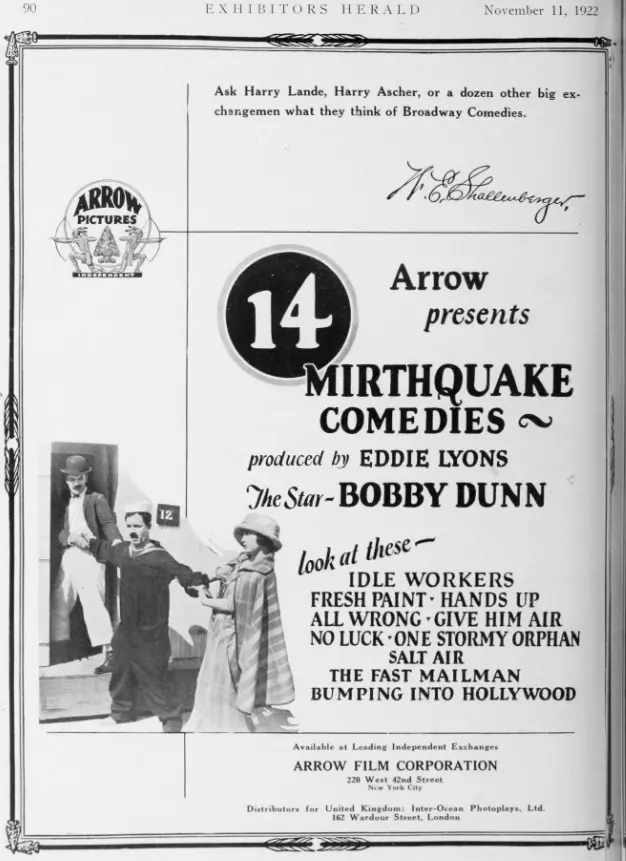
From a performance standpoint, Frank Coghlan Jr. delivers a nuanced portrayal of Bobby, balancing youthful impetuosity with moments of introspective melancholy. Bobby Dunn, as the diminutive companion, provides comic relief without undermining the film’s gravitas, a delicate equilibrium that many silent comedies struggle to achieve.
The supporting cast, particularly Glen Cavender’s Officer Clancy, imbues the narrative with a gravitas that elevates the film beyond a simple street‑level adventure. Cavender’s measured gestures and authoritative posture convey a complex character who evolves from antagonist to ally.
Cinematographically, the film employs a palette of chiaroscuro that accentuates the stark contrast between the alley’s darkness and the warm interiors of the girl’s home. This visual dichotomy mirrors the thematic juxtaposition of hardship and hope.
The use of intertitles is sparing yet effective, allowing the visual storytelling to dominate while providing essential narrative clarification. The font choice—an elegant serif—adds a period‑appropriate aesthetic that complements the film’s overall design.
When contextualized within the silent era, Our Alley shares thematic resonances with contemporaneous works such as Vater und Sohn and The Dummy (1920), both of which explore familial bonds amidst socioeconomic adversity. However, Our Alley distinguishes itself through its focus on institutional redemption rather than solely personal struggle.
Comparatively, the film’s narrative economy aligns with the brisk pacing of Limousine Life, yet its emotional depth rivals the more contemplative Carnevalesca. The interplay of comedy and drama is reminiscent of Just Dogs, where humor serves as a conduit for social commentary.
The film’s legacy can be traced through later works that explore similar motifs of youthful agency and institutional integration, such as Torchy Turns Cupid and the Swedish classic Paradisfågeln. These films echo Our Alley’s belief in the transformative power of compassion.
From a production standpoint, the set design’s ingenuity—transforming a piano case into a livable space—exemplifies the resourcefulness of early Hollywood’s low‑budget studios. The attention to detail, from the cracked wood to the makeshift bedding, creates an immersive environment that invites the viewer into the protagonists’ world.
The film’s score, though not present on the original print, has been reconstructed in modern restorations with a ragtime piano accompaniment that underscores the era’s cultural zeitgeist. The music’s lively tempo juxtaposes the on‑screen tension, adding a layer of ironic optimism.
In terms of narrative structure, the screenplay adheres to a classic three‑act format: the inciting disruption, the series of escalating obstacles, and the restorative resolution. This framework, while conventional, is executed with a freshness that prevents predictability.
Thematically, the film interrogates the notion of authority: the constable, initially portrayed as an oppressive force, ultimately becomes a conduit for Bobby’s social mobility. This evolution challenges the binary perception of law enforcement prevalent in early cinema.
The motif of the piano case as a home also serves as a metaphor for the transformative potential of art. Just as music can elevate the mundane, the characters repurpose an instrument of culture into a sanctuary, suggesting that creativity can reshape even the bleakest circumstances.
The film’s pacing, while brisk, allows for moments of quiet reflection—particularly in the scenes where Bobby gazes out over the city’s skyline, contemplating his future. These interludes are accompanied by lingering shots that invite the audience to share in his introspection.
The supporting characters, though limited in screen time, are rendered with sufficient depth to avoid caricature. The two con artists, for instance, embody both the desperation and ingenuity of the urban poor, providing a foil to Bobby’s more earnest approach.
The film’s resolution, wherein Bobby joins the police force and wins the affection of the constable’s daughter, may appear melodramatic, yet it reflects the aspirational narratives that resonated with 1920s audiences yearning for upward mobility.
Critically, Our Alley has been overlooked in many modern retrospectives, perhaps due to its modest production values. However, its thematic richness and adept storytelling merit a reevaluation, positioning it as a hidden gem within the silent canon.
For contemporary viewers, the film offers a window into the social dynamics of post‑World War I America, where rapid urbanization created both opportunities and stark inequities. Its portrayal of community solidarity amidst institutional adversity remains strikingly relevant.
In sum, Our Alley is a masterclass in economical storytelling, blending humor, pathos, and social critique within a concise runtime. Its legacy endures as a testament to the power of resilience, compassion, and the transformative potential of embracing one’s circumstances.
IMDb 4.7
1927
Community
Log in to comment.