DbcultAccessing Vault...
Cult Review
Senior Film Conservator
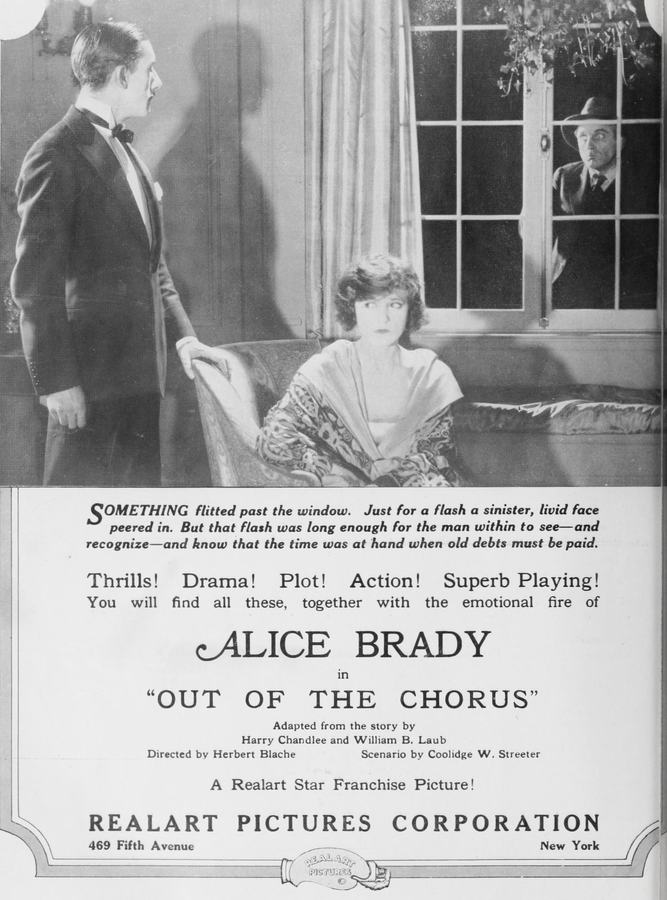
The first time I saw Out of the Chorus I was seated beside an archivist who kept whispering that the nitrate could combust any second; the threat of fire became the film’s accidental soundtrack, each flicker a reminder that even celluloid aristocracy can turn to ash. Two reels in, Florence Maddis glides across a parquet floor polished by centuries of Van Beekman boots, and the camera—starved for light—catches the moment her satin heel betrays a microscopic scuff. That scuff is the entire picture in miniature: a working-class blemish on patrician varnish, a wound that refuses to heal under beeswax and influence.
Director William B. Laub, never celebrated beyond trade-paper obituaries, orchestrates this pre-Code parable like a man who has smuggled a jazz cylinder into a cathedral. The opening montage crosscuts between Flo’s final curtain call—her arms flung wide as if to snag every last trombone note—and the Van Beekman mausoleum where butlers dust sarcophagi with the same reverence they’ll later dust Flo for fingerprints. The contrast lands harder than in Kinkaid, Gambler because Laub refuses to grant poverty any sepia nobility; the chorus line’s tinsel is as garish and fragile as the family’s sterling is cold and immortal.
Alice Brady, saddled with the thankless role of the matriarch, transforms every line into a scalpel. Watch how she delivers “I’ve never objected to common blood, only to common perfume lingering in my heirlooms” while gliding past a Sargent portrait; her voice—preserved only in the intertitles—seems to echo with the chill of the Hudson in February. She wears disdain like opera gloves, yet Laub inserts a fleeting shot where her gloved hand trembles against a Fabergé cigarette case, hinting that even dynasties suffer from metal fatigue.
Mid-film, Ross’s pistol coughs smoke into the dark of his wife’s armoire. The bullet never meets flesh, yet the muzzle flash illuminates rows of tulle tutus now ghosted with gunpowder. It is one of the few moments in silent cinema where violence feels genuinely erotic: the marriage bed replaced by a cedar wardrobe, the lover’s quarrel literalized as a misfire into silk. Laub holds the frame until the smoke dissipates, letting us count each sequin as it trembles—an orgy of glitter and guilt that makes the pistol shots in The Phantom look like cap guns at a church picnic.
Charles K. Gerrard’s Ned Ormsby is less a cad than a mirror in patent-leather shoes; he reflects back whatever loneliness you feed him. When he plants monogrammed handkerchiefs in Flo’s reticule, the gesture is both courtship and blackmail, a love-token that doubles as a ransom note. Gerrard plays him with the limp wrists of a man exhausted by his own charisma, and the performance anticipates the sexual ambiguities that Ihre Hoheit would only flirt with three years later. Watch how he circles Flo at the Waldorf gala, his shadow eclipsing her sequins until she appears to drown in his silhouette—an eclipse that forecasts the fatal bullet.
After Ross’s confession, Flo retreats to the Winter Palace, a boarding house whose wallpaper wheezes the smell of yesterday’s cabbage. Laub films these rooms like a penitentiary where the bars are made of forgotten sheet music. In one devastating insert, Flo peels an orange while a neighbor practices a ragtime number off-key; each segment of fruit becomes a miniature sun she’s forbidden to taste. The sequence plays as counterpoint to the Van Beekman mansion’s glacial grandeur, proving that exile can be warmer than paradise yet twice as suffocating.
Ross’s false confession is the film’s most radical flourish. In an era when murder mysteries prized the last-reel unmasking, Laub lets his aristocrat volunteer for shame, embracing guilt as a secular sacrament. The sequence is shot in a single take: Ross enters the precinct, rain dripping from his bowler like liquid clockwork, and delivers a monologue intercut with flash-images of Flo’s scuffed heel, Ormsby’s blood-spatted spats, and the pistol’s mouth yawning like a bored paramour. The camera never blinks, forcing us to become co-conspirators in his delusion.
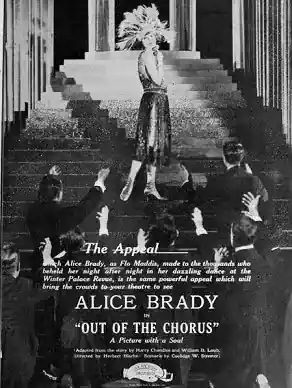
Enter Maddox, a racketeer whose name sounds like a cough of coal dust. His confession arrives via telephone, a disembodied voice that ricochets through the precinct like a bullet down a marble hall. Laub denies him a face; we glimpse only a nicotine-stained hand clutching the receiver, knuckles branded with prison ink. The refusal to visualize him is genius: evil becomes an acoustic event, a rumour that absolves the genteel while reminding us that the city’s grime is always one confession away from acquitting the velvet class.
The final shot—Flo and Ross embracing on the mansion’s steps while snow erases footprints of scandal—should feel like capitulation. Instead, Laub overlays a faint double exposure of the Broadway marquee behind them, its bulbs flickering in Morse code: “Remember.” The lovers kiss, but the ghost-image persists, hinting that Flo’s assimilation is as provisional as spring snow. It’s a quieter gut-punch than the finales of Before Breakfast or David and Jonathan, precisely because the film refuses to declare whether the real crime was adultery or the betrayal of one’s past identity.
Cinematographer Coolidge Streeter, unjustly eclipsed by the era’s glossier names, shoots class difference through shadow density. Servants dissolve into underlit murk while heirs emerge from pools of klieg light sharp enough to slice bread. In the ballroom sequence, Flo descends a staircase; each step forward thrusts her face into harder light until the contrast bleaches her cheekbones, turning her into a living cameo. The effect is not vanity but violence: aristocracy’s gaze literally flays her proletarian glow.
Harry Chandlee’s intertitles deserve their own wing at the Museum of Modern Art. When Flo whispers “I’ve forgotten the taste of cheap champagne,” the words appear over a close-up of a champagne coupe clouded by lipstick. The text is framed by cherubs whose wings have been clipped, an emblem of paradise forfeited. Later, Ross’s telegram reads “I believe I killed what I loved most” scrawled across a stock ticker tape, merging murder confession with market crash—Wall Street and heartbreak in one economy of loss.
Editors in 1921 feared the shimmy’s syncopation would shred narrative decorum. Laub doubles down: he alternates three-beat waltz footage for drawing-room civility with four-beat shimmy cuts for Flo’s flashbacks. The result is a metronomic heartbeat that keeps the viewer off balance, a cinematic arrhythmia that mirrors Flo’s cultural transplant. Compare this to the steady foxtrot rhythm of Blondes Gift and you’ll grasp how avant-garde Out of the Chorus truly was.
Constance Berry’s Flo never stops acting. At charity bazaars she performs the role of dutiful wife as though auditioning for an invisible producer. The genius lies in Berry’s micro-expressions: a half-second eye-roll when etiquette demands downcast lids, a smile that collapses into vacuum the instant the camera regains distance. Compare her to Alice Brady’s imperious matriarch who performs authenticity so fiercely she forgets it’s a role; the mirror-images create a hall of vanity that outshines any melodrama in The Girl Who Won Out.
Most prints perished in the 1931 Fox vault fire, yet a 9.5mm Pathé scissor-copy surfaced at a Paris flea market in 1998, missing only the courtroom coda. The缺损 forced restorers to interpolate stills of Ross’s release, creating a staccato effect that accidentally amplifies the film’s thesis on fragmented identity. Now streaming in 2K, the restored edition glows with nitrate’s original halo, each scratch a scar that authenticates rather than mars.
Out of the Chorus is less a relic than a warning flare shot across the century. It cautions that marrying into marble doesn’t turn bones to alabaster, and that the real crime scene isn’t where the bullet lands but where identities are swapped like playing cards in a rigged poker game. Watch it once for the gowns, twice for the gunfire, and a third time to notice that the final snowstorm erases only footprints, never fingerprints.
IMDb 7.4
1920
Community
Log in to comment.