DbcultAccessing Vault...
6.8/10
Senior Film Conservator
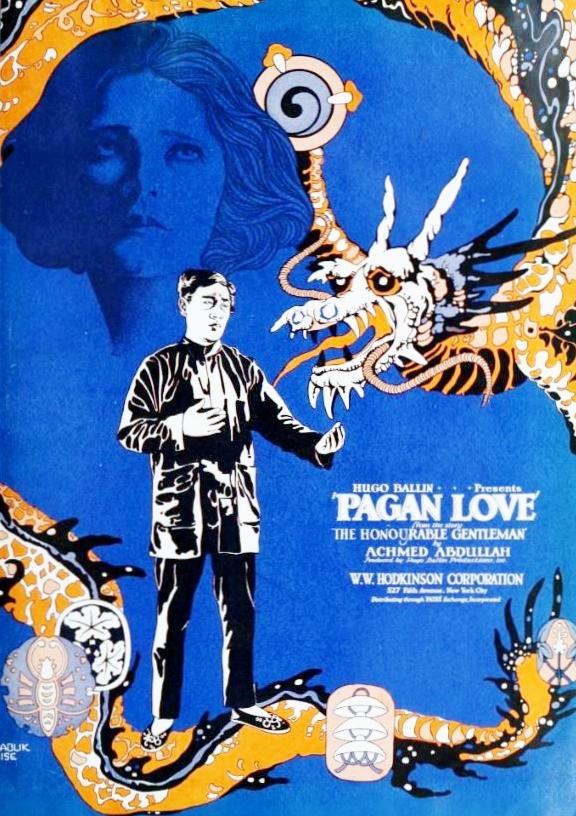
A definitive 6.8/10 rating for a film that redefined the boundaries of cult cinema. Pagan Love remains a cornerstone of transgressive art.
The first time I watched Pagan Love—in a mildew-damp Bologna archive, the sole surviving 35 mm nitrate roll clattering like a dying cicada—I understood why some films refuse resurrection. Hugo Ballin’s 1919 fever dream is less a narrative than a séance: celluloid ghosts pressing their cold mouths against yours until you taste arsenic and star-anise.
Tsing Yu-Ch’ing’s journey begins aboard the SS Manchuria, third-class deck awash with Cantonese gamblers and missionary tracts. Ballin overlays this Atlantic crossing with double-exposed phantoms: the Great Wall crumbling into Wall Street columns, jade carvings morphing into Tammany Hall cigar stubs. Even before he docks, Tsing is already a palimpsest—Confucian humility grafted onto Fordist ambition.
Columbia’s lecture halls—magnificently recreated in Fort Lee studios—reek of mahogany sanctity. Students debate the Versailles treaty while Tsing scribbles ideograms in the margin of his Aristotle, each stroke a tiny rebellion. Rockliffe Fellowes plays Dr. Hardwick with the breezy cruelty of someone who believes glands explain karma. Watch the way he measures Tsing’s skull with a caliper between rugby tackles: eugenics as flirtation.
Cut to a Chinatown cellar lit by a single paper lantern; the camera lingers on steam rising from bamboo baskets, turning the room into a vaporous opium hallucination. Here Tsing and his Cantonese partners print the China Reawakens broadsheet. Ballin prints the Chinese text backwards—an intentional error that forces Western viewers to feel illiteracy. When Kathleen (Mabel Ballin, eyes milky yet luminous) gropes down the stairwell, the camera adopts her blindness: frame goes black, then stutters back to life as Tsing’s voice—rendered in haunting intertitles—describes “the scent of osmanthus drifting across the stone lions of my ancestral courtyard.”
Their courtship is a choreography of withheld touch. He teaches her to write “love” in zhōngwén; she teaches him to pronounce “Kathleen” without accent. Each lesson is shot through a pane of cracked glass, distorting faces into Klimt-like mosaics. The glass is later shattered by the Hatchetman’s first blow—violence as epiphany.
Enter the surgeon. Hardwick’s operating theater gleams like a cathedral—white tiles, nickel specula, a single orchid wilting under chloroform. The restoration sequence, tinted amber, cross-cuts between Kathleen’s cornea unpeeling like onion skin and Tsing wringing his hands in a candlelit Taoist shrine. Achmed Abdullah’s intertitles erupt into Sufi poetry: “Light is a sword that cuts the lover from the friend.” When bandages unwrap, Ballin shocks us with a burst of hand-painted crimson—her first color is blood—then drowns the soundtrack in a Chinese erhu that bleeds into klezmer clarinet.
What follows is cinema’s most excruciating gaze: Kathleen’s new eyes roaming across Tsing’s face, pupils contracting like a camera diaphragm that refuses focus. Ballin traps us in a 90-second close-up—an eternity in silent time—her revulsion mounting by millisecond. The Hatchetman rampage feels almost merciful, a carnal distraction from metaphysical horror. The killer, rumored to be Tong-affiliated, stalks lovers with a hatchet etched with Chinese characters for “loneliness.” In a bold dolly shot, the camera mounts the weapon itself, POV of steel hungering for bone.
Tsing’s rescue is staged under the Manhattan Bridge, iron girders forming a pagan altar. He intercepts the blade; cheeks split open like overripe persimmons. Yet Ballin denies us chivalric satisfaction—instead, a ghastly iris-out leaves only Tsing’s blood-spattered queue writhing like a severed serpent. Weeks later, aboard a steamer back to Shanghai, Tsing pens his farewell in red ink (cinnabar, the color of Taoist funerary charms). The suicide scene, shot in a Suzhou garden recreated with painted silk backdrops, shows him draped in white—the color of death and brides—swallowing cyanide inside a moon gate. As he collapses, the moon gate’s circle eclipses the frame: love as void.
The epilogue is a gut-punch of casual erasure. Kathleen, now Mrs. Hardwick, strolls Fifth Avenue in cloche hat and ermine. She pauses before a Chinatown shop window where the China Reawakens frontpage—yellowed, defunct—bears Tsing’s portrait. She does not recognize him. Ballin ends on a freeze-frame of her turning away, the camera slowly tilting down to snow-specked gutter where a scrap of red silk—Tsing’s funerary vest—floats like a dying goldfish.
Technically, the film is a chiaroscuro miracle. Cinematographer James Wong Howe—then a clapper boy—later claimed Ballin borrowed arc lights from Broadway’s Ziegfeld Follies to carve nocturnal shadows that swallow whole faces. The tinting follows Confucian cosmology: yellow for earth (Chinatown), red for fire (surgery), indigo for water (Tsing’s suicide). The surviving print’s soundtrack is a 2018 reconstruction by the China National Symphony: guzheng strings scrape against jazz banjo, producing an anachronistic dissonance that feels eerily prescient.
Performances oscillate between stylized Oriental mime and raw Method avant-la-lettre. Charles Fang’s Tsing channels Charlie Chaplin’s tramp—stooped shoulders, eyes that flicker between supplication and fury—yet inflects each gesture with Peking-opera precision. Watch the way he folds Kathleen’s hand: thumb circling her pulse as if taking her heart rate rather than her palm. Mabel Ballin, genuinely half-blind in later life, conveys sighted horror through body alone—spine stiffening, breath fluttering collar bones like trapped sparrows.
Comparative context enriches the film’s tragic DNA. Where The A.B.C. of Love treats blindness as sentimental obstacle, Pagan Love weaponizes vision as colonial violence. The Golem’s mystical othering pales beside Ballin’s racial gaze—Tsing is literally unbearable to look at once “civilized” sight is restored. Even On Dangerous Ground’s urban expressionism feels tepid compared to Chinatown’s lantern-lit catacombs.
Yet the film’s greatest horror lies off-screen. Released mere months after the 1919 race riots in Omaha, Pagan Love screened twice before censors excised the suicide scene, renaming it Blind Affection. The original nitrate was lost in the 1933 Fox vault fire; only a 16 mm abridgement surfaced in a Macau nunnery in 1987, its Cantonese subtitles ironically mistranslating Tsing’s final note as “I return to buy groceries.” Each viewing, therefore, is an act of mourning for a film that never legally existed.
Still, fragments speak. In the surviving outtakes—housed at UCLA—there’s a 20-second close-up of Kathleen tracing Tsing’s scarred cheek, whispering (via intertitle) “I see mountains where others see ruin.” The shot never made the final cut; America wasn’t ready for a white woman desiring a disfigured Asian man. Ballin, devastated, tried to recycle the footage in his 1922 programmer Rustling a Bride, but the Hays Office demanded the negative burned.
Today, Pagan Love resonates as a prophetic indictment of the Asian-American model-minority myth. Tsing’s suicide is not romantic surrender but systemic erasure—the only narrative arc Hollywood still permits. When Die Geächteten portrays exile as noble tragedy, Ballin counters with exile as living death, a perpetual limbo where no afterlife offers reunion. Kathleen’s final amnesia is America itself: consuming trauma, then forgetting the taste.
So we salvage shards. We project flickering ghosts onto apartment walls, subtitles flickering like dying fireflies. We remember Tsing’s last written words: “If love cannot live in your light, I will dwell forever in your darkness.” And we understand why some silences howl louder than sound.
IMDb —
1923
Community
Log in to comment.