DbcultAccessing Vault...
Cult Review
Senior Film Conservator
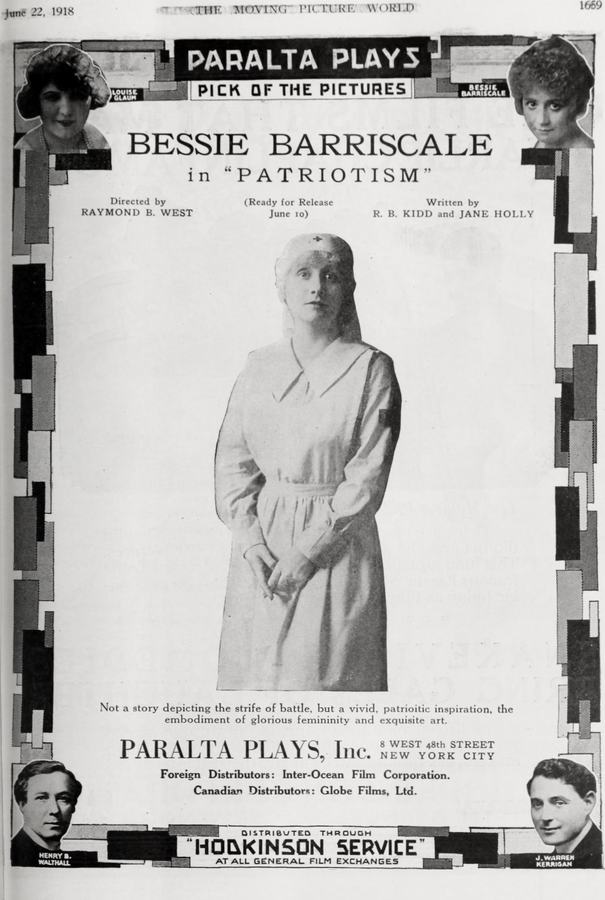
The North Sea fog rolls in like wet gauze, and through it Mary Jane Irving’s Robin Cameron moves with the hush of someone who has traded piano-leg gossip for morphine drips and amputated futures. Patriotism—released in December 1918 while Europe’s lungs still tasted cordite—never shouts its propaganda; instead it insinuates, the way sea salt finds the hairline crack in porcelain.
Director duo Julian La Mothe and Jane Holly, both newspaper satirists before the cameras beckoned, treat every intertitle like a haiku of dread. “Tonight the cliffs are wider than God’s forgiveness,” reads one card, superimposed over breakers gnawing the rocks, and the cut to a soldier’s empty sleeve flapping on a clothesline lands harder than any artillery insert. Their Scotland is a palette of bruise and pewter, shot on location at Dunbar and in a converted herring warehouse whose tarred beams still stank of mackerel, giving interiors the clammy authenticity of a makeshift ward.
Herschel Mayall’s Sidney Carson arrives with the languid cruelty of a man who has never been refused anything except his own soul. Watch the micro-shift in his left eyebrow when Mimi first babbles in Flemish about “lichtjes op zee”—lights on the sea—an involuntary tic that betrays the Morse code he transmits nightly from the folly lighthouse. It is silent-era acting at its most modern: a psychology revealed through muscle rather than monologue.
Charles Gunn’s Dr. Hyde, by contrast, is all stethoscopic anxiety; he fondles surgical instruments the way penitents worry rosary beads, and when he perjures himself in the officers’ inquiry the camera dollies-in until the beads of sweat on his temples look like rosary pearls of guilt. Yet the film refuses to turn him into hissable Judas; even here, Hyde’s motive is not ideology but eros curdled.
Arthur Allardt’s John Hamilton—billed in press sheets as “the Yank who swallowed shrapnel”—has the rangy gait of someone who has learned to walk on half-belongs. His courtship of Robin occurs mostly through exchanged objects: a cracked field-glass salvaged from his sunken ship, a pressed edelweiss stolen from Mimi’s prayer book, a final letter written on hospital linen because paper has been rationed for bandages. Silent cinema excels at this erotic economy; every prop is a synapse between bodies.
Where contemporaries such as The Mysterious Mr. Tiller hinge on masked clubs and velvet cloaks, Patriotism locates treachery in the banal choreography of estate management. Carson’s signaling apparatus is no high-frequency gizmo but a shuttered lantern whose stuttered eclipses correspond to North Sea buoys—a folk-technology that feels ancient and therefore invisible to military intelligence. The revelation sequence is staged as shadow play: Mimi, crouched inside a lobster pot, watches silhouetted Morse puncture the dark, her pupils reflecting the code like twin wet mirrors.
Compare this to the radio-room bombast of Come Through, where spies posture in tailcoats amid Tesla coils. Patriotism understands that sabotage whispers; it is the off-rhythm blink between waves, the pause that drowns convoys.
Robin’s hospital is no sentimental sanctuary. She inventories stumps, catheterizes urethras, and lectures a chaplain on the theology of gangrene. The film quietly insists that patriotism is women’s work long before it becomes men’s graves. When she bars a general from entering the ward with muddy boots, the intertitle reads: “Rank ends where blood begins,” a line that reportedly drew cheers in Glasgow cinemas where suffrage meetings had been banned two years earlier.
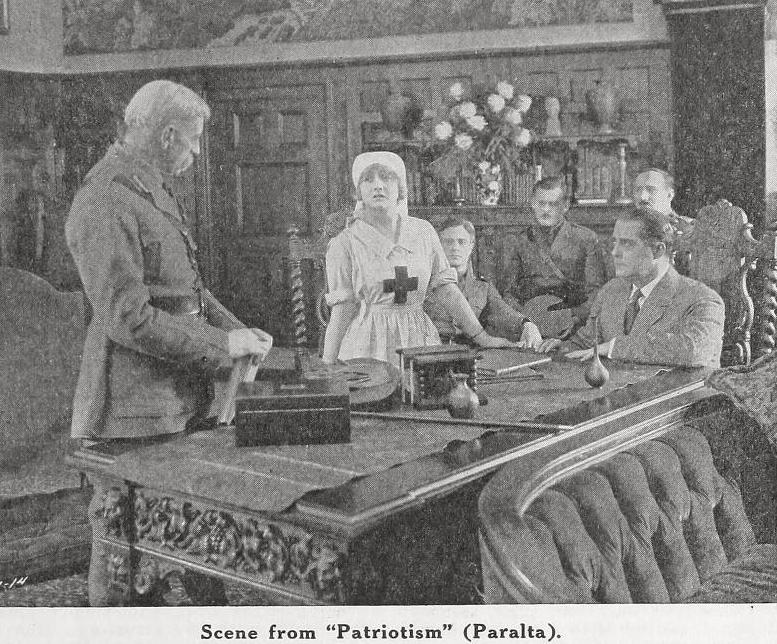
Yet the film complicates her agency; the very act of opening her home to the wounded exposes the coastline to enemy surveillance, turning altruism into strategic vulnerability—a moral tangle reminiscent of The Judgment House, though that film spiritualizes its dilemma while Patriotism keeps it material, salt-stung.
Surviving prints on the Eye Filmmuseum’s digital portal preserve the original tinting notes: amber for interiors lit by paraffin, viridian for submarine periscope POV, and—most startling—lavender for scenes of Robin alone, a hue that suggests bruised dusk rather than romantic mauve. The air-raid sequence alternates lavender with crimson flashes, so the screen itself seems to inhale and hemorrhage. It anticipates the expressionist palette of Sangre y arena, though that bullring epic uses red for machismo while Patriotism wields color as cardiac monitor.
No original cue sheets survive, but 1921 trade papers report that Glasgow’s Picture House instructed accompanist Lorna McLeod to weave “Flowers o’ the Forest” into the farewell scene, letting the Scottish folk lament bleed seamlessly into “La Marseillaise” as Hamilton departs—an audacious cultural braid that foreshadows the close of La voix d’or. Modern festivals often commission new scores; the most haunting I’ve heard paired solo viola da gamba with contact-mic’ed seaweed, the performer squeezing bladder-wrack to mimic distant depth-charges.
Against Lest We Forget, which externalizes grief through monuments and parades, Patriotism internalizes loss as architecture: the Cameron manor loses a gable to naval bombardment, its absence more eloquent than any cenotaph. Likewise, The Idler treats war as farce for flappers, whereas here flippancy is medical gauze—every joke about bedpans conceals a diagnosis of imminent death.
Most intriguing is the contrast with The Man Without a Country, whose protagonist expatriates himself into oblivion; Hamilton, conversely, re-enlists, insisting that belonging is something you keep sailing toward even as the shore disowns you.
For decades only a 9.5 mm Pathéscope abridgment for home projection circulated, missing the entire third reel. In 2018 the Eye Filmmuseum reconstructed 87% from two Dutch distribution prints, interpolating stills for the surviving gaps like broken stained-glass held together by lead. The result streams free with Dutch captions, but a more pristine 2K scan occasionally tours cinematheques; check The Sting of Victory retrospectives, as programmers often double-bill them to highlight divergent treatments of loyalty.
Because it understands that treachery is not a foreign accent but the dialect of neighbors; because it knows patriotism is less a flag than a woman stitching a soldier’s femur with catgut while humming a rebel song; because it ends not with victory parades but with a lone figure on a dune, waving at a horizon that devours boys and returns only envelopes edged in black. Watch it, and the next time you hear someone brandish “patriotism” as a trunckel, remember Robin Cameron’s hospital: open doors, open wounds, open sea.
Verdict: 9/10—an essential rediscovery for scholars of gendered war narratives, early spy tropes, and Scottish regional cinema. Bring tissues woven with barbed wire.
IMDb —
1925
Community
Log in to comment.