DbcultAccessing Vault...
Cult Review
Senior Film Conservator
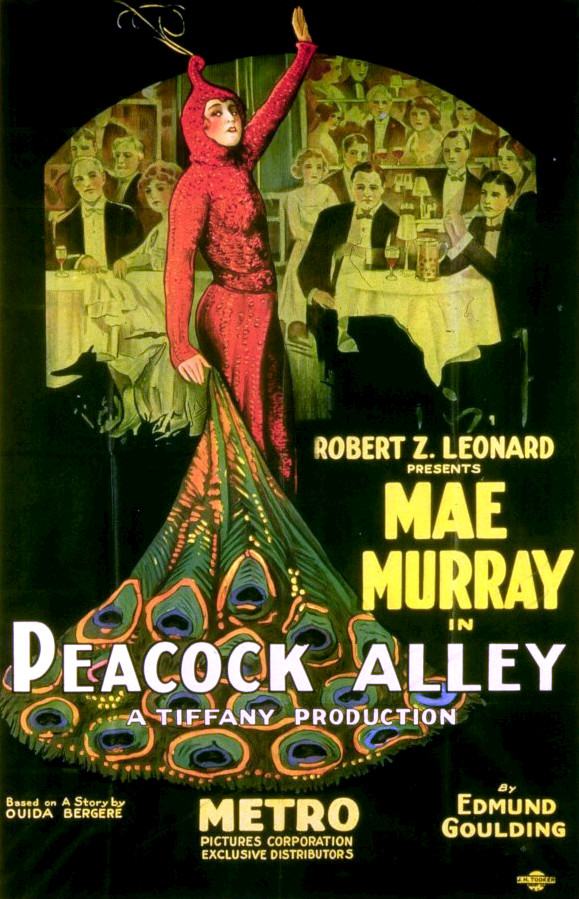
The first time you see Cleo—Mae Murray’s iridescent Parisian gamine—she is only a fractured reflection in a warped cabaret mirror, a trick of gaslight and silver nitrate that promises the world will break before she does.
Robert Z. Leonard’s Peacock Alley (1922) is nominally a rags-to-riches-to-rags parable, yet its bloodstream pumps with something far more volatile: the terror of being looked at. Every frame interrogates who gets to be watched, who pays the price for visibility, and how desire is monetized under the gilded scaffolding of the post-WWI economy. The picture opens on transatlantic steam, fog horns moaning like widowed leviathans; Elmer Harmon—played by Monte Blue with the rubber-boned optimism of a man who believes capitalism has a conscience—struts down the gangway convinced the Old World will genuflect. Instead, he is devoured by a montage of cancan kicks, champagne cascades, and Cleo’s kinetic shoulder-blades slicing through bead curtains like ivory propellers.
There is a sublime gag early on: Elmer attempts to sign the lucrative French armaments contract at a rococo desk while, in the deep background, Cleo rehearses a serpentine dance. Each time her body arcs, a candle flame gutters; the contract flutters, unsigned. The film never verbalizes the metaphor—power flickers when feminine spectacle enters the room—but the visual algebra is unassailable.
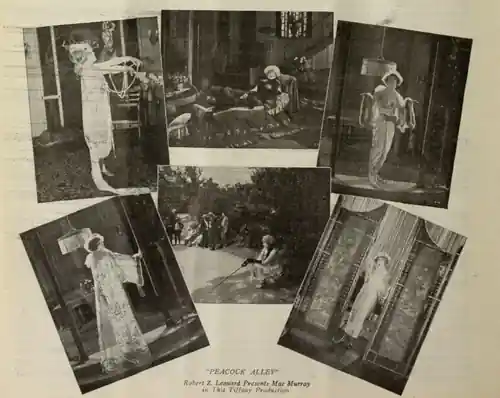
Leonard, aided by scenario doyenne Ouida Bergère, structures the narrative like a diptych of incompatible color temperatures: Parisian cobalt vs. Pennsylvanian umber. Once the newlyweds dock in Harmontown, the camera’s once-mobile libido is suddenly corseted. Iris shots narrow on provincial faces, squeezing Cleo into a petticoated panopticon where every gaze accuses. Murray, ever the shrewd tragedienne, lets her shoulders climb toward her earlobes, morphing the dancer’s confident port de bras into the startled wings of a trapped magpie. The town’s gossip is conveyed through superimposed eyeballs that float across the screen—an avant-garde flourish that feels both quaint and scalpel-sharp a century later.
Finances implode with Expressionist velocity. Elmer’s downfall is staged in a swirl of chiaroscuro worthy of Das Defizit’s feverish inflation tables: mahogany desks dwarf him, shadows eat his outline, a quill pen resembles a saber. When he forges his uncle’s signature—an act the intertitles hysterically call “the ink of damnation”—Leonard jump-cuts to a close-up of Napoleon the Dog (yes, the canine supporting player) lowering his head in shame, a moment so bonkers it loops back to Brechtian genius.
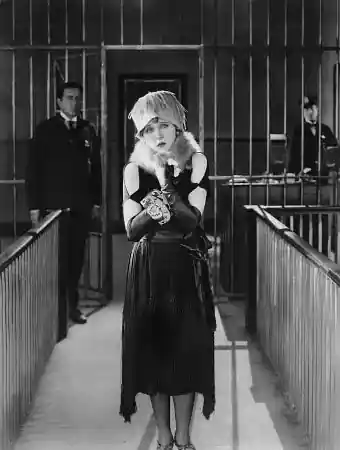
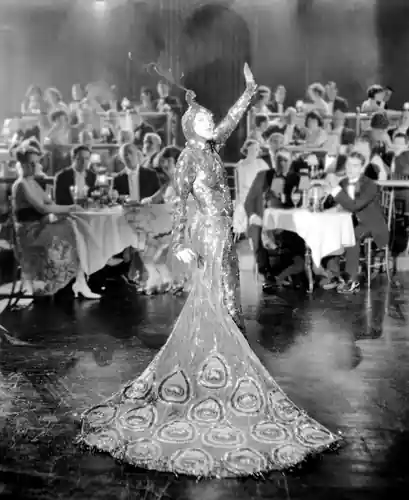
Third-act New York becomes a glittering ulcer. Cleo’s desperate cabaret comeback, shot in two-strip Technicolor inserts that have since faded to bruised magenta, literalizes the commodification of the female body under duress. Murray, nicknamed “The Gardenia of the Screen,” slinks across the stage in a costume of pearlescent discs that clack like shell casings when she moves—an echo of the very arms deal that ignited the plot. Meanwhile Elmer, imprisoned in the Tombs, is lit from below so his cheekbones resemble cracked porcelain; the mise-en-scène foreshadows the morbid male fragility later perfected in Conscience.
Of course, misunderstanding must arrive clad in evening dress. Cleo’s reunion with a louche childhood friend—Edmund Lowe in lacquered hair and a smile like a switchblade—sets the third-act jealousy conflagration. The sequence is a masterclass in negative space: Leonard blocks the actors so that a vacant, echoing chaise longue between them becomes an abyss of suspicion. When Elmer bursts in, the camera dollies backward, as if even the apparatus itself recoils from masculine entitlement.
Redemption, that chronic cinematic liar, shows up via train smoke and torrential rain. Elmer’s return to the Broadway boardinghouse is filmed in a single take that lasts fifty-three seconds—an eternity in 1922. Murray stands in a doorway, backlit, her silhouette haloed by the sickly sodium glow of streetlamps. She does not rush to forgive; instead, she lets the silence pool until it reflects both their faces. Only when he kneels—an act Blue performs with the ungainly thud of a man dropping a lifetime of ego—does Cleo’s hand, trembling, touch his hair. The film ends not with a kiss but with a fade on their interlaced fingers, a visual whisper that reconciliation is a process, not a punctuation mark.
Mae Murray’s performance is the mainspring that keeps this antique timepiece ticking. Trained in the toe-tangling extravaganzas of the Folies Bergère, she grafts balonic precision onto melodramatic excess. Watch her wrist flicks during the reconciliation scene: tiny helices of hope spinning inside despair. Critics of the era carped that she “over-posed,” yet today her gestural semaphore reads as proto-feminist semaphore—every exaggerated arch of her spine protests the corset of patriarchal narration.
Monte Blue, all elbows and earnestness, offers the perfect foil: a man who mistakes possession for protection. His physique—six-foot-three, with the rangy gait of a cowboy who read one too many Rousseau pamphlets—embodies the awkward collision between Wilsonian idealism and Roaring-Twenties rapacity. In the penultimate shot, when he trudges through Pennsylvania slush, his overcoat hangs like a penitent’s hairshirt, a visual mea culpa.
Edmund Goulding, later famed for Grand Hotel, allegedly ghost-polished the intertitles, and his epigrammatic wit flashes throughout. My favorite: “Love signed in ink can be erased by tears, but love signed in blood leaves a stain the soul keeps for collateral.” It’s the sort of line that makes you half-believe hearts really do run on crimson ledger sheets.
Composer Louis F. Gottschalk’s original score, now lost, was described by Variety as “a hurricane wearing a string of pearls.” Contemporary festivals often retrofit the film with nuevo-tango ensembles, yet I prefer the hush of a lone piano, its minor seventes echoing like footsteps in an abandoned customs house—fitting for a story about contracts signed and souls imported.
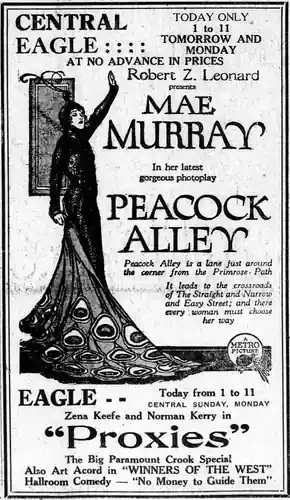
Visually, the movie straddles the cusp between late-Teens ornamentalism and hard-edged Jazz Age geometry. Art director William Cameron Menzies (yes, the future Gone with the Wind wizard) drapes Paris in Cubist scrims that fracture chandeliers into kaleidoscopic knives. Contrast that with Harmontown’s Germanic woodcuts: linden trees claw the sky like blackened vertebrae, while coal trains bisect the horizon—an inverted frontier myth. The palette, though monochromatic, feels synesthetic; you can practically taste the nickel beer on the Pennsylvania air and smell the gardenias wilting in Cleo’s hair.
Comparative contextualization enriches the experience. Fans of Old Heidelberg’s wistful royal-commoner romance will recognize the structural DNA, yet Peacock Alley refuses the balm of tragedy; it insists on the messier ledger of forgiveness. Likewise, the fiscal desperation that curdles Elmer’s ethics rhymes with the inflationary panic in Heimgekehrt, though Leonard domesticates the trauma into bourgeois shame.
Gender scholars will feast on the film’s taxonomy of gazes. The Paris cabaret sequences literalize the scopophilic economy: male diplomats in opera boxes train monocles on Cleo as though she were a living balance sheet. Back in Pennsylvania, the townswomen invert the power dynamic, scrutinizing Cleo through lace curtains, their collective vision a matriarchal carceral system. The camera itself becomes bisexual, at once desiring and disciplining its star.
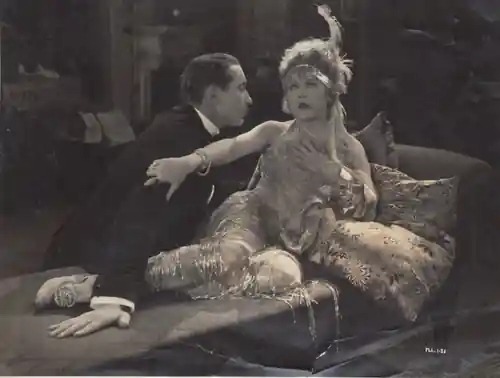
Technically, the picture is a bridge between epochs. The cutting rhythm accelerates during the New York montage—cross-fades, whip-pans, even an embryonic flash-forward achieved by double-exposing negative footage—anticipating the Soviet montage explosion. Yet Leonard still clings to theatrical tableau in interior scenes, letting dialogue-rich intertitles breathe between static two-shots. The tension between dynamism and stasis mirrors the couple’s own oscillation between liberation and constraint.
Reception history is a saga of boom, bust, and resurrection. Released in January 1922, Peacock Alley became the first film to play two consecutive weeks at New York’s Capitol Theatre, grossing a then-astronomic $92,000. Mae Murray’s snake-dance spawned a thousand imitations from San Francisco to Singapore; couturiers hawked “Peacock” capes of dyed pheasant plumes. Yet by the late twenties, prints languished in vaults, deemed “passé” beside flapper comedies like Cissy’s Saucy Stockings. A 1952 MGM warehouse fire nearly obliterated the negative; only a 9.5mm pathé-baby abridgment and a 35mm Czech archive dupe survived, both marred by nitrate bloom. Digital restoration in 2019—funded by a Kickstarter fueled largely by drag performers who cite Cleo’s costumes as ancestral scripture—returned the film to 96% completeness, though the Technicolor cabaret fragments remain lost, represented only by sepia stills.
Contemporary resonance? Observe the way Cleo’s body is monetized to bail out her husband—an antecedent to today’s influencer economy where personal brand equity doubles as emergency fund. Or consider the final tableau: reconciliation deferred, embodied in touch rather than declaration, a rebuke to Hollywood’s modern compulsion to neat endings. In an era when algorithms curate nostalgia into bite-size GIFs, Peacock Alley dares to be mercurial, lavish, and inconveniently human.
So, should you stream it? Absolutely—preferably at 2 a.m., headphones clamped, bourbon within reach. Let the flicker burnish your retinas until the boundary between 1922 and now dissolves. You will emerge raw, humming with the suspicion that every contract we sign—whether for love, money, or mere belonging—contains a hidden clause inked in invisible blood, waiting for the right shaft of light to expose it.
IMDb 6.4
1932
Community
Log in to comment.