DbcultAccessing Vault...
Cult Review
Senior Film Conservator

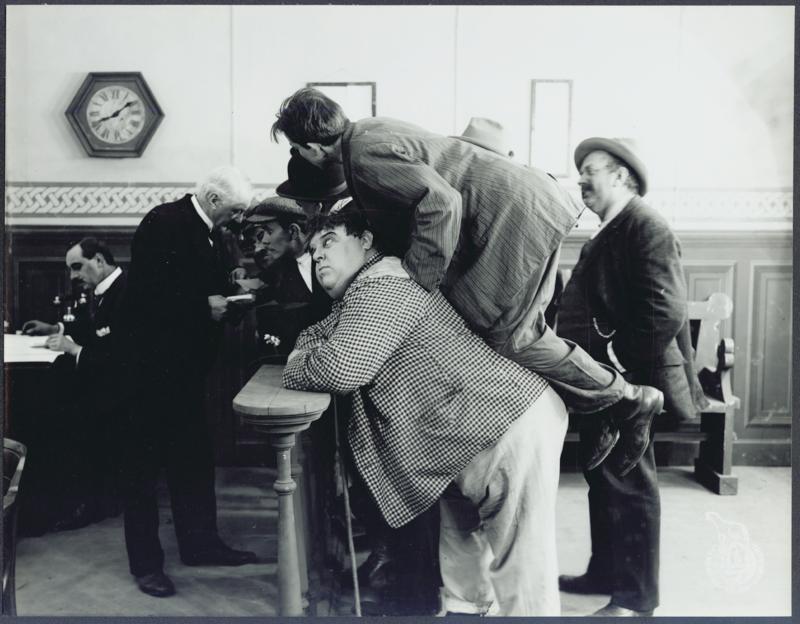
Stepping back into the flickering shadows of 1918, a year dominated by the somber echoes of the Great War and profound societal shifts, we encounter a cinematic curio that, despite its brevity and seemingly simple premise, offers a surprisingly rich tapestry of comedic insight: 'The Messenger.' This delightful silent film, featuring the prodigious talents of Billy West, Oliver Hardy, and a spirited ensemble including Ethel Marie Burton and Leatrice Joy, serves as more than just a historical artifact. It’s a vibrant, often uproarious, exploration of ambition, performance, and the inherent absurdity that arises when unwavering seriousness collides with the inherently frivolous world of the stage.
The narrative, a deceptively straightforward one, centers on Billy, a character whose initial existence is defined by the mundane, the routine, and the unglamorous role of a messenger. His days are ostensibly filled with the carrying of missives, a task that demands diligence but little fanfare. Yet, in a stroke of narrative genius, this very prosaic occupation becomes the unlikely springboard for an unexpected theatrical career. Through a series of events, likely orchestrated by the exigencies of a beleaguered production or the sudden absence of a designated talent, Billy is thrust into the limelight, elevated from the wings to the very center stage as the leading man. This initial transformation is ripe with comedic potential, a classic 'fish out of water' scenario where the ordinary individual is placed in an extraordinary role. One might anticipate a journey of self-discovery, a blossoming of hidden talent, or perhaps a series of charming missteps that ultimately lead to triumph. However, 'The Messenger' subverts these expectations with a nuanced comedic twist that elevates it beyond mere slapstick.
Billy, it turns out, possesses an earnestness that transcends mere dedication; it borders on the almost pathological. He approaches his newfound leading role with a seriousness so profound, so unyielding, that it becomes an unwitting instrument of comedic chaos. This isn't the charming awkwardness of an amateur, nor the deliberate overacting of a ham; it is the absolute, unironic conviction of a man who takes his role, and indeed himself, with an almost religious fervor. This gravitas, admirable in many walks of life, becomes utterly detrimental in the context of a theatrical performance designed for entertainment. His unwavering commitment to his lines, his gestures, and the very essence of his character, ironically, begins to spoil the play. What should be a seamless, engaging spectacle transforms into a disjointed, almost painful experience for the audience and, one can imagine, for his fellow performers. The impending disaster is not born of malice or incompetence, but from an excess of virtue, a comedic paradox that anchors the film's enduring appeal. It's a testament to the film's subtle wit that it dares to suggest that sometimes, the greatest threat to a performance isn't a lack of effort, but an overwhelming surplus of it.
At the heart of this delightful calamity is Billy West, a performer often overshadowed by the colossal figures of Chaplin and Keaton, yet whose contributions to silent comedy are undeniably significant. West's portrayal of Billy in 'The Messenger' is a masterclass in understated physical comedy and expressive mime. He doesn't rely on exaggerated pratfalls or outlandish costumes to elicit laughter, though elements of those are certainly present in his broader oeuvre. Instead, his humor here springs from the meticulous observation of human behavior, specifically the kind of intense, almost rigid seriousness that can become inherently funny when misplaced. West's face, a canvas of subtle shifts, conveys the character's unwavering focus, his furrowed brow and intense gaze speaking volumes about his internal struggle to 'do it right.' The humor arises from the audience's understanding of the disconnect between his profound effort and the increasingly disastrous results.
His body language, too, is meticulously crafted. The way he might stiffen at a critical moment, the overly dramatic flourish that misfires, the genuine confusion that washes over his features when the audience fails to appreciate his profound commitment – these are the hallmarks of West's comedic genius in this role. He embodies the tragicomic figure, a character whose very dedication becomes his undoing. It's a performance that requires a delicate balance, ensuring that Billy remains sympathetic even as his actions lead to chaos. West achieves this by imbuing Billy with an innocence, a guileless belief in the importance of his craft, that makes his earnest blunders endearing rather than irritating. His unique brand of comedy, often characterized by a blend of Chaplin-esque pathos and a more direct, less stylized approach, finds a perfect vehicle in 'The Messenger,' showcasing his ability to craft humor from sincerity.
While Billy West commands the central comedic spotlight, 'The Messenger' is significantly enriched by its supporting players, each contributing to the escalating sense of theatrical mishap. A particular standout, even in these nascent stages of his career, is Oliver Hardy. Though not yet the portly, long-suffering foil to Stan Laurel, Hardy's presence is unmistakable. His early roles often saw him as a more imposing, sometimes villainous, figure, or a straight man whose reactions grounded the more outlandish antics of others. In 'The Messenger,' his contribution, however brief, likely lies in providing a solid, perhaps exasperated, counterpoint to West's earnest chaos. Hardy's ability to convey a sense of put-upon authority or bewildered frustration would have amplified the comedic effect of Billy's seriousness. His stoic expressions, even at this stage, were a potent ingredient in silent comedy, often communicating more with a raised eyebrow or a slight grimace than pages of dialogue ever could.
Ethel Marie Burton and Leatrice Joy, both prominent figures in early cinema, undoubtedly brought their own distinct flavors to the production. Burton, known for her vivacious screen presence, might have played a fellow performer, perhaps a leading lady whose carefully constructed performance is systematically dismantled by Billy's overzealousness. Her reactions – whether expressions of shock, annoyance, or veiled amusement – would have provided crucial visual cues for the audience, mirroring their own growing disbelief. Leatrice Joy, a star who would later achieve considerable fame, likely contributed a touch of elegance or dramatic flair, serving as another anchor against which Billy's comedic waves crashed. Her ability to convey subtle emotions, even in broad comedic strokes, would have added depth to the ensemble's response to the unfolding chaos. Joe Bordeaux and Leo White, seasoned character actors of the era, would have rounded out the cast, filling roles that further exacerbated Billy's predicament or served as additional comedic targets. White, often cast as a pompous or aristocratic figure, could have been a director driven to distraction, or an indignant audience member, while Bordeaux, known for his versatility, might have played a stagehand or another minor actor caught in the crossfire. The synergy of these performers, reacting to and amplifying West's central performance, is what transforms 'The Messenger' from a solo act into a truly ensemble-driven comedic piece, where every reaction shot, every shared glance, contributes to the overall hilarity.

'The Messenger' deftly explores several timeless themes, chief among them the very nature of performance and the often-blurred lines between authenticity and illusion. Billy's seriousness raises a fundamental question: is true acting about embodying a role with such conviction that it becomes indistinguishable from reality, or is it about crafting an illusion that entertains and delights? The film, through its comedic lens, suggests the latter, highlighting that an excess of 'truth' can be as detrimental to theatrical success as a complete lack of it. It's a playful critique of method acting before the term even existed, showing the pitfalls of taking oneself, or one's role, too literally. Furthermore, the film touches upon ambition, albeit an accidental variety. Billy doesn't actively seek the leading role; it's thrust upon him. His subsequent dedication, however misguided, speaks to a universal human desire to excel, even in an unexpected capacity. The film's humor then stems from the ironic consequences of this earnest ambition.
Regarding the film's genesis, it's worth noting the absence of credited writers, a common practice in the early days of cinema. Many films of this era, particularly shorts, were often collaborative efforts, with directors, producers, and even actors contributing to the narrative and comedic beats on the fly. This improvisational spirit often lent a raw, energetic quality to these productions, allowing for spontaneous gags and character developments that might have been stifled by a rigid script. The uncredited nature of the writing for 'The Messenger' suggests a similar organic development, where the comedic situations likely arose from the interplay of its talented cast and a basic plot outline. The direction, though unflashy by modern standards, would have been crucial in orchestrating the precise timing of the gags and ensuring the visual clarity of the comedic narrative, a significant challenge in the absence of spoken dialogue.
To fully appreciate 'The Messenger,' one must place it within its historical context. 1918 was a pivotal year. The First World War was drawing to a close, and the world was simultaneously grappling with the devastating Spanish Flu pandemic. Cinema, then still in its relative infancy, served as a vital escape, a source of entertainment and distraction from the grim realities of daily life. Comedies, in particular, offered a much-needed respite, a chance to laugh and momentarily forget the anxieties of the era. Films like 'The Messenger' exemplify this role, providing lighthearted fare that, while not overtly political, subtly reflected the human need for joy amidst turmoil. The simplicity of its storytelling, the reliance on visual gags, and the universal appeal of its comedic premise made it accessible to a wide audience, transcending linguistic barriers in an age before synchronized sound.
Compared to the heavy dramatic narratives that often dominated the screen, such as the war-themed A Long, Long Way to Tipperary or the intense moral dilemmas explored in Treason, 'The Messenger' offered a refreshing counterpoint. Its humor, while specific to its theatrical setting, tapped into universal anxieties about public performance, the fear of failure, and the irony of good intentions gone awry. While films like The Cheat (though earlier, its themes of sacrifice and manipulation resonate with enduring power) explored the darker facets of human nature, 'The Messenger' found its comedic vein in the lighter, more relatable foibles. The contrast between the stark realities of the world outside the cinema and the contained, farcical world within 'The Messenger' likely enhanced its appeal, offering a brief, joyous reprieve.
Moreover, the film's exploration of identity and unexpected roles finds echoes in other period pieces. While not a direct comparison in plot, the theme of individuals navigating unfamiliar social landscapes or assuming new personas is present in films like The Cave Man, where a rustic character is thrust into urban society, or even in the more dramatic character transformations seen in Wild Honey. Billy's journey, though comedic, speaks to the broader human experience of adapting to new circumstances, sometimes with hilariously disastrous results. The film's compact narrative, a hallmark of silent shorts, demanded efficiency in storytelling, a skill that 'The Messenger' demonstrates with considerable charm and wit. It wastes no time in establishing its premise and then meticulously builds its comedic tension, culminating in the inevitable, yet uproarious, near-disaster.
Despite its age and its place within the vast, often forgotten, landscape of early silent cinema, 'The Messenger' retains a remarkable freshness. Its humor, rooted in character and situation rather than ephemeral trends, holds up surprisingly well. The film serves as a valuable document of a particular strain of silent comedy, one that relied less on frantic chases or elaborate stunts and more on the subtle interplay of personality and circumstance. Billy West's performance, in particular, deserves renewed attention, showcasing his unique ability to blend earnestness with absurdity, creating a character who is both pitiable and profoundly funny.
The film's legacy lies not in being a groundbreaking technical achievement or a profound social commentary, but in its masterful execution of a simple, yet potent, comedic idea. It reminds us that laughter can be found in the most unexpected places, even in the earnest endeavors of a reluctant leading man whose seriousness threatens to unravel the very fabric of a theatrical production. 'The Messenger' is a testament to the enduring power of silent film to charm, to entertain, and to offer a timeless reflection on the human condition, proving that sometimes, the greatest humor springs from the most sincere intentions. It's a delightful discovery for any cinephile eager to delve deeper into the rich, often overlooked, annals of early cinematic history, offering a genuine belly laugh and a poignant reminder of the art of comedic timing perfected long before the advent of sound.
IMDb —
1922
Community
Log in to comment.